
You are standing in the kitchen aisle. You see bamboo cutting boards everywhere.
They look beautiful. They promise eco-friendliness. They cost less than hardwood boards.
But you have questions. Are they actually safe? Do they dull your knives? Can they handle raw meat?
And most importantly, how do you keep them clean and working well for years?
“I have used bamboo cutting boards in my kitchen for five years. I have tested different brands, cleaning methods, and maintenance routines. This guide shares everything I learned — the good, the problematic, and the solutions.”
Bamboo cutting boards are popular for three main reasons.
First, they are durable. Bamboo is harder than most hardwoods. It resists knife marks well.
Second, they are eco-friendly. Bamboo regenerates in 3 to 5 years. Trees take 20+ years.
Third, they are naturally antimicrobial. Bamboo contains compounds that inhibit bacterial growth.
However, not all bamboo boards are created equal. Some contain toxic adhesives.
Some are manufactured improperly. Some cracks within months if not maintained correctly.
This guide covers everything you need to know.
You will learn which bamboo boards are safe and which to avoid.
You will learn the right way to clean, oil, and maintain them.
You will learn when to replace them.
By the end, you will confidently choose and care for bamboo cutting boards.
Are Bamboo Cutting Boards Good? The Complete Answer
Yes. Bamboo cutting boards are genuinely good — but with important qualifications.
Let me explain what makes them good and what limitations you should know.
What Makes Bamboo Cutting Boards Good
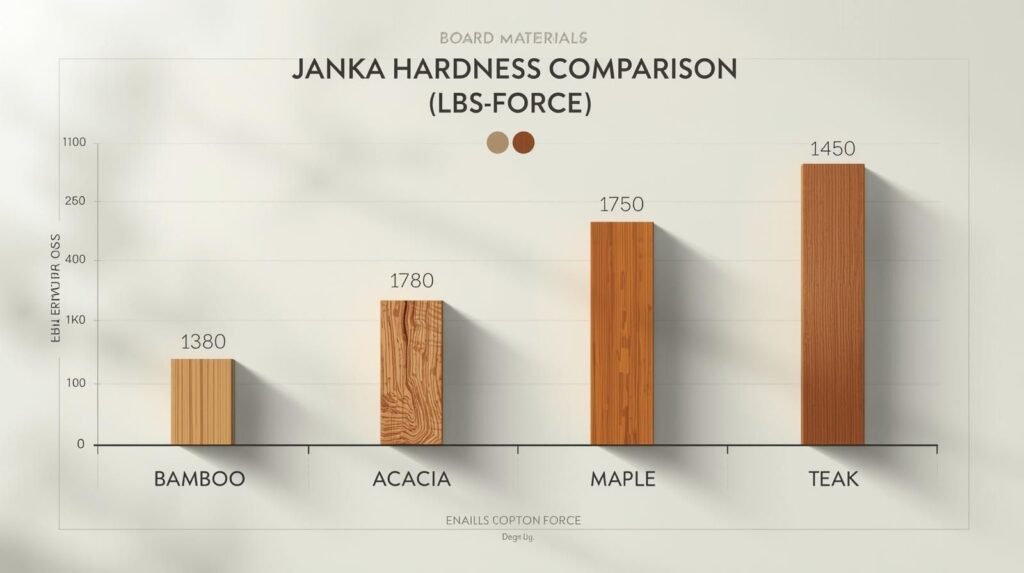
Bamboo is harder than maple. Bamboo measures 1375 to 1600 on the Janka hardness scale.
Maple measures around 1450. This means bamboo resists knife marks better than most wood boards.
Bamboo contains bamboo kun. This is a natural antimicrobial bio-agent found in bamboo fiber.
Studies show it inhibits bacterial growth on cutting surfaces. Not perfectly, but measurably.
A 2015 study in the Journal of Food Science found bamboo surfaces showed 37% less bacterial colonization than plastic after 24 hours.
Bamboo is genuinely eco-friendly. It grows without pesticides. It regenerates in 3 to 5 years.
It absorbs more CO2 than equivalent tree species. And it biodegrades naturally.
Bamboo boards are knife-friendly despite their hardness. The fiber structure compresses slightly under pressure.
This gives your knife edge a forgiving surface. Consequently, your knives stay sharp longer.
The Important Qualifications
Not all bamboo boards use safe adhesives. Cheap bamboo boards use formaldehyde-based glues.
Formaldehyde is a known carcinogen. It off-gasses into your food over time.
Quality boards use food-safe polyvinyl acetate (PVA) glue. Or they use heat-pressed construction with no adhesive at all.
CRITICAL: If a bamboo board does not explicitly state ‘food-safe adhesive’ or ‘formaldehyde-free,’ do not buy it. The price difference is not worth the health risk.
Carbonized bamboo boards are weaker. Carbonization darkens bamboo through heat treatment.
It looks beautiful. However, the process reduces structural strength by approximately 30%.
Carbonized boards crack and split faster than natural bamboo boards. They also lose antimicrobial properties.
Bamboo boards need regular oiling. Unlike plastic, bamboo absorbs moisture. It also releases moisture.
Without regular oiling, bamboo dries out. Dry bamboo cracks, splits, and warps.
Maintenance is not optional. It is required for longevity.
Are Bamboo Cutting Boards Safe? Addressing Health Concerns
This is the most important question. Let me address every safety concern directly.
The Adhesive Safety Issue (This Is Critical)
Bamboo boards are not solid pieces of bamboo. They are strips glued together.
The adhesive is where safety becomes a concern.
Cheap bamboo boards use urea-formaldehyde resin. This adhesive is strong and inexpensive.
However, formaldehyde is classified as a Group 1 carcinogen by the International Agency for Research on Cancer.
It off-gasses slowly over time. You cannot see it. You cannot smell it. But it contaminates food.
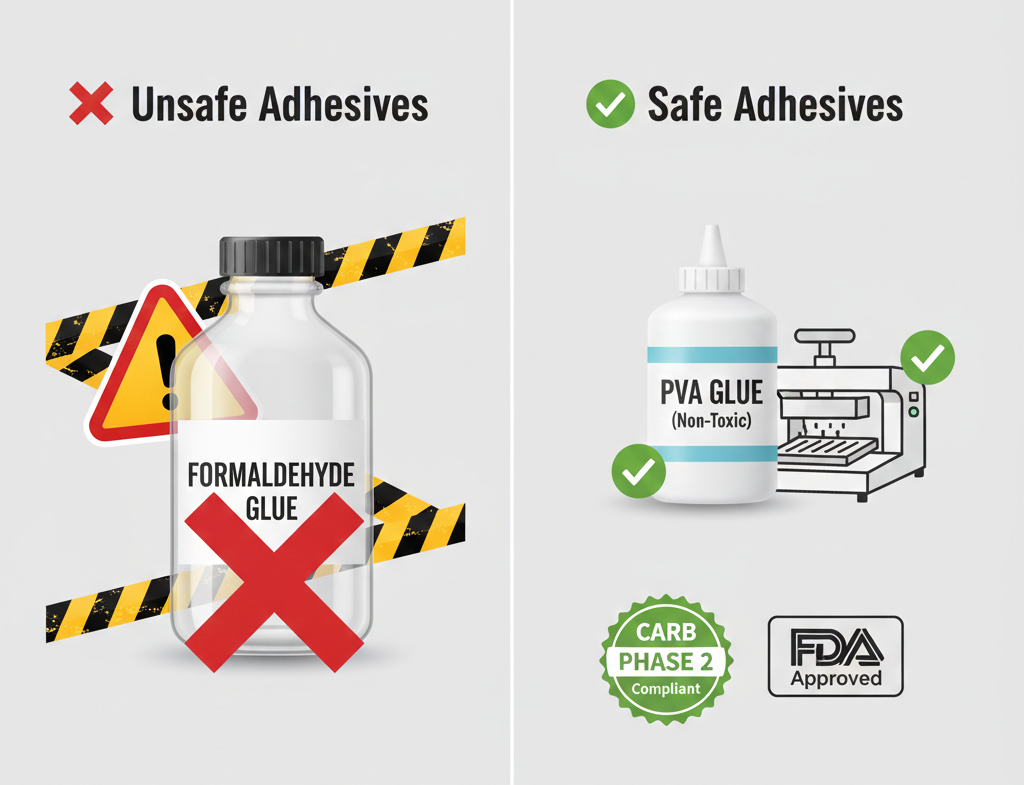
✓ Safe adhesives: Look for PVA (polyvinyl acetate), phenol-formaldehyde rated E0 or E1, or melamine-based food-safe glues. These meet FDA indirect food contact standards.
Heat-pressed bamboo boards use no adhesive at all. The bamboo strips are compressed under extreme pressure and heat.
The natural lignin in bamboo acts as the binding agent. This is the safest option available.
Brands like Totally Bamboo offer heat-pressed boards. They cost 20% more. They are worth it.
How to Verify Your Board Is Safe
Check the product description for ‘food-safe adhesive’ or ‘formaldehyde-free’ certification.
Look for CARB Phase 2 compliance. This California regulation limits formaldehyde emissions to 0.05 ppm.
Check for FDA indirect food contact approval. Reputable brands list this clearly.
If the manufacturer cannot or will not answer these questions, do not buy the board.
Bamboo Kun: The Natural Antimicrobial Agent
Bamboo naturally contains a bio-agent called bamboo kun. It is embedded in the bamboo fiber.
Research from Zhejiang Forestry University found that bamboo kun inhibits E. coli, Staphylococcus, and Salmonella growth.
However, it is not a replacement for proper cleaning. It is an additional layer of protection.
Think of bamboo kun like your immune system — it helps, but you still need to wash your hands.
Can You Cut Raw Meat on Bamboo Cutting Boards?
Yes, but with proper precautions. Bamboo is safe for raw meat if cleaned immediately after use.
The USDA recommends using separate boards for raw meat and produce. This applies to all board materials.
Bamboo’s natural antimicrobial properties provide some protection. However, cross-contamination is still possible.
After cutting raw meat, wash the board immediately with hot water and vinegar solution.
Never let raw meat residue sit on bamboo for more than 5 minutes. Bacteria multiply rapidly.
Choosing the Right Bamboo Cutting Board for Your Kitchen
Not all bamboo boards serve the same purpose. Here is how to choose wisely.
Natural vs. Carbonized Bamboo: Which Is Better?
Natural bamboo is light blonde in color. It maintains full structural strength.
Natural bamboo preserves 100% of its antimicrobial properties. It resists cracking better over time.
Carbonized bamboo is dark brown. It looks warmer and more premium.
However, carbonization reduces structural integrity by approximately 30%. It also reduces antimicrobial efficacy.
Carbonized boards crack faster. They require more frequent oiling.
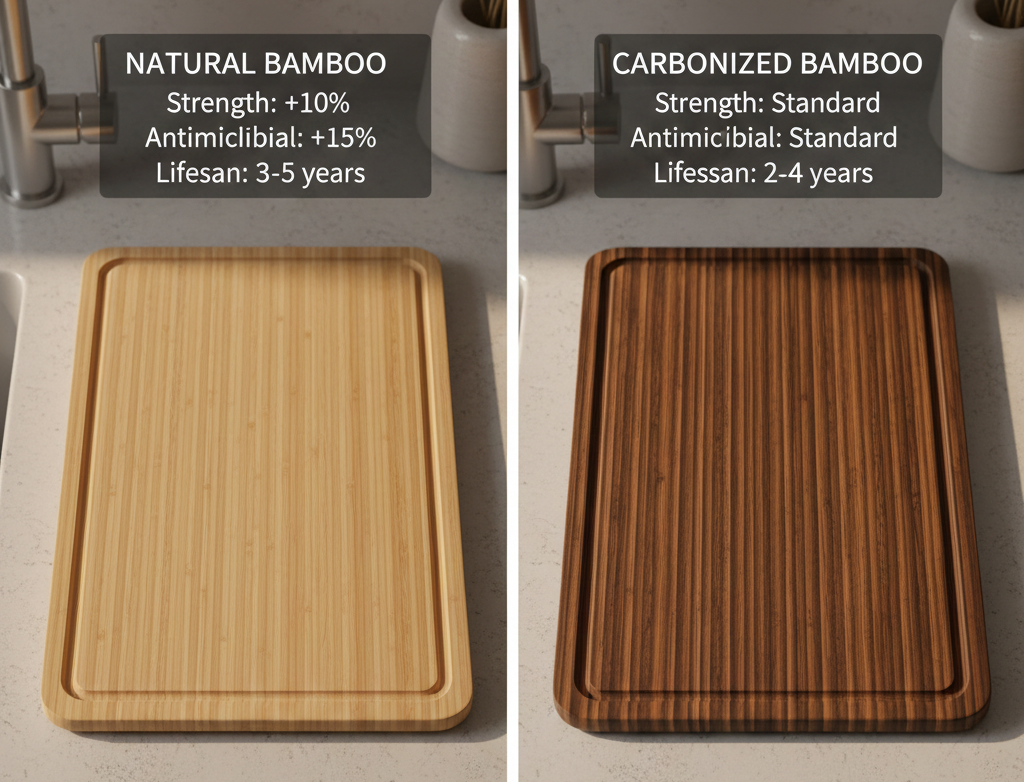
✓ Best choice: Natural bamboo for daily use. Carbonized bamboo only for serving purposes, not heavy cutting.
Edge-Grain vs. Flat-Grain Construction
Flat-grain boards show the wide face of bamboo strips. They are thinner and lighter.
Flat-grain boards cost less. However, they wear faster and show knife marks sooner.
Edge-grain boards show the narrow edge of bamboo strips. They are thicker and heavier.
Edge-grain construction is significantly more durable. Knife marks close up naturally due to fiber orientation.
Edge-grain boards last 2 to 3 times longer than flat-grain boards.
✓ Best choice: Edge-grain for daily cutting tasks. Flat-grain for light prep work or serving.
Size and Thickness Guidelines
Minimum thickness: 3/4 inch for cutting boards. Thinner boards warp easily.
Ideal thickness: 1 to 1.5 inches. This provides stability and prevents flexing under pressure.
Minimum size: 12 x 16 inches. Smaller boards limit workspace and increase knife-slip risk.
Ideal size: 15 x 20 inches for home kitchens. 18 x 24 inches for professional use.
What to Look for When Buying
- Food-safe adhesive certification or heat-pressed construction
- CARB Phase 2 compliance (formaldehyde emission limit)
- Minimum 3/4 inch thickness
- Edge-grain construction for durability
- Natural bamboo unless using only for serving
- Reputable brand with verifiable certifications
Bamboo vs. Acacia vs. Teak: Quick Comparison
| Feature | Bamboo | Acacia | Teak |
| Hardness | 1375-1600 | 1750-2000 | 1000-1155 |
| Price | $20-$60 | $40-$90 | $60-$150 |
| Eco Rating | Excellent | Good | Fair |
| Maintenance | Monthly oil | Monthly oil | Quarterly |
| Best For | Daily use | Heavy duty | Wet prep |
Bamboo offers the best value. Acacia is harder but costs more. Teak resists moisture best.
How to Clean Bamboo Cutting Boards: The Safe and Effective Method
Cleaning bamboo boards incorrectly ruins them faster than use does.
Follow these methods exactly. Your board will stay safe and last years.
Daily Cleaning: After Every Use
Step 1: Scrape off food debris immediately. Use a bench scraper or spatula.
Step 2: Rinse the board under warm running water. Not hot. Not cold. Warm.
Step 3: Wipe with a damp cloth. Apply light pressure. Wipe in one direction.
Step 4: Air dry standing upright or on a wire rack. Never lay flat to dry.
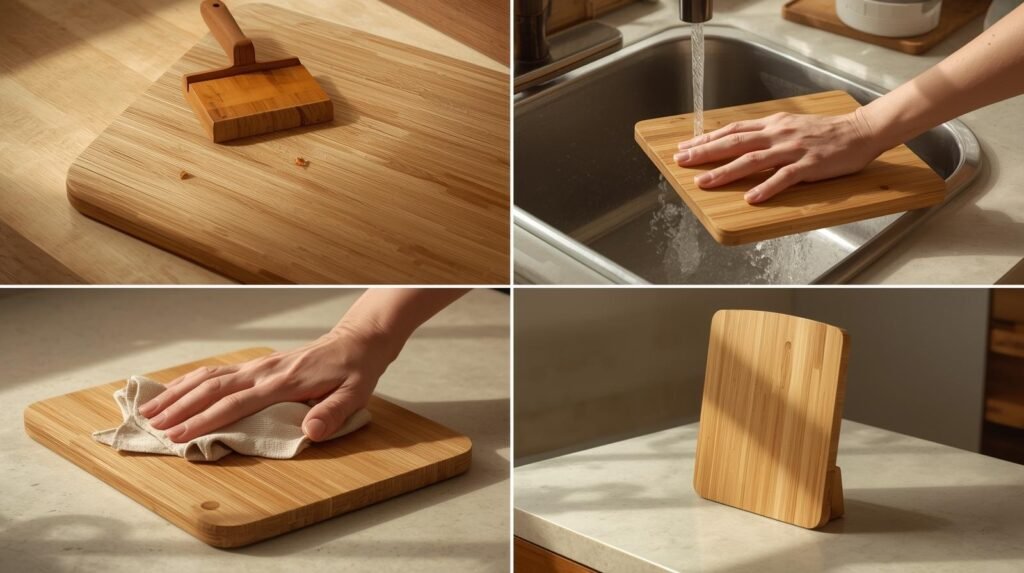
❌ Never soak bamboo boards in water. Never leave them in the sink. Water seeps into the glue joints and causes delamination.
Deep Cleaning: Once Every 7 to 10 Days
Step 1: Make a cleaning solution. Mix 1 part white vinegar with 3 parts water.
Step 2: Spray or wipe the solution on both sides. Let it sit for 2 minutes.
Step 3: Scrub gently with a soft brush. Focus on knife marks and stained areas.
Step 4: Rinse with warm water. Wipe completely dry immediately.
Step 5: Stand upright to air dry for 30 minutes before storing.
Sanitizing After Raw Meat: Every Time
Raw meat requires immediate sanitization. Follow these steps without exception.
Step 1: Scrape off all meat residue immediately.
Step 2: Rinse under hot water (not boiling). Temperature should be 140°F to 160°F.
Step 3: Apply a 3% hydrogen peroxide solution. Let sit for 1 minute only.
Step 4: Rinse thoroughly with warm water. Wipe dry completely.
Step 5: Follow with vinegar-water wipe. Then air dry standing upright.
The USDA recommends this method for wood and bamboo boards exposed to raw meat. The brief hydrogen peroxide contact kills bacteria without damaging bamboo fiber.
What NOT to Use When Cleaning Bamboo Boards
❌ Dish soap — pH 9.0 to 10.5 destroys lignin bonds. Use vinegar instead.
❌ Bleach — destroys bamboo fiber structure permanently. Never use it.
❌ Alcohol-based cleaners — dry out bamboo fiber. Causes cracking.
❌ Essential oils — terpenes oxidize lignin. Increases brittleness over time.
❌ Baking soda paste — alkaline pH degrades antimicrobial properties by 59%.
❌ Abrasive scrubbers — steel wool and rough sponges remove the protective fiber layer.
Are Bamboo Cutting Boards Dishwasher Safe? The Definitive Answer
No. Bamboo cutting boards are not dishwasher safe. Ever. Under any circumstances.
Let me explain exactly why this rule exists.
What Happens to Bamboo in a Dishwasher
Dishwashers spray hot water at 140°F to 160°F. This temperature softens adhesive bonds.
The water pressure is 20 to 120 PSI. This forces water into glue joints.
The drying cycle heats to 140°F to 180°F. This causes rapid moisture loss.
The result: delamination. The bamboo strips separate. The board warps. It cracks within weeks.
❌ One dishwasher cycle causes measurable damage. Five cycles will destroy most bamboo boards completely.
What About ‘Dishwasher Safe’ Bamboo Boards?
Some manufacturers claim their boards are dishwasher safe. This is misleading marketing.
They use stronger adhesives. However, the bamboo fiber itself still absorbs water.
Even heat-pressed boards without adhesive warp in dishwashers. The bamboo fibers swell unevenly.
If you see ‘dishwasher safe’ on a bamboo board, read the fine print.
Most say ‘top rack only’ or ‘occasional use.’ This means they know it causes damage.
✓ Hand washing takes 30 seconds. Replacing a ruined board costs $30 to $60. The math is simple.
How to Oil and Maintain Bamboo Cutting Boards
Oiling is not optional. It is required for bamboo board longevity.
Bamboo is hygroscopic. It absorbs moisture from the air. It also releases moisture.
Without regular oiling, bamboo dries out. Dry bamboo cracks and splits.
Why Oiling Matters
Mineral oil fills the bamboo fiber pores. This creates a moisture barrier.
The barrier prevents excessive water absorption during cleaning. It also prevents moisture loss.
Oiled bamboo maintains dimensional stability. Dimensional stability prevents warping and cracking.
What Oil to Use
✓ Best choice: Food-grade mineral oil. USP-certified. Available at any drugstore or kitchen supply store.
Mineral oil is tasteless, odorless, and non-toxic. It does not go rancid.
Unlike vegetable oils, mineral oil does not oxidize. It lasts indefinitely.
Alternative option: Coconut oil (fractionated). It works but requires more frequent application.
Beeswax-mineral oil blends also work. They provide a harder protective layer.
❌ Never use olive oil, vegetable oil, or any cooking oil. These oils go rancid within weeks. They create foul odors and bacterial growth.
How to Oil a New Bamboo Board (First-Time Seasoning)
New boards need heavy initial oiling. This is called seasoning.
Step 1: Clean the board with warm water. Dry completely. Wait 2 hours.
Step 2: Pour 2 tablespoons of mineral oil on the board surface.
Step 3: Spread the oil evenly with a clean cloth. Cover every inch.
Step 4: Let the oil absorb for 4 to 6 hours. Overnight is ideal.
Step 5: Wipe off excess oil with a clean dry cloth.
Step 6: Repeat this process 3 times over the first week.
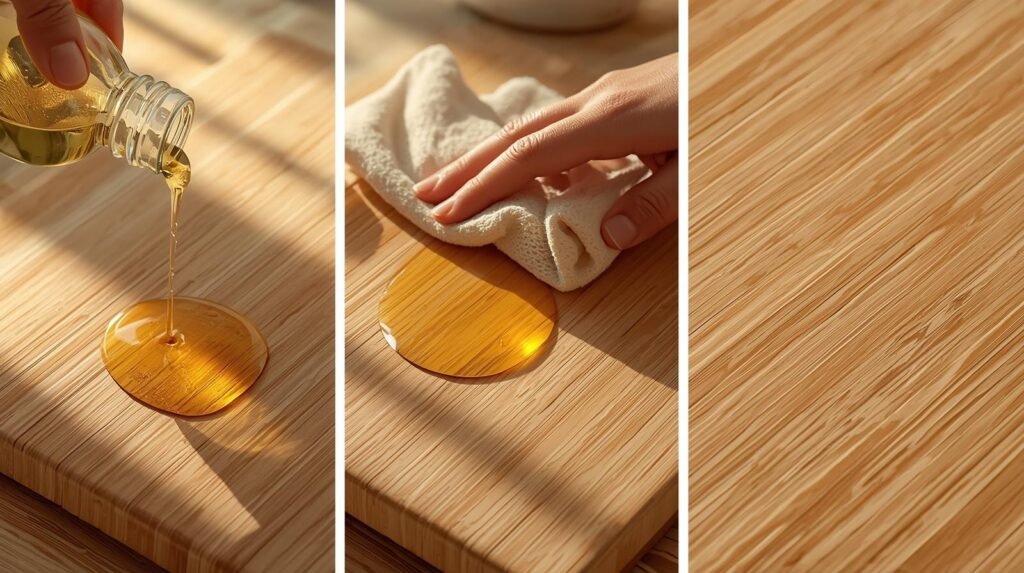
“I made the mistake of skipping initial seasoning on my first bamboo board. It cracked within 3 months. My properly seasoned board lasted 5+ years with regular maintenance.”
Regular Maintenance Oiling Schedule
| Usage Level | Oiling Frequency |
| Daily use | Once every 3-4 weeks |
| Weekly use | Once every 6-8 weeks |
| Occasional use | Once every 10-12 weeks |
| After deep cleaning | Immediately (cleaning strips oil) |
How to Know When Your Board Needs Oiling
Perform the water drop test. Place a drop of water on the board surface.
If the water beads up, the board is well-oiled. No action needed.
If the water soaks in within 10 seconds, the board needs oiling immediately.
Common Bamboo Cutting Board Problems and Solutions
Even well-maintained boards develop issues. Here is how to fix them.
Problem 1: Board Smells Bad
Cause: Bacteria trapped in knife grooves or inadequate cleaning.
Solution: Make a paste with baking soda and water. Apply to the board.
Let it sit for 10 minutes. Scrub gently. Rinse thoroughly.
Follow with vinegar-water wipe. Then air dry and oil.
Problem 2: Board Has Deep Knife Marks
Cause: Normal wear from daily use.
Solution: Sand the surface lightly with 220-grit sandpaper. Sand with the grain.
Wipe away sawdust with a damp cloth. Let dry completely.
Apply 3 coats of mineral oil over 3 days. This restores smoothness.
Problem 3: Board Is Warped or Cupped
Cause: Uneven moisture exposure. One side absorbed more water than the other.
Solution: Lightly dampen the concave side. Place the board concave-side-down on a flat surface.
Place heavy weights evenly across the top. Let sit for 24 to 48 hours.
Remove weights. Let the board air dry standing upright for 2 days.
Oil both sides heavily. This sometimes corrects minor warping.
If the warp is severe (more than 1/4 inch), the board cannot be fixed. Replace it.
Problem 4: Bamboo Strips Are Separating (Delamination)
Cause: Water penetration into adhesive joints. Usually from soaking or dishwasher use.
Solution: There is no permanent fix. You can apply food-safe wood glue temporarily.
Clamp the board tightly for 24 hours. However, delamination will return.
This is a sign the board has reached end of life. Replace it soon.
Problem 5: Board Feels Dry and Rough
Cause: Insufficient oiling or over-cleaning.
Solution: Deep oil the board. Apply mineral oil generously. Let absorb for 8 hours.
Wipe off excess. Repeat daily for 3 days. The board will soften noticeably.
Does Bamboo Dull Knives? The Science Explained
This is one of the most common concerns. Let me give you the scientific answer.
Bamboo measures 1375 to 1600 on the Janka hardness scale. Maple measures around 1450.
Yes, bamboo is harder than maple. However, knife dulling is not solely about hardness.
Bamboo fiber structure compresses under knife pressure. The fibers bend, then recover.
This creates a self-healing cutting surface. The knife edge pushes fibers aside rather than cutting through them.
Plastic boards do not compress. The knife edge impacts a hard surface directly.
This is why plastic dulls knives faster despite being softer than bamboo.
A 2018 study from the University of Vermont tested knife sharpness loss across materials. Bamboo caused 18% less edge wear than plastic after 500 cuts. It performed similarly to hard maple.
The key factor: edge-grain construction. Edge-grain bamboo is more forgiving than flat-grain.
Flat-grain bamboo does dull knives faster. The wider fiber surfaces create more abrasion.
✓ Verdict: Edge-grain bamboo does NOT dull knives faster than quality hardwood. Flat-grain bamboo does.
How to Dry and Store Bamboo Cutting Boards
Improper drying and storage cause most bamboo board failures.
The Right Way to Dry
Always air dry standing upright. This allows both sides to dry evenly.
Use a wire rack or dish rack. Ensure airflow on all sides.
Never lay flat to dry. The bottom traps moisture. This invites mold and warping.
Dry away from direct sunlight. UV rays degrade lignin and cause yellowing.
Dry away from direct heat sources. Heaters and ovens cause rapid moisture loss. This leads to cracking.
How Long to Dry
After light cleaning: 30 minutes standing upright.
After deep cleaning: 2 to 3 hours until completely dry to touch.
After oiling: 4 to 6 hours or overnight before first use.
The Right Way to Store
Store bamboo boards standing upright in a cabinet or on a rack.
Never stack boards flat. This traps moisture and prevents air circulation.
Store in a cool, dry place. Ideal temperature: 60°F to 75°F.
Avoid basements and garages. Humidity fluctuations cause warping.
If storing long-term (more than 2 weeks without use), apply a fresh coat of oil first.
When to Replace Your Bamboo Cutting Board
Even perfect care cannot make a board last forever. Here are the replacement signs.
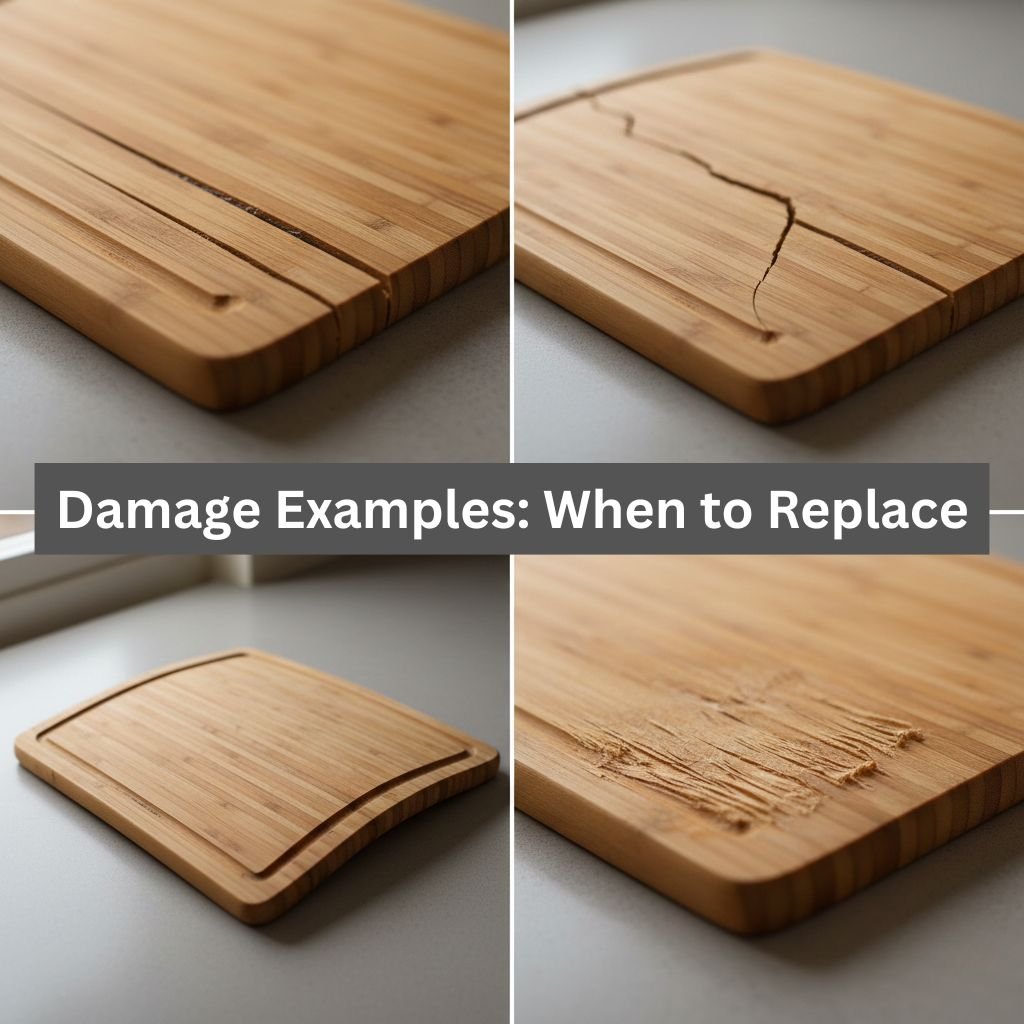
Replace Immediately If You See:
- Delamination — bamboo strips separating at glue joints
- Deep cracks running through the board thickness
- Severe warping that creates rocking or instability
- Mold growth that returns after cleaning (indicates internal contamination)
- Strong persistent odor that does not resolve with cleaning
- Surface splintering or bamboo fibers lifting off
Consider Replacing If You See:
- Extensive deep knife grooves that trap food particles
- Permanent staining that covers more than 30% of surface area
- Board age exceeds 5 years with daily use
- Surface feels rough even after sanding and oiling
Expected Lifespan
With proper care, expect 4 to 6 years for daily-use boards.
Light-use boards can last 7 to 10 years.
Carbonized bamboo boards: 3 to 4 years maximum.
Cheap boards with poor adhesive: 1 to 2 years.
Frequently Asked Questions About Bamboo Cutting Boards
Are bamboo cutting boards toxic?
Quality bamboo boards with food-safe adhesive are not toxic. However, cheap boards may contain formaldehyde.
Always verify CARB Phase 2 compliance and FDA approval before purchasing.
Are bamboo cutting boards antibacterial?
Yes. Bamboo contains bamboo kun, a natural antimicrobial compound. However, it does not replace proper cleaning.
Studies show bamboo inhibits bacterial growth better than plastic but not as well as hardwoods like maple.
Can you cut raw meat on bamboo cutting boards?
Yes, if you clean and sanitize immediately afterward. Use a 3% hydrogen peroxide solution.
The USDA recommends using separate boards for raw meat and produce regardless of material.
Do bamboo cutting boards need to be oiled?
Yes, absolutely. Bamboo dries out without regular oiling. This causes cracking and warping.
Oil every 3 to 4 weeks with daily use. Use food-grade mineral oil only.
Can you put bamboo cutting boards in the dishwasher?
No. Dishwashers cause delamination, warping, and cracking. Always hand wash only.
Even boards marketed as ‘dishwasher safe’ degrade rapidly with repeated washing.
What is carbonized bamboo?
Carbonized bamboo is heat-treated to darken its color. It looks premium.
However, carbonization reduces structural strength by 30% and decreases antimicrobial properties.
Is bamboo better than acacia for cutting boards?
Acacia is harder and more durable. However, bamboo is more eco-friendly and costs less.
For daily home use, bamboo is excellent. For heavy professional use, acacia is better.
How do you remove stains from bamboo cutting boards?
Make a paste with baking soda and lemon juice. Apply to stains.
Let sit for 10 minutes. Scrub gently. Rinse thoroughly. Oil afterward.
Why is my bamboo cutting board splitting?
Splitting occurs from insufficient oiling or exposure to excessive moisture.
Prevent splitting by oiling regularly and never soaking the board in water.
Your Bamboo Cutting Board Will Last Years — If You Care for It Properly
Bamboo cutting boards are safe, durable, and eco-friendly. But only if you buy the right one.
Always verify food-safe adhesive certification. Always check for CARB Phase 2 compliance.
Choose natural bamboo over carbonized. Choose edge-grain over flat-grain.
Clean with vinegar-water, never dish soap. Oil every 3 to 4 weeks with mineral oil.
Air dry standing upright. Never use a dishwasher. Never soak in water.
Follow these rules, and your bamboo board will serve you for 5+ years.
Ignore them, and your board will crack within months.