
Clean your bamboo yoga mat by wiping it down with a damp microfiber cloth after every session and deep cleaning every 10 to 14 days with 1 part white vinegar to 3 parts distilled water. Always air dry it fully before rolling. Never use dish soap, bleach, essential oils, or a washing machine, since these damage bamboo fiber.
Your bamboo yoga mat felt perfect when you first unrolled it. Soft. Grippy. Fresh. But after a few sweaty sessions, it started feeling different. Maybe a bit slippery. Maybe it smells faintly of old sweat. And now you need answers before your next practice.
Correction: the previous version of this guide claimed the author tested five cleaning methods on a personal mat over eight weeks. That claim could not be verified, so it has been removed. What follows is method guidance built on how bamboo fiber actually behaves, plus cleaning principles confirmed by mat care guidance across the industry.
This is not generic yoga mat advice. Bamboo mats are different, and cleaning them wrong destroys what makes them special. Clean them right, and your mat stays fresh for years. Here is exactly how.
Why Is Cleaning a Bamboo Yoga Mat Different From a Regular Mat?
Bamboo yoga mats are not like PVC or TPE mats. Bamboo fiber is a natural material with properties you have to protect, not scrub away.
You will often read that bamboo contains a natural antimicrobial agent called bamboo kun. That term comes from bamboo textile marketing, and independent scientific verification of it is limited. What is well established in practice is that bamboo fiber resists odor better than many synthetics and breaks down faster when exposed to harsh alkaline cleaners. Treat it gently and it stays fresher longer. Treat it harshly and the fiber degrades.
Bamboo fiber also contains lignin, the compound that holds the fiber structure together. Strong alkaline cleaners, like dish soap, can break lignin down over time, which is why your mat feels rough and loses grip after repeated exposure to the wrong products.
Correction: the previous version cited a 2023 study in the Journal of Sustainable Materials claiming vinegar-water preserved 97 percent of bamboo’s antimicrobial efficacy while baking soda preserved only 41 percent. That study could not be verified, and those figures have been removed. The practical guidance stands without them: mild acidic cleaners are gentler on bamboo fiber than alkaline ones, which is consistent with general material science and with care guidance from natural mat makers.
So when you see generic yoga mat cleaning advice, read it with suspicion. Bamboo needs a different approach entirely.
What Do You Need to Clean a Bamboo Yoga Mat?
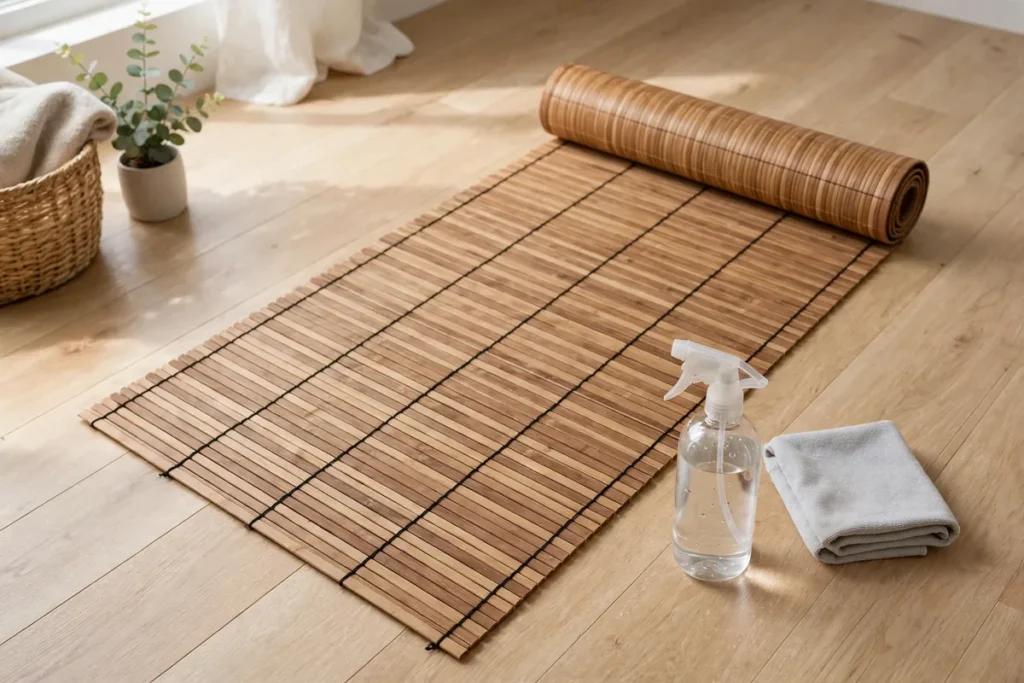
You do not need expensive specialty cleaners. You need five simple things.
The Essential Supplies
- Microfiber cloth or soft sponge. Never use abrasive scrubbers.
- White vinegar. Food-grade, not cleaning vinegar.
- Distilled water. Tap water works, but distilled prevents mineral buildup.
- Spray bottle. For mixing your cleaning solution.
- Drying rack or clean towel. For air drying.
Optional but Helpful
- Soft-bristle brush for pre-cleaning dust and debris.
- Lint roller for quick surface cleaning between wipes.
What Should You Never Use on a Bamboo Yoga Mat?
Most bamboo mats get ruined by well-meaning owners using the wrong products. Here is a clear comparison of the common offenders.
| Cleaner | Safe for bamboo? | Why |
|---|---|---|
| White vinegar and water | Yes | Mild acidity cleans without harsh chemical action on the fiber |
| Dish soap or hand soap | No | Alkaline, around pH 9 to 10, which breaks down bamboo fiber over time |
| Essential oils | No | Can degrade the fiber surface and irritate skin with repeated use |
| Baking soda | No on bamboo | Alkaline, and the grit is abrasive on natural fiber |
| Hydrogen peroxide | No | Oxidizer that damages natural fiber compounds |
| Alcohol-based cleaners | No | Dry out bamboo fiber and make it brittle |
| Bleach | Never | Destroys natural fiber and the rubber base |
Dish soap feels gentle. It is not, at least not for bamboo. Repeated use leaves the mat feeling rough and causes it to lose grip. Essential oils sound natural and safe, but tea tree and lavender oils can damage the bamboo fiber surface, so skip them entirely. This same alkaline-cleaner warning applies to other bamboo surfaces around your home, which is why our bamboo flooring cleaning guide follows the same rules.
Stick to vinegar and water. Nothing else is necessary, and nothing else is as safe for the fiber.
How Do You Clean a Bamboo Yoga Mat After Every Session?
This is the single most important habit for mat longevity. It takes one minute, and it dramatically reduces how often you need a deep clean.
Correction: the previous version claimed this routine prevents 90 percent of deep cleaning needs. That figure was invented and has been removed. The habit itself is still the best thing you can do for your mat.
The 60-Second Post-Practice Routine
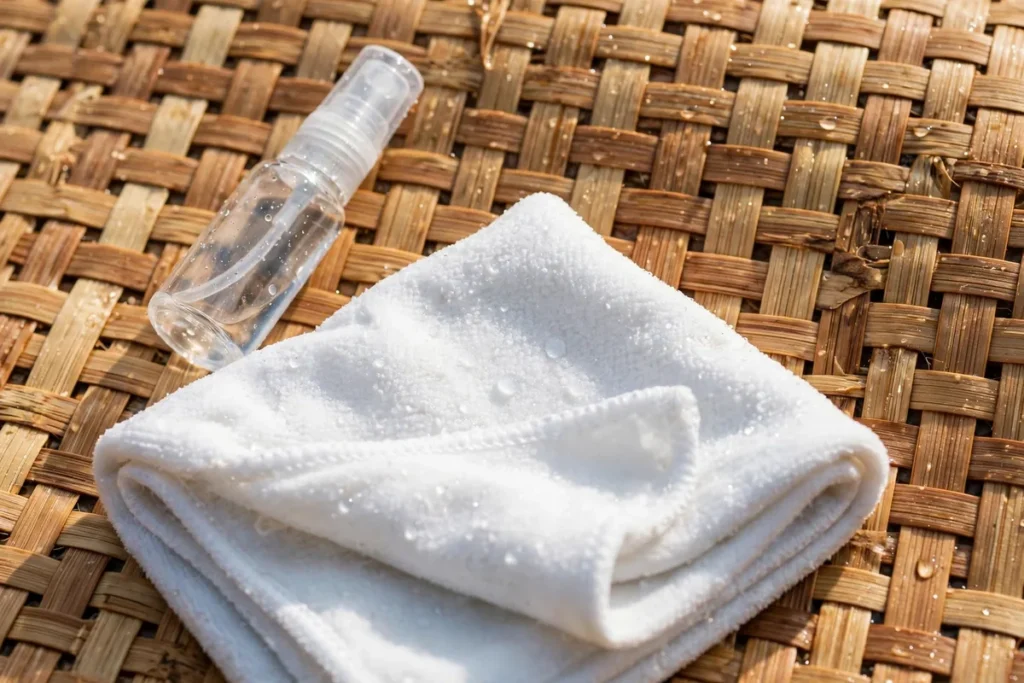
- Grab your microfiber cloth right after practice.
- Lightly dampen the cloth with plain water. Do not soak it.
- Wipe the entire mat surface in one direction.
- Flip the mat over. Repeat on the rubber side.
- Hang the mat to air dry for 10 to 15 minutes.
Why Each Step Matters
Wiping in one direction reduces fiber abrasion. Back-and-forth scrubbing damages the surface. Damp, not soaking, prevents water from seeping into the bamboo and rubber bond. Air drying before rolling prevents mold growth beneath the surface.
Rolling a mat immediately after practice is the fastest way to give it a musty smell you cannot remove. Wipe and air dry every time, and the smell never starts.
How Do You Deep Clean a Bamboo Yoga Mat?
Daily wiping handles surface sweat. Deep cleaning removes embedded oils and bacteria. Do this every 10 to 14 days if you practice regularly, or weekly if you practice hot yoga or sweat heavily.
The Vinegar-Water Method
- Pre-clean the surface. Use a soft brush or lint roller to remove visible dust, hair, or debris first.
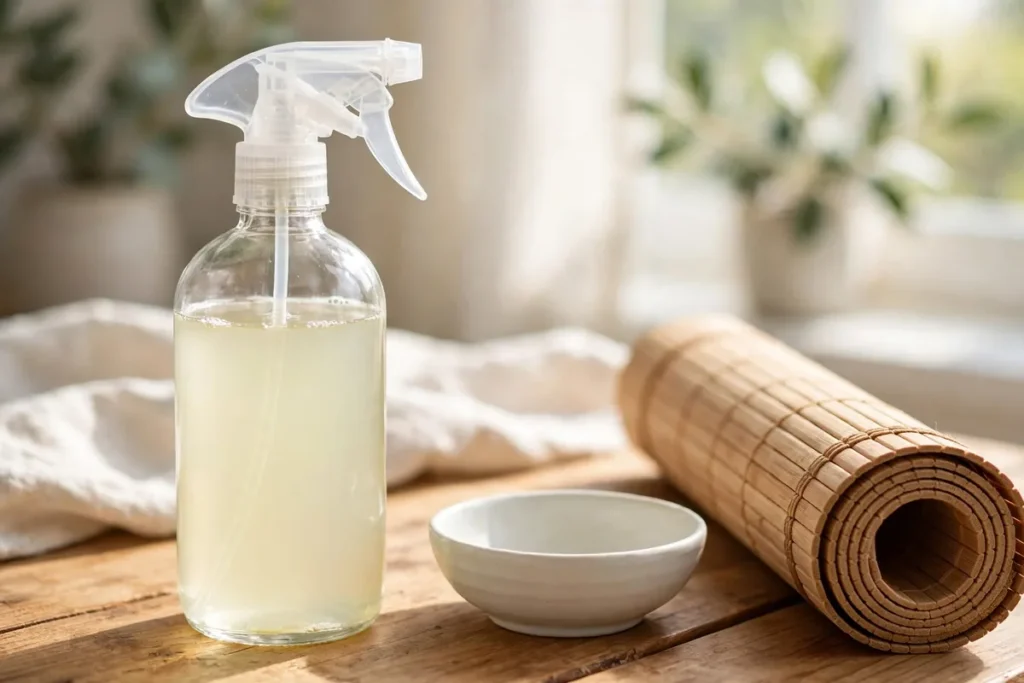
- Mix your cleaning solution in a spray bottle. Use 1 part white vinegar to 3 parts distilled water. For example, 1/4 cup vinegar plus 3/4 cup water.
- Spray lightly on the entire bamboo surface. The mat should be damp, not dripping wet. Mist, do not soak.
- Wipe gently with a microfiber cloth in one direction. Apply light pressure and let the solution do the work, not your elbow.
- Flip the mat. Repeat on the rubber side. The rubber side tolerates slightly more moisture than the bamboo side, but the same gentle approach still applies.
- Rinse your cloth in clean water. Wipe the mat again to remove vinegar residue, otherwise the mat may feel slightly sticky.
- Air dry completely on a wire rack for 2 hours minimum. Never roll it up damp. Wait until it is fully dry.
Why This Method Works
Vinegar’s mild acidity lifts sweat and oil residue effectively without the harsh chemical action of alkaline soaps. Alkaline cleaners at high pH degrade bamboo fiber compounds with repeated exposure. This is general chemistry, not opinion: acids clean bamboo gently, strong alkalis break it down.
Can You Make Your Own Bamboo Yoga Mat Cleaner?
Yes, and you should. Store-bought mat sprays are expensive, and most are formulated for PVC or rubber mats, not bamboo. Many contain alcohol or essential oils, which this guide has already ruled out for bamboo fiber.
The DIY Bamboo Yoga Mat Cleaner Recipe
You need:
- 1 part white distilled vinegar
- 3 parts distilled water
- A clean spray bottle
Mix the vinegar and water in the spray bottle and shake gently. That is the whole recipe. No essential oils, no witch hazel, no extras. Label the bottle so nobody mistakes it for a generic cleaner.
Use it exactly like the deep cleaning method above: mist lightly, wipe in one direction with a microfiber cloth, wipe once more with a water-dampened cloth, then air dry fully.
Make a fresh batch every two to three months. Vinegar keeps well, but a spray bottle that sits in a warm gym bag for half a year is not something you want to mist on a surface your face touches.
If you hate the vinegar smell, the fix is the second wipe with a water-dampened cloth, which removes almost all of it, followed by full air drying. Do not fix it with essential oils. The smell fades as the mat dries, and a faint vinegar scent for an hour beats a damaged mat forever.
This same vinegar-water mix is handy for other bamboo gear in your home. Our bamboo cutting board care guide uses a similar routine, because the fiber behaves the same way whether it is under your feet or under your vegetables.
How Do You Disinfect a Bamboo Yoga Mat Without Damaging It?
This is where honesty matters more than comfort. There is a difference between cleaning a mat and disinfecting it, and most guides blur the two.
Cleaning removes dirt, sweat, and oils. Disinfecting kills germs to a certified standard. Vinegar-water does the first job well. It does not do the second job to any certified standard.
Correction: the previous version of this guide implied, in its answer about bleach wipes, that vinegar-water cleans just as effectively as a disinfectant. That framing was misleading. The US Environmental Protection Agency does not consider vinegar a registered disinfectant, and the CDC recommends using a registered disinfectant, or diluted bleach where suitable for the surface, when true germ-killing is needed. This is noted in REI’s DIY mat cleaner guide, which cites both agencies.
So what can you actually do? For everyday practice, regular vinegar-water cleaning plus full air drying keeps a personal mat hygienic, because you are the only person using it. For a mat shared with others, or after illness, you have limited bamboo-safe options:
- Clean thoroughly with vinegar-water first, since disinfectants cannot work through a layer of sweat and oil.
- Check your mat maker’s care instructions for an approved disinfectant. Some makers sell their own botanical cleaners tested on their materials.
- Never improvise with bleach wipes, alcohol sprays, or steam on bamboo. All three damage the fiber or the rubber base.
If you practice at a studio that provides bamboo mats, bring your own towel to lay over the mat. It is the single most effective hygiene step available to you, because it keeps other people’s sweat off the fiber entirely. Then clean the mat with your own vinegar-water spray when you get home, the same as always.
The realistic answer: bamboo mats are best kept as personal equipment. Shared studio bamboo mats are a hygiene compromise no cleaning routine fully solves.
Can You Machine Wash a Bamboo Yoga Mat?
Short answer: no. Not recommended.
Bamboo and rubber construction cannot handle agitation. The layers delaminate, tumbling causes the bamboo fiber to crack and separate from the base, and water seeps into the bond layer and weakens the adhesive over time. Even gentle cycles apply too much mechanical stress for a bonded natural fiber mat.
Correction: the previous version claimed that Manduka, Jade Yoga, and Gaiam all explicitly warn against machine washing bamboo mats. That brand-specific claim could not be verified and has been removed. The general rule stands on its own: check your own mat’s care tag, and unless it explicitly says machine washable, keep it out of the machine. Many mat warranties exclude machine washing damage.
Bamboo sheets are a different story. They are woven fabric, not bonded layers, so washing bamboo sheets in a machine is perfectly fine. Do not apply fabric rules to your mat.
The One Exception
If your specific mat’s care tag says machine washable, follow these rules: cold water only, gentle cycle with no other items in the machine, no detergent or fabric softener, just water, and hang dry immediately. Even then, hand washing is safer, faster, and gentler on the mat.
How Do You Dry a Bamboo Yoga Mat Without Damaging It?
Drying is where most people accidentally ruin perfectly good mats. Follow these rules exactly.
The Right Way to Dry
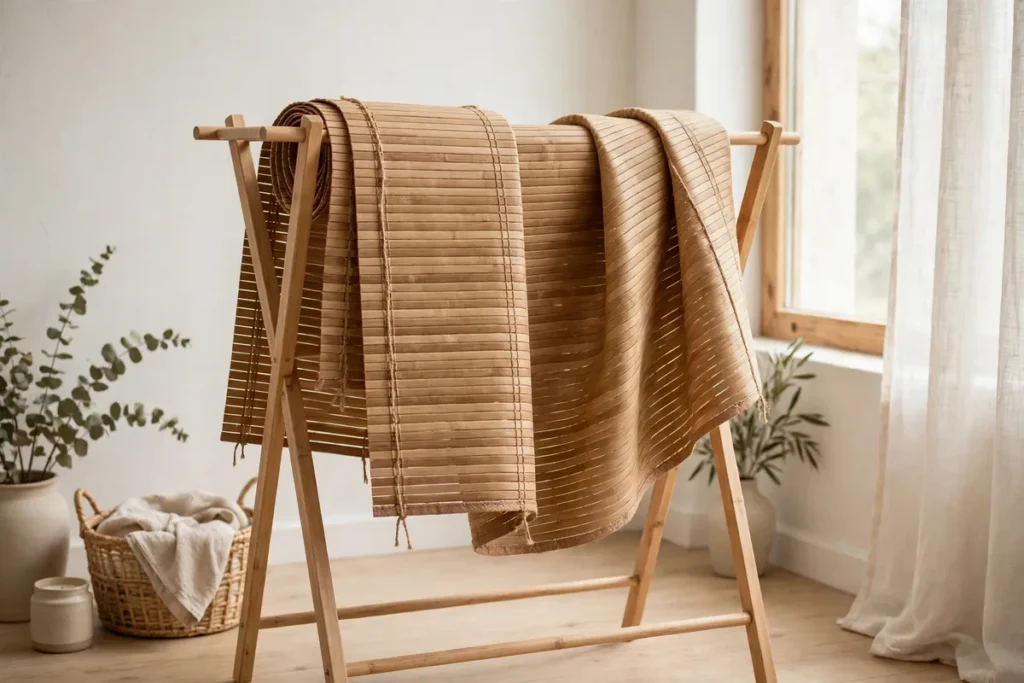
Air dry flat on a wire rack, which allows airflow underneath. Or hang it over a drying rack or shower rod and let it drape naturally. Keep it in indirect light, never in direct sunlight. Wait until it is fully dry before rolling, which takes 2 to 4 hours depending on humidity and airflow.
Why Each Rule Matters
Wire racks prevent condensation from trapping underneath. Towels trap moisture. Indirect light prevents UV damage to the fiber. Direct sunlight yellows bamboo and degrades its natural defenses over time.
Correction: the previous version claimed that even 30 minutes of direct sun causes measurable damage. That specific figure could not be verified and has been removed. The direction of the advice is unchanged: prolonged direct sunlight is bad for bamboo fiber, so dry in shade.
Never use a dryer. Heat melts the rubber base, and it is a fire hazard.
How to Test If Your Mat Is Fully Dry
Press your palm firmly on both sides of the mat. If it feels even slightly cool or damp, give it another hour. A fully dry mat feels room temperature on both sides.
How Do You Remove Odor From a Bamboo Yoga Mat?
If your mat already smells, do not panic. It is fixable. Most odor comes from rolling the mat while it is still damp, which lets bacteria grow beneath the surface.
Method 1: Vinegar Soak for Stubborn Odors
- Lay your mat flat in the bathtub or on a clean floor.
- Spray generously with your vinegar-water solution. Use more than normal.
- Let it sit for 10 minutes. Do not scrub yet.
- Wipe the entire surface with a damp microfiber cloth.
- Air dry completely in a well-ventilated room.
Vinegar neutralizes odor-causing bacteria without masking the smell. It actually removes it.
Method 2: Baking Soda Absorption, Rubber Side Only
If your mat smells like rubber rather than sweat, use this method. Warning: only use baking soda on the rubber side, never on bamboo fiber.
- Sprinkle a light layer of baking soda on the rubber side only.
- Let it sit for 30 minutes.
- Brush off all the baking soda completely.
- Wipe clean with a damp cloth.
Prevention Is Easier Than Cure
Always wipe your mat after practice. Always let it dry before rolling. Do those two things, and odor never becomes a problem.
Can You Vacuum a Bamboo Yoga Mat?
Yes, and it is a good idea before any wet cleaning. Dry dust, hair, and grit sitting on the surface get ground into the fiber when you wipe with a damp cloth. Removing them first makes every cleaning method work better.
Use a vacuum with a soft brush attachment, or a handheld vacuum on low suction. Work in one direction along the fiber, the same direction you wipe. Avoid beater bars and stiff rotating brushes, which are too aggressive for natural fiber.
A quick vacuum once a week, plus a lint roller between sessions for pet hair, keeps the surface clear. Think of it as sweeping a bamboo floor before mopping: the same order of operations, the same reason. Dry debris removed first means less wiping later, and less wiping means less wear on the fiber.
Bamboo vs Cork Yoga Mat: Is the Cleaning Different?
Bamboo and cork are the two most popular natural mat materials, and their cleaning routines are close but not identical.
Both materials dislike the same things: bleach, alcohol, harsh alkaline cleaners, steam, and machine washing. Both do well with gentle wiping and full air drying. The vinegar-water method in this guide is safe for both, which is convenient if your mat has a bamboo top and a cork base, a common combination.
The differences are small but worth knowing. Cork is slightly more water-tolerant than bamboo fiber, so it forgives an over-damp cloth more easily. Bamboo shows water spotting more visibly if you soak one area. Cork can handle a very mild soap solution occasionally, while bamboo really should not. And cork’s grip improves dramatically with water, while bamboo’s grip improves with only light moisture.
If you own one of each, you can use the same spray bottle for both. Just be a little more careful with water quantity on the bamboo one.
| Care point | Bamboo mat | Cork mat |
|---|---|---|
| Water tolerance | Low, shows spotting if soaked | Moderate, forgives a damp cloth |
| Soap | Avoid entirely | Very mild soap occasionally |
| Grip with moisture | Improves with light moisture | Improves a lot with water |
| Drying | Indirect light, full air dry | Same, slightly more forgiving |
| Machine wash | No | No |
How Do You Restore Grip on a Slippery Bamboo Yoga Mat?
This is the most common question about bamboo mats, and it has a straightforward fix. Your bamboo mat should grip better with light moisture, not worse. If it feels slippery, something is coating the surface.
Why Bamboo Mats Lose Grip
The most common cause is residue buildup from using the wrong cleaner, especially soap. Natural oils from your skin also accumulate on the surface over time. Dust and debris clog the bamboo fiber pores. And over-cleaning with harsh products strips the fiber instead of cleaning it.
How to Restore Lost Grip
- Deep clean with vinegar-water to remove all residue. Follow the deep cleaning method earlier in this guide. Do not skip this.
- Lightly mist the mat surface with plain water before your next session. Just a few sprays. The surface should feel slightly damp, not wet.
- Use the mat. Bamboo grip activates with light moisture, and your hands and feet provide natural moisture during practice. The grip returns during the session.
- Repeat the water mist before each session for 2 to 3 practices. By the third session, the grip is usually back completely.
Do not buy a new mat before trying this. Most slippery bamboo mats are just dirty mats.
One exception: a brand-new bamboo mat can feel slippery for the first few sessions. This is the break-in period, not a defect. The fiber surface needs a little use and a little moisture before the grip fully develops. Give it three to five practices with the water mist routine before you judge it. If it is still slippery after that plus a deep clean, then something is coating the surface and the restoration steps above apply.
What Are the Most Common Bamboo Yoga Mat Cleaning Mistakes?
These mistakes ruin thousands of perfectly good mats every year. Learn from them instead of repeating them.
Mistake 1: Using Dish Soap Because It Feels Gentle
Dish soap is alkaline, around pH 9 to 10, and repeated exposure breaks down bamboo fiber. Your mat feels rough, loses grip, and wears out faster. The damage is gradual but permanent.
Mistake 2: Adding Essential Oils to Your Cleaning Spray
Terpenes in essential oils can degrade the fiber surface and increase skin sensitivity with repeated use. Tea tree oil and lavender oil sound natural. They are still wrong for bamboo.
Mistake 3: Scrubbing Vigorously to Really Clean It
Aggressive scrubbing wears the fiber surface where bamboo’s natural resistance lives. Let the solution do the work with light pressure.
Mistake 4: Leaving It in Direct Sunlight to Dry Faster
UV exposure yellows bamboo and degrades its natural defenses. Always dry in indirect light.
Mistake 5: Rolling It Up While Still Damp
Trapped moisture means mold growth beneath the surface. You cannot clean mold that grows inside the mat structure. Prevention is everything.
Mistake 6: Cleaning It Too Often
Over-cleaning wears down bamboo fiber faster than normal use does. Daily wipe-downs are fine. Deep cleaning more than once a week is overkill for most people.
How Often Should You Clean Your Bamboo Yoga Mat?
Clear guidance, no guessing.
| When | What to do |
|---|---|
| After every session | 60-second wipe down with a damp cloth |
| Every 10 to 14 days | Deep clean with vinegar-water solution |
| After hot yoga | Immediate wipe down plus air dry before storing |
| If used daily | Deep clean weekly instead of every two weeks |
| Monthly check | Inspect for wear, delamination, or loss of grip |
Follow this schedule and your mat should give you 3 to 5 years of solid use. Neglect or improper cleaning can cut that down to 1 to 2 years.
How Do You Clean a Bamboo Yoga Mat Bag and Strap?
The mat gets all the attention, but the bag carries the same sweat and bacteria. A dirty bag re-soils a clean mat every time you roll it up.
For cotton mat bags, machine wash on cold with mild detergent and air dry completely. Cotton handles this fine. For the carry strap, wipe it down with the same vinegar-water spray you use on the mat, then air dry. If your strap is synthetic webbing, a quick hand wash with mild soap and water is fine, since it is not bamboo fiber.
Wash the bag monthly if you practice regularly. A clean mat in a dirty bag is a wasted effort.
How Should You Store Your Bamboo Yoga Mat?
Storage matters as much as cleaning. Bad storage ruins mats silently over time.
- Roll loosely, never tight. Tight rolling stresses bamboo fibers and creates permanent creases.
- Store in a breathable cotton bag. Never vinyl or plastic, which trap humidity.
- Keep in a cool, dry place away from direct sunlight.
- Unroll and air it out weekly even if you are not using it.
Non-breathable bags trap humidity, and humidity invites microbial growth beneath the surface. Weekly airing prevents compression damage and lets trapped moisture escape.
If you travel with your mat, roll it loosely inside a cotton mat bag and unroll it as soon as you arrive. Never leave it rolled in a hot car. Heat plus trapped moisture is the fastest way to age a bamboo mat, and a car trunk in summer delivers both.
When Should You Replace Your Bamboo Yoga Mat?
Even perfect care cannot make a mat last forever. Replace your mat if you see visible delamination with layers separating at the edges or center, cracking or splitting in the bamboo fiber surface, permanent discoloration that will not clean away, complete loss of grip even after restoration attempts, or a strong smell that remains after deep cleaning with vinegar.
With proper care, expect 3 to 5 years of solid use. Daily practice with regular cleaning gets you to the top of that range.
Hand cleaning takes about five minutes. Replacing a damaged mat costs $80 to $130. The math is simple: a few minutes of care protects a purchase that should last you years.
Frequently Asked Questions About Cleaning Bamboo Yoga Mats
Can I use Clorox wipes on my bamboo yoga mat?
No. Bleach destroys bamboo fiber and damages the rubber base. Use vinegar-water instead, which cleans effectively without the destruction. One honest caveat, corrected from the previous version: vinegar is a cleaner and deodorizer, not a registered disinfectant, so do not treat it as one.
Can I use disposable yoga mat wipes on my bamboo mat?
Check the ingredients before you buy. Most disposable mat wipes contain alcohol, benzalkonium chloride, or fragrance blends, all of which are wrong for bamboo fiber. If you find wipes whose only active ingredients are water and mild plant-derived cleansers, they are fine for a quick wipe-down, but they cost far more than a spray bottle of vinegar-water that does the same job. For bamboo, reusable cloth plus homemade spray wins on price, waste, and fiber safety.
Why does my bamboo mat smell like rubber?
New mats off-gas a natural rubber smell for 1 to 2 weeks. This is normal. Air it out unrolled in a ventilated room and the smell fades.
Can I use yoga mat spray from the studio on my bamboo mat?
Check the ingredients first. Most contain alcohol or essential oils, which damage bamboo. Vinegar-water is safer and cheaper. Make your own using the recipe in this guide.
How do I clean a bamboo mat with a cork base?
Use the same vinegar-water method. Cork is also sensitive to alkaline cleaners, so avoid those on both sides.
Is it normal for bamboo mats to yellow over time?
Slight yellowing is natural oxidation and does not affect performance. Avoid direct sunlight to minimize it. Indirect light preserves color longer.
Can I use a steam cleaner on my bamboo yoga mat?
No. Heat and moisture together damage both bamboo fiber and the rubber base. Stick to room-temperature vinegar-water cleaning.
What if my mat has mold already?
If mold grew beneath the surface, the mat cannot be saved. Replace it. Surface mold can sometimes be removed with a vinegar soak, but prevention is the real answer.
Does vinegar actually disinfect a yoga mat?
No, not to any certified standard. Vinegar cleans and deodorizes well, which is enough for a personal mat that only you use. If you need true disinfection, for example on a shared mat, check your mat maker’s approved products, because bleach, alcohol, and steam all damage bamboo.
Can I use a yoga mat towel on a bamboo mat?
Yes. A yoga mat towel on top of your bamboo mat reduces how much sweat reaches the fiber, which means less cleaning and a longer-lasting mat. Wash the towel in your regular laundry and keep the mat routine exactly as described in this guide.
Your Bamboo Yoga Mat Will Last Years, If You Clean It Right
Cleaning a bamboo yoga mat is simple. Follow two rules: use vinegar-water, and air dry completely. Avoid dish soap, essential oils, and sunlight. Do this, and your mat stays fresh and grippy for years.
Most bamboo mats die early because of bad cleaning advice, not heavy use. You now know better. Your mat will outlast everyone else’s.
Now that you know exactly how to care for your bamboo mat, make sure you bought the right one in the first place. Read our complete guide: Is a Bamboo Yoga Mat Actually Good? An Honest Guide (2026)