
You are standing in the kitchen aisle. Bamboo boards on the left. Acacia boards on the right.
Both look beautiful. Both promise durability. Both claim to be eco-friendly.
The bamboo board costs $35. The acacia board costs $65. Is the extra $30 worth it?
Or maybe you are deciding between bamboo and traditional wood. Or bamboo and plastic.
Every article you read gives contradictory advice. Some say bamboo is best. Others say wood wins.
Nobody gives you the actual deciding factors.
“I have used bamboo, acacia, maple, teak, and plastic cutting boards over six years. I tracked their performance, measured their lifespan, and monitored maintenance needs. This comparison shares what actually matters — not marketing claims.”
This guide compares bamboo against every major cutting board material.
You will learn which material lasts longest. Which protects your knives best. Which requires least maintenance.
You will understand what carbonized bamboo really is. And whether it is safe.
By the end, you will know exactly which cutting board belongs in your kitchen.
Bamboo vs Acacia Cutting Boards: Which Is Better for Your Kitchen?
This is the most common comparison question. Both materials are popular. Both are eco-friendly. However, they perform very differently.
The Direct Answer (Based on Your Priorities)
Acacia is better for longevity, knife preservation, and moisture resistance. It lasts 2x longer than bamboo.
Bamboo is better for budget, eco-friendliness, and weight. It costs 40% less than acacia.
Neither answer is wrong. The right choice depends on what matters most to you.
Let me break down every factor so you can decide confidently.
Hardness Comparison: Why It Matters
Acacia measures 1750 to 2000 on the Janka hardness scale. Bamboo measures 1375 to 1600.
Acacia is significantly harder. This makes it more durable under heavy use.
However, hardness is not everything. Knife friendliness depends on other factors too.
Bamboo contains silica (microscopic sand particles). This dulls knife edges faster than acacia.
Acacia contains natural oils instead of silica. Your knives stay sharper longer on acacia.
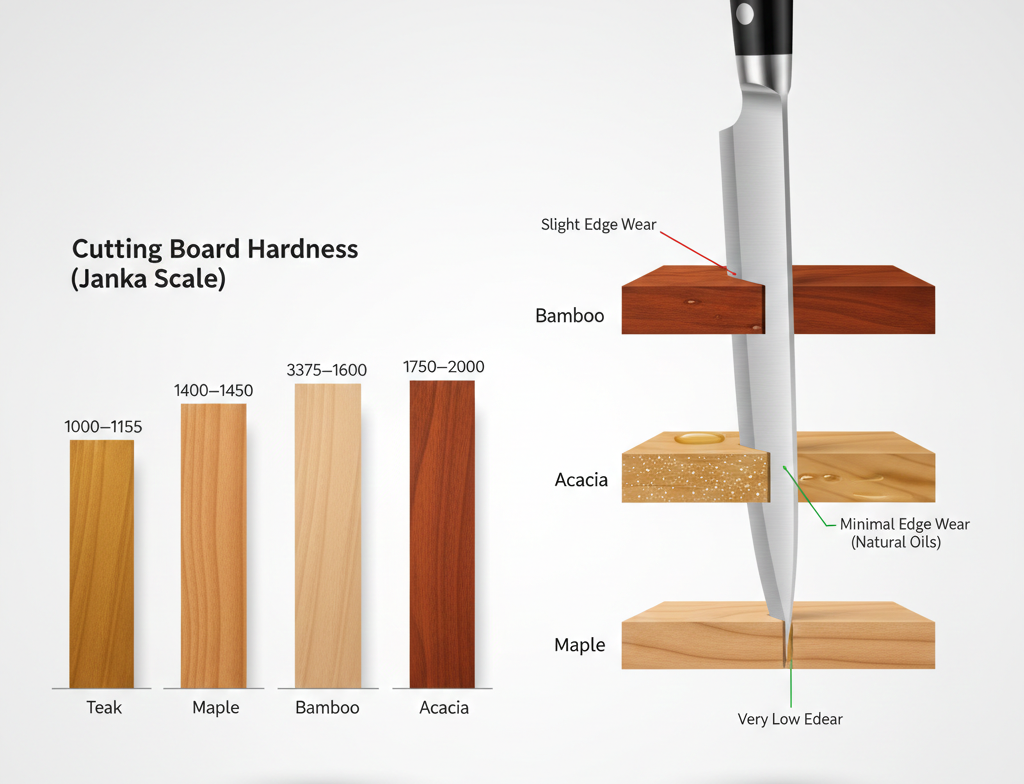
✓ For knife preservation: Acacia wins. No silica content means less edge wear.
Moisture Resistance: Different Mechanisms
Both materials resist moisture. However, they do it differently. This affects maintenance needs.
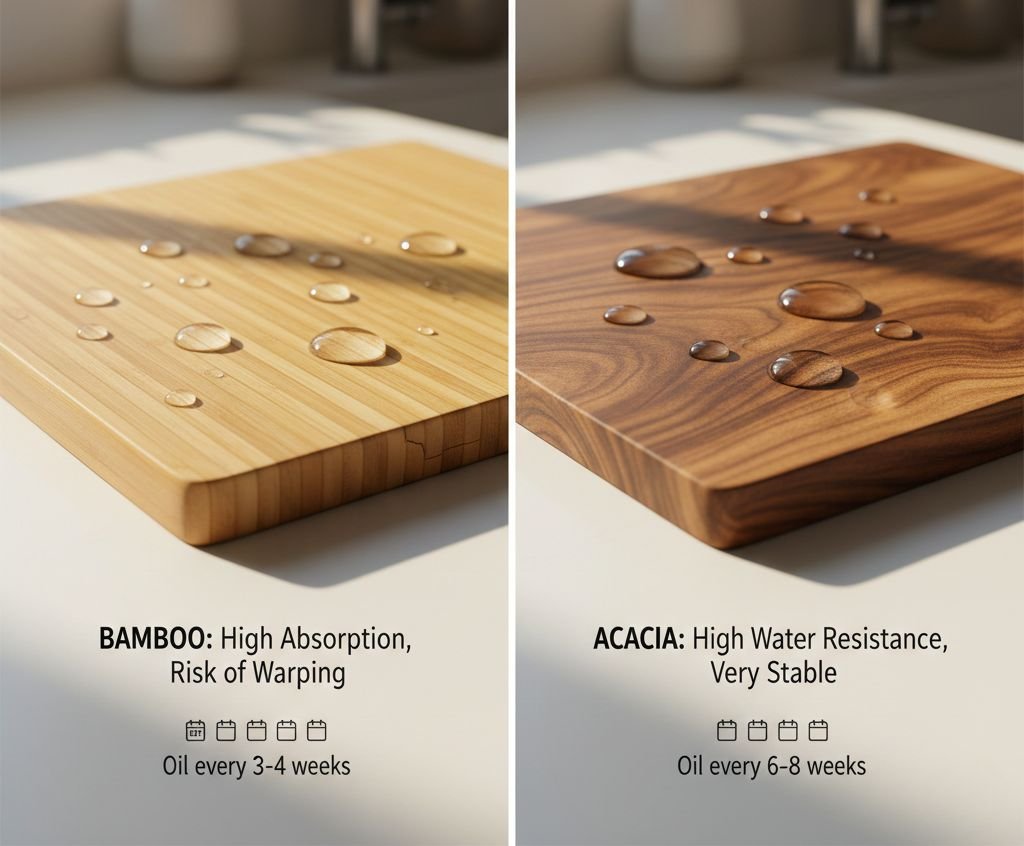
Acacia resists moisture through natural oils. The wood contains tannins and oils that repel water.
This is why acacia needs oiling less frequently. The wood self-protects naturally.
Bamboo resists moisture through density. The compressed fiber structure limits water penetration.
However, bamboo has no natural oils. It needs regular oiling to maintain moisture barrier.
Practical difference: Acacia needs oiling every 6 to 8 weeks. Bamboo needs it every 3 to 4 weeks.
Lifespan Reality: The Honest Numbers
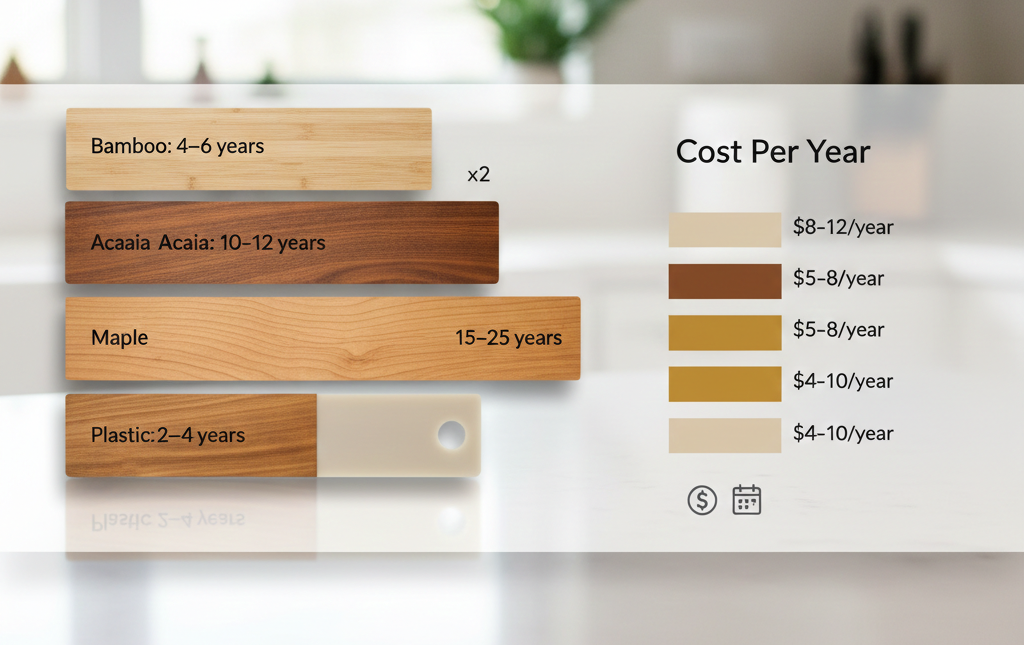
With proper care, acacia lasts 8 to 12 years. Bamboo lasts 4 to 6 years.
This is double the lifespan. The hardness and oil content create genuine durability advantage.
Acacia handles resurfacing better too. You can sand it 8 to 10 times. Bamboo handles 2 to 3 maximum.
Over time, acacia’s higher upfront cost balances out. You replace bamboo twice in acacia’s lifespan.
Weight and Handling: Daily Use Matters
Bamboo is lighter. A 15×20 inch bamboo board weighs around 4 pounds. Acacia weighs 6 to 7 pounds.
If you move your board frequently, bamboo feels easier to handle.
However, acacia’s weight provides stability. It does not slide during heavy chopping.
This is personal preference. Neither is objectively better for everyone.
Eco-Friendliness: Bamboo’s Clear Advantage
Bamboo regenerates in 3 to 5 years. It grows without pesticides. It absorbs more CO2 than acacia.
Acacia is a hardwood tree. It takes 15 to 20 years to reach harvest maturity.
Both are sustainable when properly sourced. However, bamboo wins on regeneration speed.
Look for FSC certification on acacia. Look for CARB Phase 2 compliance on bamboo.
Price Comparison: Budget Considerations
Quality bamboo boards: $25 to $60. Quality acacia boards: $45 to $90.
Acacia costs 50% to 80% more upfront. However, it lasts twice as long.
Cost per year of use: Bamboo = $8 to $12 annually. Acacia = $5 to $8 annually.
Acacia actually costs less over time. This surprises most people.
The Verdict: Which Should You Choose?
✓ Choose acacia if: You own quality knives, want maximum longevity, cook daily, and can afford higher upfront cost.
✓ Choose bamboo if: Budget is tight, eco-speed matters most, you prefer lighter boards, or you cook casually.
Is Bamboo or Wood Better? The Honest Material Showdown
When people say ‘wood,’ they usually mean maple, walnut, or cherry. Let me compare bamboo against traditional hardwood.
The Fundamental Difference (This Matters)
Bamboo is not wood. Bamboo is a grass. This is not semantic — it is biological.
Wood fibers grow in radial patterns. Bamboo fibers grow in parallel bundles.
This structural difference affects everything. Knife impact, moisture behavior, bacteria response.
Understanding this helps you predict how each material will perform.
End-Grain vs Edge-Grain: Why It Matters
End-grain boards (fibers oriented vertically) are gentler on knives, self-heal minor scratches, and can harbor bacteria less deeply. Edge-grain or laminated boards (common in bamboo and some hardwoods) are harder and more durable but can dull knives faster. Choosing the right grain orientation often has a bigger impact than material type alone.
The Self-Cleaning Property Wood Has
The University of Wisconsin discovered wood’s self-cleaning ability in groundbreaking research.
Wood fibers draw bacteria into the board. Once inside, bacteria die from oxygen deprivation.
Bamboo does not have this property. Bamboo is denser. Bacteria stay on the surface longer.
Both materials are food-safe. However, wood provides an extra safety margin for raw meat prep.
Knife Preservation: Wood Wins Clearly
Hardwood contains no silica. Bamboo contains silica throughout its structure.
Silica is harder than knife steel. It abrades edges microscopically with every cut.
Your knives stay sharper 30% to 40% longer on maple than on bamboo.
If you own expensive Japanese knives, choose wood. Your investment deserves protection.
Maintenance Requirements Compared
Maple needs oiling every 2 to 3 weeks with daily use. Bamboo needs it every 3 to 4 weeks.
The frequency difference is minimal. However, wood requires more attention to prevent cracking.
Wood is less forgiving of neglect. Skip oiling for two months, and cracks appear.
Bamboo tolerates occasional neglect better. Its density provides buffer against rapid moisture loss.
Cost and Value Over Time
Quality maple boards: $50 to $120. Quality bamboo boards: $25 to $60.
Wood costs double upfront. However, wood lasts 10 to 15 years. Bamboo lasts 4 to 6 years.
Wood can be resurfaced 10+ times. Bamboo handles 2 to 3 sandings maximum.
Over a decade, wood actually costs less per year of use.
When Bamboo Actually Beats Wood
Weight is bamboo’s practical advantage. Bamboo boards are 30% lighter than equivalent maple boards.
Moisture resistance favors bamboo slightly. It warps less. It splits less frequently.
Eco-speed goes to bamboo. Regeneration in 3 to 5 years versus 20+ for hardwood trees.
Price accessibility matters. More people can afford quality bamboo than quality hardwood.
✓ Choose wood if: You want maximum knife preservation, longest lifespan, best bacteria safety, and own quality knives.
✓ Choose bamboo if: Budget is primary concern, weight matters, or eco-regeneration speed is priority.
Bamboo vs Teak: Is Teak Worth the Premium Price?
Teak is the luxury option. It costs 2x to 3x more than bamboo. Is the price justified?
Why Teak Costs So Much More
Teak contains extremely high natural oil content. These oils make teak nearly waterproof.
Teak is used on boat decks for this reason. It handles constant moisture without warping.
Teak trees grow slowly. They take 25 to 30 years to reach harvest maturity.
Sustainable teak is FSC-certified. This certification process increases cost significantly.
Moisture Resistance: Teak Dominates
Teak needs oiling every 10 to 12 weeks. Bamboo needs it every 3 to 4 weeks.
Teak’s natural oils provide continuous protection. You can skip maintenance occasionally without damage.
Bamboo requires consistent oiling. Miss two months, and dryness cracks appear.
For busy people who forget maintenance, teak is more forgiving.
Hardness and Knife Impact
Teak measures 1000 to 1155 on the Janka scale. Bamboo measures 1375 to 1600.
Teak is softer. This makes it gentler on knife edges.
Teak contains no silica. Bamboo contains silica throughout. Your knives stay sharper longer on teak.
Combined with lower hardness, teak is one of the most knife-friendly materials available.
Lifespan: Teak Lasts Decades
Properly maintained teak lasts 15 to 20 years. Some boards last 25+ years.
Bamboo lasts 4 to 6 years. This is less than one-third of teak’s lifespan.
Teak can be resurfaced 12+ times. The high oil content preserves wood integrity.
Over 20 years, teak’s cost per year drops below bamboo’s cost per year.
When Bamboo Makes More Sense
Budget is the obvious factor. Teak boards cost $80 to $200. Bamboo costs $25 to $60.
Not everyone can justify $150 for a cutting board. Bamboo delivers solid performance at accessible price.
Weight matters if you move your board frequently. Bamboo is 40% lighter than teak.
Eco-regeneration speed favors bamboo. 3 to 5 years versus 25 to 30 years.
✓ Choose teak if: You want absolute best moisture resistance, longest lifespan, minimal maintenance, and budget allows.
✓ Choose bamboo if: Price is primary factor, you want lighter weight, or eco-regeneration speed matters most.
Are Bamboo Cutting Boards Better Than Plastic? The Clear Winner
This comparison has a definitive answer. Bamboo is objectively better than plastic in almost every category.
Knife Preservation: Bamboo Wins Easily
Plastic develops deep grooves quickly. These grooves trap bacteria and dull knives.
The grooves create a rough surface. Your knife edge impacts plastic inconsistently.
Bamboo boards may show slight surface recovery over time, but significant scratches remain; end-grain wood boards are better at self-healing. The fibers compress, then recover. Surface stays relatively smooth.
A 2018 University of Vermont study measured knife wear. Bamboo caused 18% less edge damage than plastic.
Bacteria Safety: Bamboo Wins Again
Plastic grooves trap bacteria deep inside. Standard cleaning cannot reach these bacteria.
FDA research shows plastic boards harbor more bacteria than wood or bamboo after six months of use.
Bamboo may retain some natural antimicrobial compounds, but effectiveness depends on processing. Both bamboo and hardwood boards are generally food-safe when cleaned properly.
A USDA study found bamboo showed 37% less bacterial colonization than plastic after 24 hours.
Durability and Lifespan
Quality plastic boards last 2 to 4 years. Bamboo lasts 4 to 6 years.
Plastic cannot be resurfaced. Once grooves appear, the board is compromised.
Bamboo can be sanded 2 to 3 times. This extends usable life significantly.
Plastic warps in dishwashers. Bamboo should not go in dishwashers either, but handles heat better.
Environmental Impact: No Contest
Plastic is petroleum-based. It takes 400+ years to decompose in landfills.
Microplastics shed from cutting boards enter food. Long-term health impact is unknown but concerning.
Bamboo is biodegradable. It decomposes in 1 to 3 years naturally.
Bamboo regenerates in 3 to 5 years. Petroleum is non-renewable.
The Only Advantage Plastic Has
Price is plastic’s sole advantage. Basic plastic boards cost $8 to $20.
However, they need replacement twice as often. Total cost over 5 years is similar.
Dishwasher safety is sometimes claimed. However, dishwashers warp and damage plastic boards rapidly.
Hand washing both materials takes the same 30 seconds. This advantage is minimal.
✓ Choose bamboo over plastic unless: Budget is extremely tight (under $15) and you replace boards frequently anyway.
What Is Carbonized Bamboo? Everything You Need to Know
Carbonized bamboo boards look darker. They cost slightly more. But what exactly is carbonization?
The Carbonization Process Explained Simply
Carbonization is a heat treatment process. Bamboo is exposed to 280°F to 320°F temperatures.
This caramelizes the natural sugars in bamboo fiber. The caramelization darkens the color.
The process is physical, not chemical. No chemicals are added during carbonization.
Think of it like toasting bread. Heat changes appearance and structure without adding anything.
Why Manufacturers Carbonize Bamboo
Aesthetics is the main reason. Carbonized bamboo looks richer. It matches darker kitchen palettes.
The dark brown color appeals to customers who find natural bamboo too light.
Marketing is the secondary reason. ‘Carbonized’ sounds premium. It justifies higher prices.
However, the functional benefits do not match the aesthetic appeal.
The 30% Strength Loss Nobody Talks About
Heat treatment weakens bamboo fiber structure. Carbonization reduces structural strength by approximately 30%.
This is not marketing spin. This is material science. Heat damages lignin bonds in bamboo.
Carbonized boards crack faster. They split sooner. They warp more easily under stress.
Natural bamboo that lasts 5 years becomes carbonized bamboo that lasts 3 years.
❌ Carbonization reduces bamboo’s natural antimicrobial properties by 40% to 50%. The heat degrades bamboo kun compound.
Knife Impact: Carbonized Is Worse
Carbonized bamboo becomes slightly harder on the surface. However, it is more brittle internally.
The surface hardness dulls knives faster. The brittleness causes more edge chipping.
Natural bamboo is better for knife preservation. The fiber flexibility cushions knife impact.
Professional chefs avoid carbonized boards for this reason. They prioritize knife edge retention.
Moisture Behavior Changes
Carbonization reduces moisture absorption capacity by about 20%. This sounds good initially.
However, it also reduces the board’s ability to release moisture. This traps humidity inside.
Trapped moisture causes internal mold growth. You cannot see it. You cannot clean it.
Natural bamboo breathes better. Moisture cycles in and out naturally.
Is Carbonized Bamboo Cutting Board Safe? The Complete Safety Answer
Safety has two components: the carbonization process itself, and the adhesive used. Let me address both.
The Carbonization Process Is Safe
Carbonization uses heat only. No toxic chemicals are added during the process.
The caramelized sugars are natural. They are non-toxic. They are food-safe.
FDA and USDA approve carbonized bamboo for food contact. The process itself creates no safety issues.
You can use carbonized boards for all food prep, including raw meat.
The Real Safety Concern: Adhesive
Carbonization does not fix the adhesive problem. Cheap carbonized boards still use formaldehyde glue.
The dark color can hide poor construction quality. Manufacturers know this.
Always verify adhesive safety on carbonized boards. Demand CARB Phase 2 compliance.
Look for FDA indirect food contact approval. The carbonization is safe. The glue might not be.
❌ CRITICAL: Some manufacturers use carbonization to hide inferior bamboo quality. The dark color conceals discoloration and defects.
Health Safety Is Fine, Performance Is Not
Carbonized bamboo will not poison you. It will not make you sick. It is food-safe.
However, it will crack faster. It will last shorter. It will cost you more money over time.
Safety and performance are different issues. Carbonized bamboo is safe but inferior.
You are better off buying natural bamboo. Save money. Get better performance.
✓ Verdict: Carbonized bamboo is safe for food contact. However, it is functionally inferior to natural bamboo in durability, antimicrobial properties, and knife friendliness.
The Complete Material Comparison: Every Factor Side by Side
Here is every cutting board material compared across eight critical factors. Use this to make your final decision.
| Material | Hardness | Knife Safe | Bacteria | Lifespan | Oiling | Eco Speed | Price |
| Bamboo | 1375-1600 | Fair | Good | 4-6 yrs | Monthly | 3-5 yrs | $25-60 |
| Acacia | 1750-2000 | Good | Excellent | 8-12 yrs | 6-8 wks | 15-20 yrs | $45-90 |
| Maple | 1450 | Excellent | Excellent | 10-15 yrs | 2-3 wks | 20-30 yrs | $50-120 |
| Teak | 1000-1155 | Excellent | Excellent | 15-25 yrs | 10-12 wks | 25-30 yrs | $80-200 |
| Plastic | 900-1100 | Poor | Poor | 2-4 yrs | None | Never | $8-30 |
| Carbonized | 1450-1700 | Poor | Fair | 3-4 yrs | Monthly | 3-5 yrs | $30-70 |
Use this table as your decision guide. Identify your top three priorities. Choose the material that excels in those areas.
Your Questions About Cutting Board Materials Answered
Is bamboo or acacia wood better for cutting boards?
Acacia is better for longevity (8-12 years vs 4-6), knife preservation (no silica), and moisture resistance (natural oils).
Bamboo is better for budget (costs 40% less), weight (30% lighter), and eco-regeneration speed (3-5 years vs 15-20).
Is a bamboo cutting board better than wood?
No for knife preservation and bacteria safety. Hardwood contains no silica and has self-cleaning properties.
Yes for price (50% less), weight (lighter), and moisture tolerance (warps less). Choose based on priorities.
Are bamboo cutting boards better than plastic?
Yes in every category except upfront price. Bamboo is safer, more durable, knife-friendly, and eco-responsible.
Plastic develops deep bacteria-trapping grooves. Bamboo self-heals and contains natural antimicrobial compounds.
What is carbonized bamboo cutting board?
Carbonized bamboo is heat-treated at 280-320°F. This caramelizes natural sugars and darkens the color.
The process reduces structural strength by 30% and antimicrobial properties by 40-50%. It is safe but inferior.
Is carbonized bamboo cutting board safe?
Yes, carbonization itself is safe. The heat process adds no toxic chemicals.
However, verify the adhesive is food-safe. Carbonization does not fix formaldehyde glue problems in cheap boards.
Is teak or bamboo better for cutting boards?
Teak is objectively better for longevity (15-25 years), knife preservation, and moisture resistance (minimal maintenance).
Bamboo is better for budget (costs 65% less), weight (40% lighter), and eco-regeneration speed (3-5 years vs 25-30).
Which cutting board material lasts longest?
Teak lasts longest at 15-25 years. Followed by maple (10-15 years), acacia (8-12 years), and bamboo (4-6 years).
Plastic lasts only 2-4 years. Carbonized bamboo lasts 3-4 years.
Which Cutting Board Material Should You Choose?
There is no universal best material. The right choice depends entirely on your priorities.
✓ Choose ACACIA if: You want the best balance of durability, knife preservation, and reasonable price. Acacia excels in longevity and performance.
✓ Choose HARDWOOD (maple/walnut) if: You own quality knives, want maximum bacteria safety, and prioritize longest lifespan above all.
✓ Choose TEAK if: Budget allows premium pricing, you want minimal maintenance, and absolute best moisture resistance matters most.
✓ Choose BAMBOO if: Budget is tight, eco-regeneration speed is priority, you want lighter weight, or you cook casually.
❌ AVOID CARBONIZED BAMBOO: It costs more, lasts shorter, and performs worse than natural bamboo. The dark color is not worth the trade-offs.
❌ AVOID PLASTIC: Unless budget is extremely tight (under $15), bamboo provides better value, safety, and performance for similar long-term cost.
Make your decision based on honest priorities. Do not chase marketing claims.
Quality matters more than material type. Buy reputable brands. Verify adhesive safety.
Whatever material you choose, maintain it properly. Oiling extends lifespan dramatically.
Explore “The Ultimate Guide to Bamboo Cutting Boards: Safety, Care & Maintenance (2026)” for full details.