
You bought a bamboo cutting board. Maybe someone gifted it to you. Either way, at some point you Googled something like “do bamboo cutting boards need to be oiled” and ended up more confused than when you started.
Some sites say use mineral oil. Others say coconut oil works fine. A few say you do not need to oil bamboo at all. And almost nobody explains the difference between “oiling” and “seasoning.”
So let us fix all of that right now. This guide covers everything, including what oil to use, how to season a brand new board, how to keep it maintained long term, and what actually happens when you use the wrong oil. No fluff. Just clear answers.
Quick answer: Yes, bamboo cutting boards need to be oiled. Skipping this step shortens the life of your board, makes it more likely to crack, and can let bacteria hide in the dry, split fibers. Use food-grade mineral oil. Do it before first use, then once a month after that.
Do Bamboo Cutting Boards Need to Be Oiled?
Yes, they do. And here is why.
Bamboo is a natural material. Even though it is harder and denser than most woods, it still absorbs and loses moisture all the time. When your board dries out too much, the fibers start to separate. That leads to cracks, warping, and a rough surface where bacteria can settle in.
Oiling creates a barrier. The oil soaks into the bamboo and slows down how fast it dries out. It keeps the fibers flexible, the surface smooth, and the board looking good for years.
Important: Bamboo is not solid wood. It is made from thin strips of bamboo grass pressed and glued together. That glue holds everything in place. Too much dryness weakens the glue joints. So yes, oiling your bamboo board is not optional if you want it to last.
Now, some people skip oiling because the board “looks fine.” That is a common mistake. By the time your board looks cracked or dry, the damage has already started on the inside. Regular oiling prevents problems before they show up.
What Happens If You Never Oil Your Bamboo Cutting Board?
Skipping oil is not immediately catastrophic. But over months of use, here is what tends to happen:
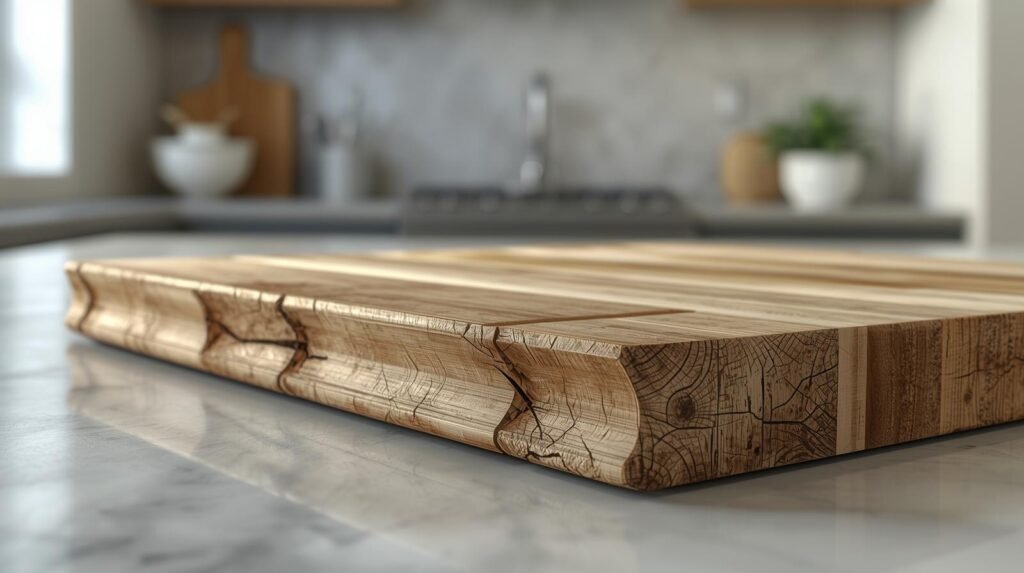
- The surface becomes rough and starts to feel scratchy under your knife.
- Small cracks appear, usually along the edges or the glued seams.
- The board starts to warp slightly, especially if it gets wet and dries unevenly.
- Bacteria and food residue get trapped in those tiny cracks.
- The board starts to smell even after washing.
A well-oiled board avoids all of this.
Oiling vs. Seasoning: What Is the Difference?
Most guides use these words like they mean the same thing. They do not. Understanding the difference helps you take better care of your board.
Seasoning = what you do to a brand new board before its first use. You apply multiple coats of oil over a few days to fully saturate the bamboo fibers. This is a one-time process.
Oiling = the regular maintenance you do every month or so once the board is in daily use. This keeps the board conditioned and prevents it from drying out.
Think of seasoning as a deep conditioning treatment before the board ever touches food. And think of regular oiling as the monthly upkeep that keeps it in good shape after that.
Most people skip the seasoning step because they are excited to use their new board. That is a mistake. Taking three days to properly season your board at the start can add years to its life.
What Oil to Use on a Bamboo Cutting Board
This is the question that causes the most confusion. So let us be very direct about it.
The best oil for a bamboo cutting board is food-grade mineral oil. It is the one professionals and woodworkers have recommended for decades, and for good reason.
Why Mineral Oil Works Best
- It is food-safe and flavorless. It will never affect the taste of your food.
- It is a pure mineral compound, which means it does not contain any organic fats that can spoil.
- It does not go rancid, ever. You can oil your board today and not worry about any smell developing later.
- It absorbs deeply into bamboo fibers without sitting on the surface.
- It is inexpensive and available at any pharmacy or kitchen store.
One thing worth knowing: the “cutting board oil” products you see at kitchen stores are almost always just mineral oil, sometimes with added beeswax. You can buy them, or you can buy plain food-grade mineral oil from the pharmacy for a fraction of the cost. Same result.
Other Oils That Work
- Fractionated coconut oil: This is different from regular solid coconut oil. The fractionation process removes the fatty acids that cause spoiling. It stays liquid at room temperature and works well on bamboo.
- Beeswax and mineral oil blends (board cream): These work well as a finishing coat after oiling. The beeswax sits on top of the bamboo and forms a protective seal. Apply the oil first, then the wax on top.
What Oil NOT to Use on a Bamboo Cutting Board
This part matters just as much. Several common household oils will actively damage your board over time.
- Olive oil: Olive oil contains unsaturated fatty acids. These break down and go rancid inside your board. You won’t see it, but after a few weeks the board starts to smell off. Mold can also grow under the surface.
- Vegetable oil, canola oil, sunflower oil, corn oil: Same problem. All of these are cooking oils with organic compounds that oxidize and spoil. Keep them away from your board.
- Regular coconut oil (solid): Regular coconut oil still contains enough unsaturated fats to go rancid. Do not confuse it with fractionated coconut oil, which has had those fats removed.
- Walnut oil: Technically a better oil than olive oil, but it is a tree nut product. If anyone in your household has a tree nut allergy, do not use walnut oil on a board that you then use to prepare food for them.
The simple rule: If you cook with it, do not oil your board with it. Cooking oils go bad. Mineral oil does not.
Oil Comparison at a Glance
| Oil Type | Safe to Use? | How Long It Lasts | Notes |
| Food-grade mineral oil | YES (best choice) | Months | Odorless, tasteless, won’t go rancid |
| Fractionated coconut oil | YES | Months | Stays liquid, doesn’t go rancid like regular coconut oil |
| Beeswax + mineral oil blend | YES (great finish coat) | Longer than oil alone | Adds a protective wax layer on top |
| Walnut oil | CAUTION | 2 to 4 weeks | Tree nut allergen. Avoid in allergy households |
| Olive oil | NO | Goes rancid fast | Smells bad, grows mold under surface |
| Vegetable oil | NO | Goes rancid fast | Same problem as olive oil |
| Coconut oil (regular, solid) | NOT RECOMMENDED | Short | Contains unsaturated fats. Can go rancid over time |
| Sunflower / corn / canola oil | NO | Goes rancid fast | All cooking oils with polyunsaturated fats go rancid |
How to Season a Brand New Bamboo Cutting Board (First-Time Protocol)
When you get a new bamboo cutting board, do not just rinse it and start cutting. Take three days to season it properly. You only have to do this once, and it makes a significant difference in how long the board lasts.
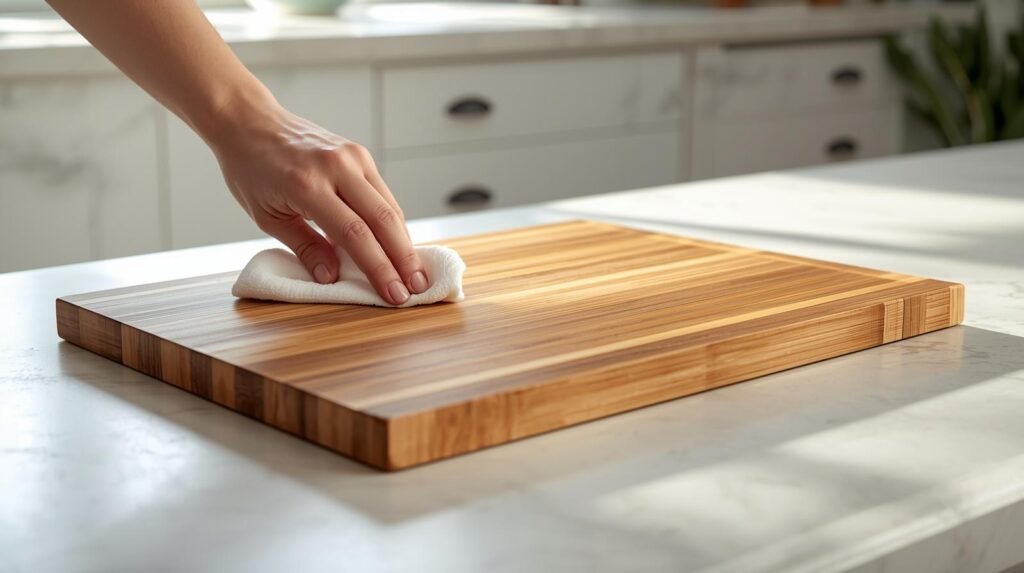
Here is exactly what to do.
What You Need
- Food-grade mineral oil (available at any pharmacy or kitchen store)
- A clean, lint-free cloth or paper towels
- Somewhere to rest the board horizontally while the oil absorbs
Step-by-Step Seasoning Process
Day 1
- Wash the board with warm water and a small amount of dish soap. Do this only this once at the start. Rinse well.
- Dry the board completely. Pat it down with a towel, then let it air dry for at least 30 minutes. Applying oil to a wet board reduces how much the bamboo can absorb.
- Pour a generous amount of mineral oil onto the board and spread it across the entire surface using your cloth. Cover the top, bottom, and all four sides.
- Let the board sit horizontally and absorb the oil for at least 8 hours. Overnight works well here.
- The next morning, wipe off any excess oil that has not absorbed. The surface should feel slightly tacky or oily, not wet.
Day 2
- Repeat the process. Apply another coat, let it sit overnight, wipe off the excess.
Day 3
- Apply a third and final coat. Let it absorb for 8 hours or more.
- Do the water bead test: Splash a few drops of water on the board. If the water beads up and sits on the surface like it would on a waxed car, the board is properly seasoned. If the water soaks in, apply one more coat and test again.
- Once the water beads up, your board is ready to use.
After seasoning, some people apply a thin coat of board cream or beeswax blend as a finishing step. This adds an extra protective layer on top of the oil and helps the board stay conditioned longer between oil applications.
How to Oil a Bamboo Cutting Board (Ongoing Maintenance)
Once your board is seasoned and in regular use, you switch to a simpler monthly maintenance routine. This takes about five minutes and mostly just means waiting for the oil to absorb.
Step-by-Step Oiling Process
- Wash and dry the board completely before oiling. Oil does not absorb well into damp bamboo. Let it air dry for at least 30 minutes after washing.
- Apply a moderate amount of mineral oil to the board. You do not need to flood it. A thin, even coat across all surfaces is enough.
- Use a cloth or your hands to rub the oil into the surface in the direction of the grain.
- Let the oil absorb for at least 4 to 6 hours. Overnight is ideal for maintenance coats.
- Wipe off any excess oil. If you see oil pooling on the surface after several hours, wipe it away.
- That is it. Your board is ready to use again.
The Water Bead Test: How to Know If Your Board Is Ready
This is the simplest way to check whether your board has absorbed enough oil.
Splash a few drops of water on the surface. Watch what happens.
- If the water beads up and sits on top: the board is well-oiled. You are in good shape.
- If the water spreads out and soaks in quickly: the board needs more oil. Apply another coat.
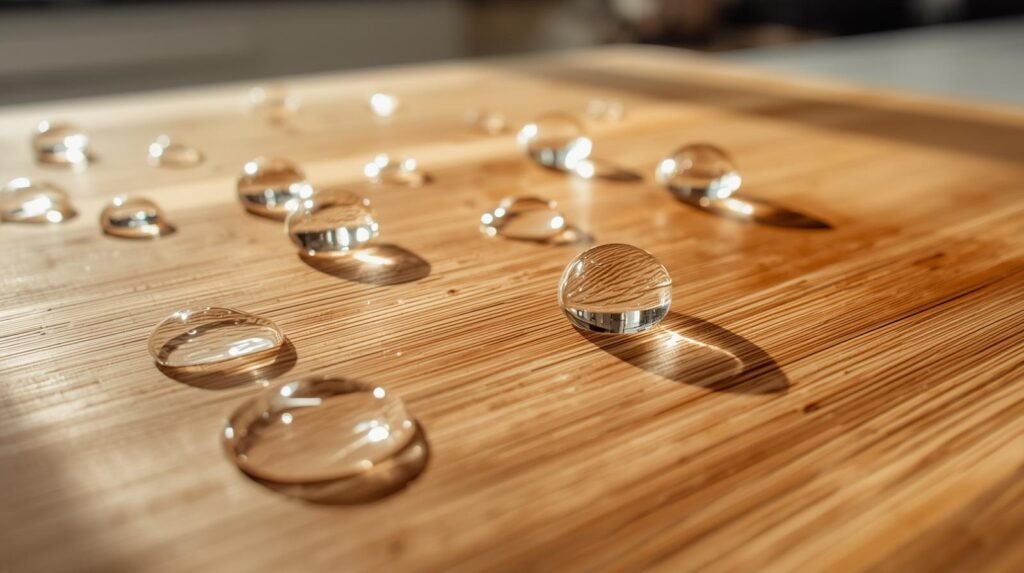
Do this test after oiling to confirm you are done. Do this test before oiling when you are checking if maintenance is due.
How Often Should You Oil a Bamboo Cutting Board?
The honest answer is: it depends. But here is a practical schedule that works for most people.
General rule: Oil your bamboo cutting board once a month if you use it regularly. If you use it less than once a week, every 6 to 8 weeks is enough.
That said, several factors change this schedule. Use the water bead test described above as your real guide. Your schedule might look like this:
Adjust Your Schedule Based on These Factors
- Heavy daily use: Oil every 2 to 3 weeks. Frequent washing strips the oil faster.
- Occasional use: Oil every 6 to 8 weeks. Less washing means oil lasts longer.
- Dry or desert climate: Oil every 2 to 3 weeks. Dry air pulls moisture out of bamboo faster than humid air does.
- Humid climate: Monthly is usually fine. Moisture in the air slows the drying process.
- Winter with indoor heating: Oil more frequently. Central heating creates very dry indoor air that dries out bamboo quickly.
- You put it through the dishwasher: Oil immediately after. Dishwashers strip oil completely and cause significant damage to bamboo boards.
Signs Your Board Needs Oil Right Now
- The surface looks lighter or ashy in color.
- The surface feels rough or slightly scratchy to the touch.
- Water does not bead on the surface and instead spreads flat.
- The edges or corners look slightly cracked or dry.
- The board smells a bit musty even after washing.
If you notice any of these signs, stop and oil your board before you use it again.
Can You Over-Oil a Bamboo Cutting Board?
Yes, you can. This is the part almost no other guide talks about, but it is a real problem.
If you apply oil too frequently or apply too much at once without wiping off the excess, a few things can go wrong:
- The surface becomes tacky and sticky. It attracts dust and lint and feels unpleasant to use.
- Oil that sits on the surface rather than absorbing into the fibers can turn slightly rancid if you use a low-quality oil or apply too much.
- Excessive oiling over time can actually weaken the adhesive that holds the bamboo strips together in laminated boards. Too much moisture of any kind, including oil, softens those glue joints.
The right amount of oil is a moderate, even coat that absorbs fully into the board within a few hours. If after 6 hours there is still a lot of visible oil sitting on the surface, you used too much. Wipe the excess off.
The goal is absorbed oil, not surface oil. Bamboo should look nourished, not wet or shiny.
Bamboo vs. Wood Cutting Boards: Does Oiling Work Differently?
Most oiling advice online treats bamboo and wood as identical. They are not. There are a few important differences worth knowing.
Bamboo is a grass, not a wood. Even though we call it a hardwood material, bamboo is technically a grass that has been compressed and laminated into a rigid form. This means it has a different grain structure and absorbs oil slightly differently than solid wood.
Bamboo boards are laminated. Your board is made from strips of bamboo glued together. Those glue lines are the weakest points in the board. Keeping the board properly oiled keeps the surrounding fibers from expanding and contracting too much, which protects those seams.
Bamboo is naturally harder. Because bamboo is denser than many woods, it can take slightly longer for oil to absorb into the surface. Do not rush the process. Let each coat sit overnight for best results.
Do not soak a bamboo board. Unlike some wood boards that benefit from a long soak in oil, bamboo boards do best with moderate, absorbed coats. Too much oil over time can erode the glue joints. Keep to the step-by-step process above.
What Actually Happens When You Use the Wrong Oil
You have probably read “do not use olive oil” on every cutting board guide. But nobody explains what actually happens if you do. Here is the science behind it, in plain terms.
Olive oil, vegetable oil, and other cooking oils contain polyunsaturated fatty acids. These are organic compounds that react with oxygen in the air over time in a process called oxidation. When oils oxidize inside your cutting board, they break down and produce compounds that smell bad. This is what “rancid” oil smells like.
Now picture this: you applied olive oil to your board two months ago. The oil soaked into the bamboo fibers and stayed there. Inside your board, out of sight, that olive oil has been slowly oxidizing. You start to notice a faint, slightly unpleasant smell coming from your board even after you wash it. That is rancid oil inside the bamboo, and washing the surface does nothing to reach it.
This process typically starts showing up within 4 to 8 weeks of applying cooking oils. In warmer climates, it can happen faster. The smell ranges from mildly off to actively foul depending on how much oil was used and how warm the storage conditions are.
Mineral oil does not contain any organic fats. It cannot oxidize in the same way. This is exactly why it is the right choice.
If your board already smells bad from a past cooking oil application: scrub it with coarse salt and half a lemon, rinse, dry completely, and then begin a proper mineral oil seasoning. This can help, but a deeply rancid board may not fully recover.
Oiling Bamboo Cutting Boards in Allergy Households
This is something almost no guide addresses, but it matters.
Walnut oil is sometimes recommended as a natural alternative to mineral oil. And technically, it performs reasonably well on cutting boards because it polymerizes (hardens) and resists going rancid better than olive oil. However, walnut is a tree nut.
If you use walnut oil on your cutting board and someone in your household has a tree nut allergy, that oil is now inside the surface of the board that you use to prepare their food. Even after washing, trace amounts can remain.
The safe recommendation for allergy households is straightforward: use food-grade mineral oil. It contains no allergens, no organic compounds, and no food-derived fats. It is the default safe choice for everyone.
Extra Care Tips That Make Your Board Last Longer
Oiling is the most important maintenance step, but a few extra habits make a real difference.
- Never put your bamboo board in the dishwasher. The high heat and prolonged exposure to water strips all the oil, swells the fibers, and weakens the glue joints. Wash by hand with warm soapy water only.
- Do not let your board soak in water. Bamboo boards should not sit in a sink of water or be left wet for extended periods. Wipe and dry immediately after washing.
- Dry both sides evenly. If you only dry one side, the board dries unevenly and warps. Store it upright or lay it flat. Never lean it against a wall with only one side exposed to air.
- Use a plastic or glass board for raw meat. Even a well-oiled bamboo board is porous enough that raw meat juices can penetrate the surface. For food safety, keep a separate board for raw proteins.
- Sand lightly if the surface gets rough. If your board develops a rough texture that oiling does not fix, sand it lightly with 220-grit sandpaper, then re-season it with three coats of mineral oil.
Frequently Asked Questions
Are you supposed to oil bamboo cutting boards?
Yes. Oiling bamboo cutting boards is not optional if you want them to last. It prevents cracking, warping, and bacterial buildup in dry fibers. Start with a three-coat seasoning before first use, then oil monthly after that.
What oil can I use on a bamboo cutting board?
Use food-grade mineral oil. It is the safest, most effective, and most affordable choice. You can also use fractionated coconut oil or a mineral oil and beeswax blend. Avoid all cooking oils including olive oil, vegetable oil, and coconut oil.
Do you need to oil bamboo cutting boards differently than wood boards?
The process is similar, but bamboo is laminated with glue joints that can weaken if saturated with too much oil. Apply moderate coats and let them absorb fully rather than soaking the board. Multiple light coats work better than one heavy soak.
How do I season a bamboo cutting board for the first time?
Apply a coat of food-grade mineral oil to all surfaces. Let it absorb overnight. Repeat for three consecutive days. After the third coat, do the water bead test. When water beads on the surface, the board is ready to use.
Should you oil a bamboo cutting board on both sides?
Yes. Always oil every surface including the bottom, sides, and edges. Oiling only the top creates uneven moisture levels in the board, which causes warping over time.
What happens if I never oil my bamboo cutting board?
The board will dry out, crack along the seams and edges, warp from uneven moisture, and develop a rough surface that traps bacteria. The timeline depends on how often you wash it and how dry your environment is, but neglect shows up within a few months.
Can I use coconut oil on my bamboo cutting board?
Fractionated coconut oil is fine. Regular coconut oil (the solid kind) is not recommended because it contains unsaturated fats that can eventually go rancid inside the board. If you want to use coconut oil, make sure it is the fractionated liquid version specifically.
How long does it take for oil to absorb into a bamboo cutting board?
For a seasoning coat, allow at least 8 hours. Overnight is ideal. For regular maintenance coats, 4 to 6 hours is enough. The board should not feel wet or tacky after the oil has absorbed. Wipe off any excess if it is still sitting on the surface after 6 hours.
Wrapping Up
Oiling your bamboo cutting board is one of those maintenance habits that takes five minutes to do and saves you from replacing a 40 dollar board every year.
To summarize the core points: season every new board with three coats of mineral oil before its first use. Then oil once a month as routine maintenance, or more often if you use the board heavily or live in a dry climate. Use the water bead test to know when it is time to oil and when your board is fully conditioned. Stick to food-grade mineral oil and avoid any cooking oils.
Take care of your board this way, and it will last you years longer than most people expect from a bamboo board.
Want proper care and safety tips? See our complete bamboo cutting board guide.