
You have a bamboo cutting board. You also have a dishwasher. At the end of a long dinner prep, putting the board in with the rest of the dishes sounds perfectly reasonable.
Here is the direct answer: no, standard bamboo cutting boards are not dishwasher safe. Putting one in the dishwasher does not just reduce its lifespan a little. It actively destroys the board from the inside out, and often faster than you would expect.
But this article goes further than just saying no. It explains exactly why the dishwasher ruins bamboo boards, what is happening at the structural level during each cycle, what to do if you have already run your board through one, whether any bamboo boards are actually dishwasher safe, and the best hand-washing method that keeps your board clean and lasts just as long.
Quick answer: Standard bamboo cutting boards cannot go in the dishwasher. The combination of heat, prolonged moisture, and harsh detergent strips the oil, weakens the adhesive, swells the fibers, and causes warping, cracking, and delamination. Hand washing takes about 90 seconds and fully cleans the board without any damage.
Why Bamboo Cutting Boards Cannot Go in the Dishwasher
The answer is not just “because bamboo is natural” or “because it absorbs water.” There are four specific mechanisms happening inside a dishwasher that each cause damage on their own. Together they cause serious, often irreversible harm.
Reason 1: The Heat Breaks Down the Adhesive
Standard bamboo cutting boards are laminated products. Dozens of bamboo strips press together under high pressure and bond with adhesive to form the solid board you use. That adhesive is the structural backbone holding everything together.
Standard dishwasher wash cycles run at 140 to 160 degrees Fahrenheit. The drying cycle climbs even higher, often above 180 degrees Fahrenheit. At those temperatures, even food-safe adhesives begin to soften and lose their grip. The glue lines weaken gradually with each cycle. You first see this as hairline cracks along the seams. Over time, those seams open into gaps, and the strips start to separate. This is called delamination, and once it starts, the board is structurally compromised.
Real-world consequence: A board that could last five to seven years with hand washing often starts showing seam separation within a few months of regular dishwasher use. The damage is cumulative and gets worse with each cycle.
Reason 2: Steam Causes Fiber Expansion and Uneven Contraction
Inside a running dishwasher, the chamber fills with pressurized steam. Bamboo fibers absorb this steam rapidly and swell. When the drying cycle hits, the board goes from saturated to hot and dry in a short period. The fibers shrink back, but not evenly. The two sides of the board dry at different rates, and the fibers on one side contract faster than the other. That differential is what produces the characteristic rocking or bowing shape of a warped board.
I have seen this happen to a board after a single cycle. The board sat perfectly flat on the counter before going in. It came out with a visible bow across the center. That warp did not fully reverse after drying and oiling. Once the fibers have been stressed this way, partial warping often becomes permanent.
Reason 3: Dishwasher Detergent Strips the Oil Completely
Dishwasher detergent is formulated to cut through baked-on grease and food residue on metal and ceramic surfaces. It is significantly more alkaline and aggressive than standard dish soap. When it contacts bamboo, it strips out all the natural oils in the fibers as well as any mineral oil you have applied to protect the board.
An oiled bamboo board resists moisture, stays flexible, and seals the surface against bacteria. A board stripped of its oil becomes dry and brittle almost immediately. The surface opens up microscopic cracks and pores that absorb water, food pigments, and bacteria far more readily than a well-oiled surface. Even one dishwasher cycle undoes weeks of oiling maintenance.
Reason 4: The Cycle Duration Extends Every Damage Factor
Hand washing a cutting board takes about 90 seconds. A dishwasher cycle runs for one to two hours, with some heavy cycles lasting up to four hours. Every minute inside the dishwasher means more heat, more steam, and more detergent contact. Even if each factor alone caused minor damage, four hours of combined exposure causes serious structural harm. The USDA recommends washing bamboo boards with hot soapy water by hand, not machine washing, precisely because the duration and intensity of dishwasher cycles are too extreme for natural fiber materials.
What Actually Happens: A Cycle-by-Cycle Breakdown
Most guides tell you not to do it but never show you what happens over time. Here is the realistic damage progression so you know exactly what you are dealing with.
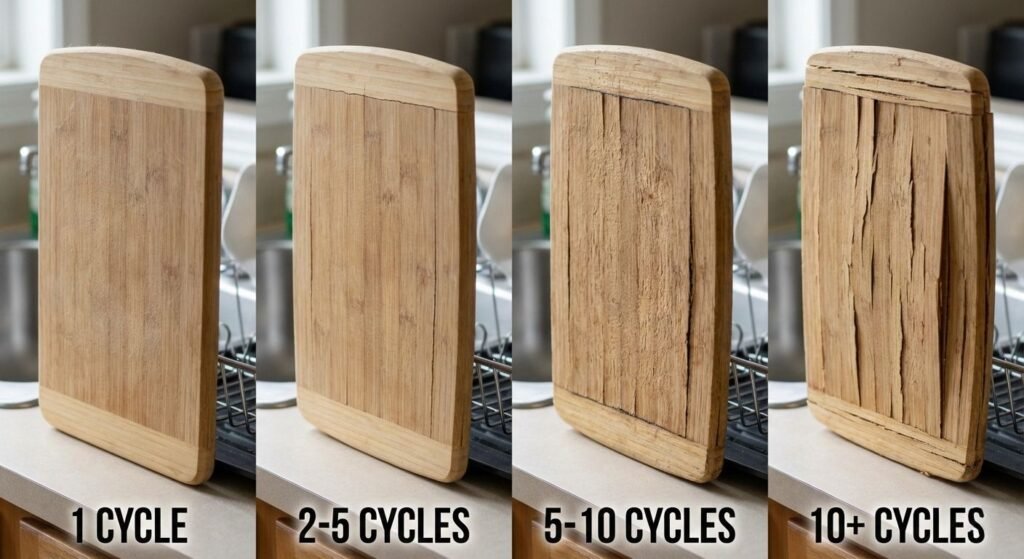
Damage Timeline: What Each Dishwasher Cycle Does to a Bamboo Board
| Dishwasher Runs | What You Will See | Recovery Options |
| 1st cycle | Surface looks dull. Oil stripped. Bamboo feels slightly rough. | Salvageable. Let dry fully then re-oil with 2 mineral oil coats. |
| 2 to 5 cycles | Hairline seam cracks begin. Surface starts to lighten unevenly. Slight warp visible. | Borderline. Deep re-oil, attempt warp fix. Monitor for seam separation. |
| 5 to 10 cycles | Obvious warping. Seam gaps widen. Surface rough and pitted. | Difficult to recover. Warping makes it unsafe to cut on. Consider retirement. |
| 10+ cycles | Delamination. Strips separating. Deep cracks. Mold risk in crevices. | Retire the board. Structural damage is irreversible. Food safety is compromised. |
The key insight from this timeline is that the damage after the first cycle is not immediately obvious to most people. The board looks mostly fine, maybe a little dull. So they put it in again. And again. By the time the warping and seam separation become visible, the board has already suffered structural damage that cannot be reversed.
I Already Put My Bamboo Board in the Dishwasher. Now What?
This happens to almost everyone at some point. Maybe you forgot, or someone else in the house did it, or you simply did not know. Here is exactly what to do based on how many times it has gone through.
If It Was One Cycle
You likely have a chance to recover the board with prompt action. Follow these steps immediately.
- Take the board out of the dishwasher as soon as the cycle finishes. Do not let it sit in the residual heat and steam.
- Pat the board dry with a clean towel. Wipe all surfaces including the bottom, sides, and edges.
- Stand the board upright on its edge and let it air dry in a cool, well-ventilated area for at least 24 hours. Do not put it near a heat source. Do not lay it flat. Standing it upright lets both sides dry at the same rate, which reduces warping.
- Once completely dry, apply two generous coats of food-grade mineral oil. Let each coat absorb overnight before applying the next. This starts to replace the oil the detergent stripped away.
- Inspect the board. Run your hand across it. Check for any warping by setting it on a flat counter and pressing the corners. Minor bowing after one cycle sometimes corrects itself during the drying and re-oiling process.
If you notice a slight warp after one cycle: place the board concave side down on a damp towel for several hours. The moisture slowly re-expands the drier side. Then move it to dry upright. This technique works for mild warping but not for boards that have already developed seam cracks.
If It Was Multiple Cycles
Be realistic about the damage. Check for these signs and use them to decide whether the board is worth keeping.
- Seam gaps or strip separation: Run your fingernail along each glue line. If you feel a ridge or gap between strips, delamination has started. This is a safety concern because those gaps trap bacteria. A board with seam separation should retire from food prep.
- Deep cracks in the surface: Surface cracks that you can feel with your fingernail trap food and bacteria. No amount of oiling fills structural cracks. This board needs replacing.
- Visible warping that does not sit flat: A rocking board is unsafe to cut on because it shifts under knife pressure. If the warp is severe and does not respond to the damp towel technique, the board is done.
- Still mostly flat with rough surface only: Sand the surface lightly with 220-grit sandpaper following the direction of the bamboo grain. Then apply three full coats of mineral oil, one per day. This can restore a usable surface if the structure is otherwise intact.
When to Retire the Board
Stop using a bamboo cutting board for food prep when you see any of the following:
- Strips separating at the seams with visible gaps.
- Cracks deep enough to catch a fingernail.
- A smell that does not go away after washing. This signals mold or bacteria inside the structure.
- Warping severe enough that the board rocks on a flat surface.
A retired bamboo board does not have to go straight in the bin. If the surface is still reasonably smooth, it works perfectly as a bread board, a cheese serving board, or a trivet for hot pots. Just keep it away from raw meat or high-bacteria prep tasks.
Are Any Bamboo Cutting Boards Actually Dishwasher Safe?
Yes, a small number of bamboo boards are engineered specifically to handle dishwasher conditions. But they work differently from standard bamboo boards and come with trade-offs worth knowing before you buy.
Dishwasher-Safe Bamboo: How It Works
Standard bamboo boards use compressed bamboo strips bonded with food-safe water-based adhesive. Dishwasher-safe bamboo boards use one of two approaches to solve the heat and moisture problem.
Approach 1: Composite bamboo. Some boards blend bamboo fiber with food-safe resins or polymers. The composite structure is far more resistant to heat, steam, and moisture expansion than pure laminated bamboo. Totally Bamboo’s GreenLite line uses this approach. These boards handle dishwasher cycles but are less natural than solid bamboo and have reduced biodegradability.
Approach 2: Advanced lamination with moisture-blocking treatments. Some brands use specialized three-layer cross-laminated construction and proprietary moisture barrier treatments applied at the manufacturing level. Koppen is the most prominent brand currently doing this with their MoistureBlock technology. These boards remain closer to traditional bamboo in feel and environmental profile.
The Trade-offs of Dishwasher-Safe Bamboo
- Composite bamboo boards are less eco-friendly than solid bamboo because the resin or polymer content makes them non-compostable.
- Both types still wear faster in the dishwasher than they would with hand washing. Even engineered dishwasher-safe boards last longer when hand washed most of the time.
- Dishwasher-safe bamboo boards are typically thinner than solid boards, which reduces their longevity and heft.
- They tend to cost more than standard bamboo boards due to the engineering required.
Bottom line: If dishwasher convenience is essential to you, look specifically for boards labeled dishwasher safe from a named brand that explains how it achieves that rating. Do not assume any bamboo board is dishwasher safe because the packaging uses phrases like “durable” or “easy to clean.” Check for explicit dishwasher-safe labeling and a brief explanation of the construction that makes it possible.
The Right Way to Clean a Bamboo Cutting Board by Hand
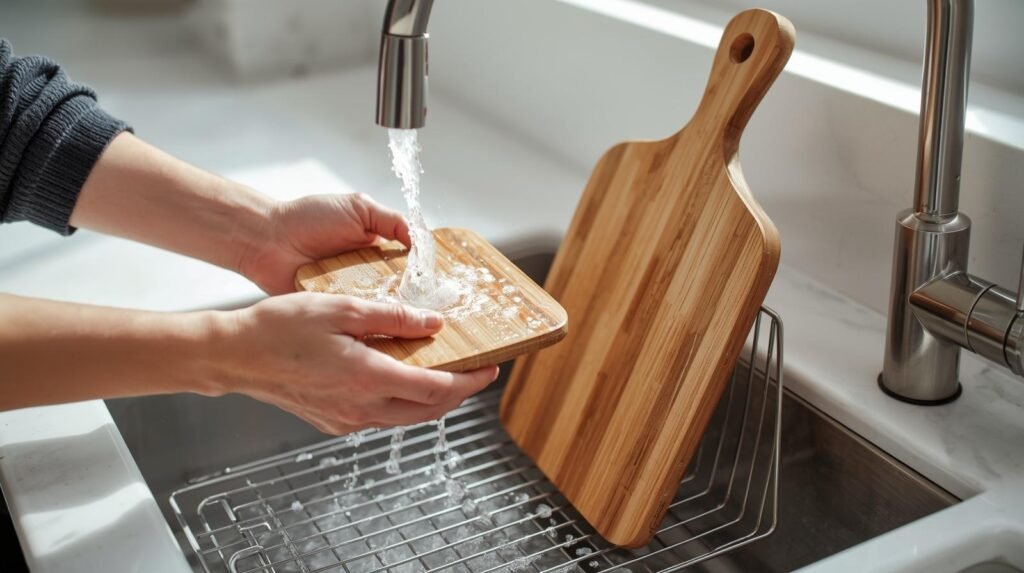
Hand washing is not complicated. The entire process takes about 90 seconds and, done consistently, keeps your board clean, safe, and in excellent condition for years. Here is exactly how to do it.
Daily Cleaning After Regular Use
- Rinse the board immediately after use under warm running water. Do not let food residue dry on the surface. The sooner you rinse, the easier the cleaning.
- Apply a small amount of mild dish soap to a soft sponge or cloth. Scrub all surfaces including the bottom and edges. Pay attention to any knife grooves where food residue collects.
- Rinse thoroughly with warm water until no soap residue remains.
- Pat the board dry immediately with a clean towel. Do not leave it wet on the counter.
- Stand the board upright on its edge, or lean it at an angle in a drying rack so air can circulate around both sides. Let it finish air drying in this position for at least 30 minutes before storing flat.
Critical drying habit: Standing the board upright is not just a preference. Laying a wet board flat traps moisture against one side, causing that side to expand while the top dries out. This is exactly the uneven moisture distribution that causes warping. Stand it upright every single time.
Deep Cleaning After Raw Meat
After cutting raw chicken, fish, or red meat, standard washing is a good start but not quite enough. Add these two steps.
- Wash with hot soapy water as described above.
- Wipe the board down with a diluted white vinegar solution. Mix one part white vinegar with four parts water, apply it to the surface with a cloth, let it sit for two minutes, then rinse and dry. Vinegar is an effective natural sanitizer that does not damage bamboo or strip the oil the way bleach does.
- For stubborn odors from fish or garlic, sprinkle coarse salt over the board and rub with half a fresh lemon. The salt acts as a mild abrasive and the lemon juice neutralizes odor compounds. Rinse well and dry.
What to Avoid When Washing
- Soaking in water: Leaving the board sitting in a sink of water, even for 30 minutes, drives moisture deep into the fibers and seams. This causes the same swelling and warping risk as the dishwasher, just more slowly.
- Steel wool or abrasive scrubbers: These scratch and score the bamboo surface, creating channels where bacteria can collect. Use only soft sponges or cloths.
- Bleach for regular cleaning: Bleach is too harsh for bamboo. It dries out the fibers, damages the surface, and accelerates cracking. Use diluted vinegar for sanitizing instead.
- Drying in direct sunlight or near a heat source: Rapid heat-drying causes the same uneven fiber contraction as a dishwasher drying cycle. Always air dry away from direct heat.
Hand Washing vs. Dishwasher: Side-by-Side
| Factor | Hand Washing | Dishwasher |
| Time required | About 60 to 90 seconds | 60 to 120 minutes cycle time |
| Oil protection | Preserved. Board stays conditioned. | Stripped entirely every cycle |
| Glue joints | Safe. Mild soap does not penetrate seams. | At risk. Heat softens adhesive over time |
| Fiber behavior | Stable. Fibers absorb minimal water briefly then dry. | Stressed. Fibers swell fully, then shrink rapidly under heat drying |
| Warp risk | Very low with immediate drying. | High. Especially after multiple cycles |
| Surface texture | Stays smooth and sealed with regular oiling. | Becomes rough, pitted, and dry |
| Bacteria removal | Effective with hot soapy water and immediate drying. | Effective sanitization, but damages the board in the process |
| Board lifespan | Five to seven years or more with proper care. | Months to a couple of years before visible damage |
Does Hand Washing Actually Sanitize the Board?
This is a fair question. One argument for dishwashers is that their high heat provides better sanitization than hand washing. That is true for ceramic and metal dishes. For bamboo, the logic breaks down.
Hot soapy water removes bacteria from surfaces through two mechanisms: the soap disrupts bacterial cell membranes, and the mechanical scrubbing physically lifts bacteria off the surface. The USDA confirms that washing cutting boards with hot soapy water removes harmful bacteria effectively for everyday use.
The dishwasher does sanitize the board during the wash cycle. But in doing so, it also strips the oil, softens the adhesive, and stresses the fibers. The result is a bacteria-free board that is now more vulnerable to bacterial contamination in the future because its protective oil layer is gone and its surface is starting to crack.
Hand washing plus periodic vinegar sanitizing gives you the same bacterial removal for everyday kitchen use without any of the structural damage. For households with immune-compromised members or situations requiring clinical sanitization, a plastic board that can handle dishwasher sterilization is a better choice than bamboo for high-risk tasks.
The USDA Food Safety and Inspection Service states that both wooden and plastic cutting boards can be sanitized with a solution of one tablespoon of unscented liquid chlorine bleach per gallon of water. For bamboo, apply this solution briefly, rinse well, and dry immediately. Use this only occasionally, not as regular cleaning, since bleach does degrade bamboo over time with repeated use.
How Water Exposure in General Affects Your Bamboo Board
The dishwasher is the most extreme form of water exposure, but even routine habits around water affect how long your board lasts. Here is what matters in daily use.
How Long Can Bamboo Safely Be Wet?
A quick rinse and wash is completely fine. The problems start when the board stays wet for extended periods. Here is a rough guide:
- Under 5 minutes wet: No problem. Normal washing and rinsing falls in this range.
- 5 to 30 minutes wet: Mild surface absorption occurs. Dry immediately afterward and this causes no lasting damage.
- 30 minutes to a few hours wet: Meaningful moisture penetration into fibers. Surface swelling begins. Drying unevenly from this point causes warping risk.
- Several hours or overnight wet: Significant damage risk. Seam swelling, warping, and mold in crevices. Treat this like a dishwasher incident and follow the recovery steps above.
The Single Worst Habit for Bamboo Boards
Leaving a wet bamboo board flat on the counter after washing is the single most common reason boards warp prematurely. Most people rinse the board and set it flat to dry while moving on to other tasks. The bottom stays wet and the top dries from air exposure. The difference in drying rates creates tension across the board that bends it.
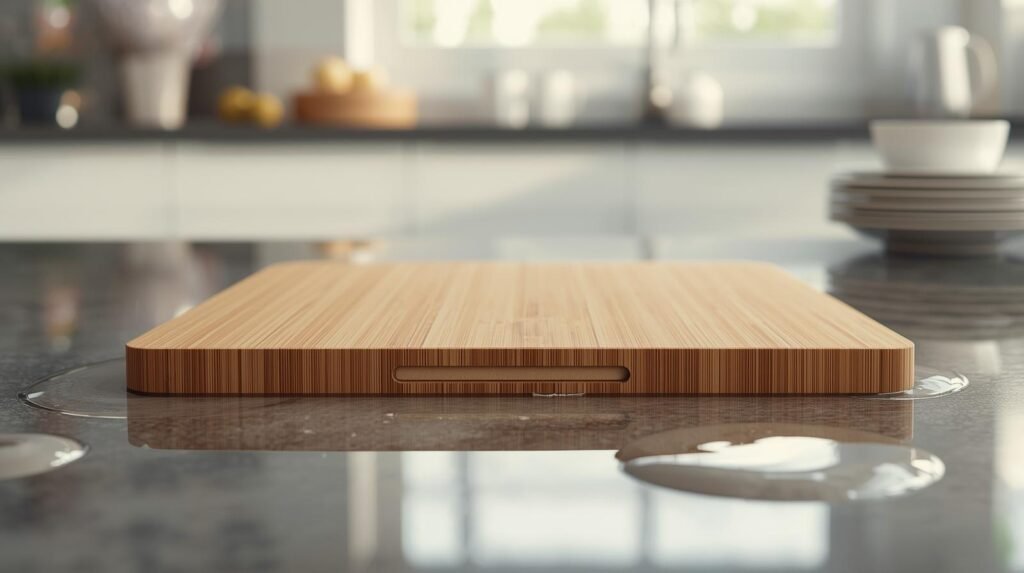
One habit change fixes this completely: always stand the board upright after washing. Prop it against the backsplash, lean it in a rack, or stand it on its edge. Both sides get equal airflow and both sides dry at the same rate. The board stays flat.
Frequently Asked Questions
Are bamboo cutting boards dishwasher safe?
Standard bamboo cutting boards are not dishwasher safe. The heat, prolonged moisture, and alkaline dishwasher detergent combine to strip the board’s oil, soften the adhesive, swell the fibers unevenly, and cause warping, cracking, and delamination. A small number of specially engineered bamboo boards are designed for dishwasher use, but these use composite materials or advanced lamination technology and are clearly labeled as dishwasher safe by the manufacturer.
Can bamboo cutting boards go in the dishwasher?
No, standard bamboo boards cannot safely go in the dishwasher. Even one cycle causes visible dulling and strips the oil that protects the board. Multiple cycles cause warping, seam separation, and surface cracking. If dishwasher convenience is a priority, look specifically for boards labeled dishwasher safe from a brand that explains how their construction handles it.
Can you put a bamboo cutting board in the dishwasher if you do it rarely?
Even occasional dishwasher use causes cumulative damage. The first cycle strips the oil and stresses the adhesive. Subsequent cycles build on that damage. The board does not get a chance to recover between cycles the way it does with hand washing and regular oiling. Occasional dishwasher use will noticeably shorten the board’s lifespan compared to consistent hand washing.
What happens if you put a bamboo cutting board in the dishwasher?
During the wash cycle, the hot water and steam swell the bamboo fibers and begin softening the adhesive. During the drying cycle, rapid heat removes moisture unevenly, causing the fibers on different sides to contract at different rates. This creates warping. The alkaline detergent strips all the protective oil. Over multiple cycles, the adhesive weakens, seams crack, and strips start to separate. The board becomes structurally unsafe and much harder to keep sanitary.
Can I put my bamboo cutting board in the dishwasher on the gentle cycle?
Even gentle cycles reach temperatures high enough to damage bamboo and still use alkaline detergent that strips the oil. The cycle time is still much longer than hand washing. A gentle cycle reduces the damage rate compared to a heavy cycle, but it does not eliminate the problem. Hand washing is always the better option for any bamboo board not specifically labeled dishwasher safe.
Can I put my bamboo cutting board in the dishwasher just to sanitize it?
The dishwasher does sanitize the board, but the cost is structural damage. You end up with a briefly sanitized board that is now more vulnerable to contamination going forward because its oil is gone and its surface is starting to degrade. For occasional sanitizing, use a diluted vinegar solution after hand washing instead. It provides effective sanitization without any damage to the board.
How should I clean a bamboo cutting board if not in the dishwasher?
Wash immediately after use with warm water and mild dish soap using a soft sponge. Scrub all surfaces. Rinse thoroughly. Pat dry immediately with a towel. Stand the board upright on its edge to finish air drying. After contact with raw meat, add a vinegar sanitizing step. Oil the board with food-grade mineral oil once a month to keep the surface sealed and protected.
What about soaking a bamboo cutting board in water?
Do not soak a bamboo board. Even 30 minutes in a sink of water drives moisture into the fibers and seams, which causes swelling and increases warping risk. Quick washing and immediate drying is always the right approach.
Final Thoughts
The dishwasher question comes up because it seems like the logical, convenient choice. You put everything else in there after dinner. Why not the cutting board?
The reason is structural. Bamboo cutting boards are laminated products held together by adhesive, and dishwashers are designed to attack exactly the kinds of substances that hold things together. The heat, steam, alkaline detergent, and extended cycle times are a perfect recipe for breaking down everything that makes a bamboo board a good cutting board.
Hand washing takes 90 seconds. It fully cleans and sanitizes the board when done properly. And it keeps the board in excellent shape for five to seven years or more. That is a straightforward trade-off that favors the extra 90 seconds every time.
If you genuinely need a board that can go in the dishwasher, buy one that is specifically engineered for it. Just do not assume that any bamboo board can handle it because it looks sturdy or because the packaging sounds reassuring.
Explore “The Ultimate Guide to Bamboo Cutting Boards: Safety, Care & Maintenance (2026)” for full details.