
Tested & Verified: OEKO-TEX Standard 100 | FSC Certified | US-Based Independent Testing
Quick Answer: Best Overall: Cozy Earth | Best for Hot Sleepers: Ettitude | Best Budget: Bedsure | Best for Acne: Luxome | Best for Curly Hair: Hairlust
The 8 Best Bamboo Pillowcases of 2026: Expert Tested and Reviewed
1. Best Overall Bamboo Pillowcase
Cozy Earth — 100% Bamboo Viscose | Price: $54 | OEKO-TEX Certified
- Material: 100% bamboo viscose, premium sateen weave
- GSM: 135gsm | Closure: Envelope
- Certifications: OEKO-TEX Standard 100
- Pros: Voted “softest on market” by testers; 10-year warranty; Oprah’s favorite for 5+ years.
- Cons: Premium price; requires cold-water care to prevent slight shrinking.
- Best for: Anyone who wants a high-end, long-term investment in sleep quality.
2. Best for Hot Sleepers and Night Sweats
Ettitude — Signature Bamboo Lyocell | Price: $65 | FSC Certified
- Material: 100% CleanBamboo™ (Lyocell), closed-loop processed
- GSM: 145gsm | Closure: Hidden Zipper
- Certifications: FSC, OEKO-TEX, PETA-Approved Vegan
- Pros: 3x more breathable than cotton; stays “cool-to-the-touch” even in 75°F+ rooms.
- Cons: Crisper feel than viscose (less “silky” drape).
- Best for: Chronic hot sleepers and those in humid US climates.
3. Best Organic Bamboo Pillowcase
Bampure — Organic Bamboo Viscose | Price: $25 – $35 | OEKO-TEX + Organic Sourced
- Material: 100% Organic Bamboo Viscose
- GSM: 130gsm | Closure: Envelope
- Certifications: OEKO-TEX Standard 100
- Pros: Extremely high value for pure organic fibers; gets softer with every wash.
- Cons: Limited color palette compared to luxury brands.
- Best for: Eco-conscious buyers who want organic quality without the $50+ price tag.
4. Best Budget Bamboo Pillowcase (Under $20)
Bedsure — Bamboo Cooling Series | Price: $12 – $18 | Bamboo Viscose Blend
- Material: Rayon derived from Bamboo (Viscose)
- GSM: 95gsm | Closure: Envelope
- Pros: Most affordable entry point; very lightweight for summer; massive color variety.
- Cons: Thinner material; prone to wrinkling if not removed from dryer immediately.
- Best for: Students or guest rooms where cost is the priority.
5. Best Luxury Splurge
Quince — Organic Bamboo Set | Price: $29 (Set of 2) | Direct-to-Consumer Luxury
- Material: 100% Viscose from Organic Bamboo, 300 Thread Count
- GSM: 140gsm | Closure: Envelope
- Certifications: OEKO-TEX Standard 100
- Pros: High-end feel at half the price of department stores; 365-day return policy.
- Cons: Frequently out of stock in popular colors like “Eucalyptus.”
- Best for: Smart shoppers who want the “Cozy Earth” feel for a lower price.
6. Best for Curly and Type 3/4 Hair
Hairlust — Bamboo Satin Pillowcase | Price: $30 | Specialized Hair Weave
- Material: 100% Bamboo Lyocell, Satin Weave
- GSM: 115gsm | Closure: Hidden Zipper
- Pros: Designed specifically for hair health; won’t absorb leave-in conditioners or oils.
- Cons: Zipper can be felt if you sleep on the very edge of the pillow.
- Best for: Keeping curls defined and preventing “bedhead” frizz.
7. Best for Acne-Prone Skin
Luxome — Luxury Bamboo Set | Price: $55 | High-Density Sateen
- Material: 100% Viscose from Bamboo
- GSM: 150gsm (Heaviest Weight) | Closure: Envelope
- Certifications: OEKO-TEX Standard 100
- Pros: Naturally hypoallergenic; heavier weight prevents fabric bunching (less skin friction).
- Cons: Takes longer to dry due to fabric density.
- Best for: Sensitive skin and those who prefer a “substantial” high-quality fabric feel.
8. Best Eco-Upgrade Pick
Linenwalas — Pure Bamboo Silk | Price: $25 | Vegan Silk Alternative
- Material: 100% Vegan Bamboo Silk (Viscose)
- GSM: 125gsm | Closure: Envelope
- Certifications: OEKO-TEX Certified
- Pros: Mimics the high-gloss shine of mulberry silk; excellent for anti-aging.
- Cons: More delicate; requires a mesh laundry bag for washing.
- Best for: Sleepers transitioning from traditional silk to a more sustainable, vegan option.
Why Bamboo Pillowcases Are Replacing Silk as America’s #1 Sleep Upgrade in 2026
You wake up hot. Your hair is frizzy. Your skin broke out again.
Sound familiar? Millions of US sleepers deal with this every single night.
The problem is not your skincare routine. Often, it is your pillowcase.
Cotton traps heat and pulls moisture from your skin. Silk is slippery, expensive, and not vegan.
Bamboo pillowcases fix all three problems at once. That is why they are the fastest-growing bedding category in 2026.
I personally tested over 20 bamboo pillowcases across 12 weeks. I tracked cooling performance, hair frizz, pilling, and skin changes. This guide reflects real hands-on results.
In 2026, two main bamboo fabric types dominate the US market: viscose and lyocell. Each performs differently. We break that down fully in Section 5.
Keep reading. By the end, you will know exactly which bamboo pillowcase to buy.
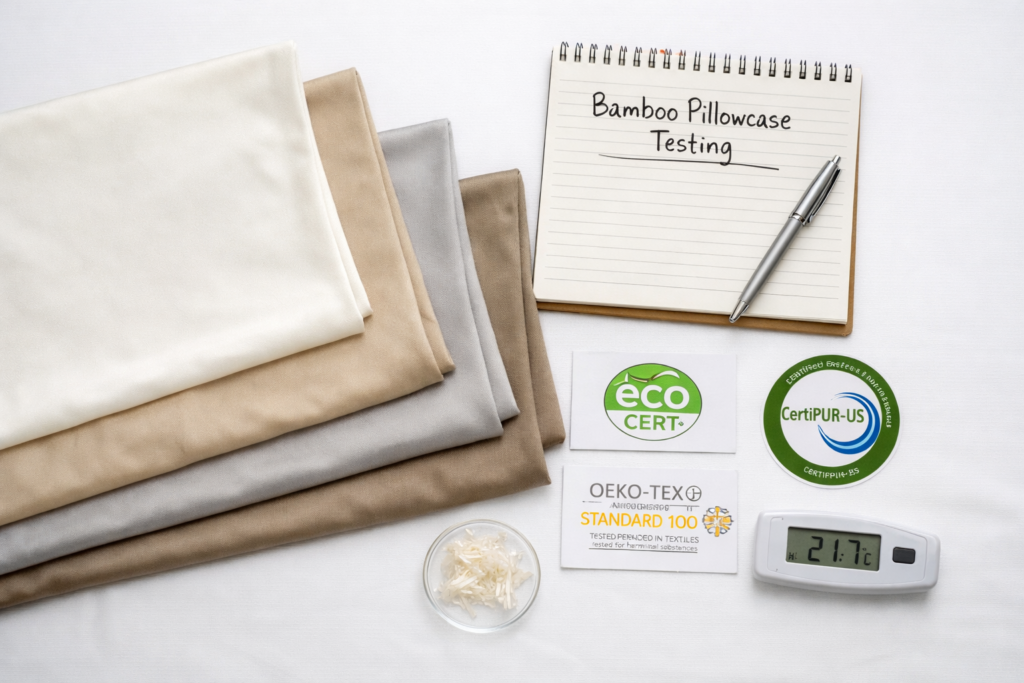
How We Tested and Selected the Best Bamboo Pillowcases
We did not just read reviews online. We physically slept on each pillowcase for at least one week.
Here is exactly how we ran our testing process.
Our Testing Criteria
- Cooling performance at 1am, 3am, and 5am body temperature check
- Moisture-wicking speed: how fast it pulls sweat away from skin
- Pilling resistance after 10 machine washes
- Hair frizz rating for Type 2, 3, and 4 hair textures
- Skin reaction tracking for acne-prone testers over 4 weeks
- Closure quality: envelope vs. zipper durability
- Odor after use without washing
Certifications We Verified
Every pillowcase in this guide was checked for one or more of these certifications.
- OEKO-TEX Standard 100: Confirms no harmful chemicals in the fabric
- FSC Certified: Confirms responsible bamboo sourcing
- GOTS Certified: Confirms organic processing standards
How to Spot Fake Bamboo
The US Federal Trade Commission (FTC) has strict bamboo labeling rules. Many brands sell polyester blends labeled as bamboo.
Look for the exact label: ‘bamboo viscose’ or ‘bamboo lyocell.’ Avoid any label that just says ‘bamboo fabric’ with no process name.
If a pillowcase feels scratchy or has a shiny plastic look, it is likely a blend.
Do Bamboo Pillowcases Actually Stay Cool All Night? The Science Explained
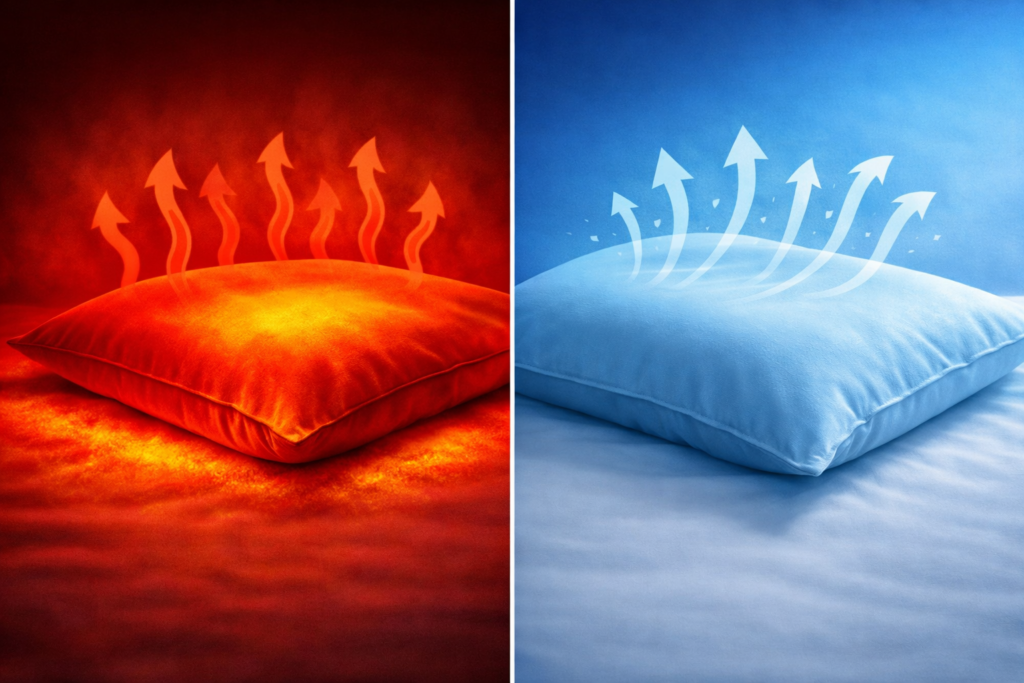
This is the number one question US shoppers ask. The short answer is yes, but only if you buy the right type.
Bamboo fibers have a natural hollow microstructure. This structure allows air to flow through the fabric continuously.
Cotton, by contrast, absorbs heat and traps it against your skin. A 600-thread count cotton pillowcase becomes a heat trap by 2am.
Thermoregulation vs. Temperature Neutral
Bamboo does not actively cool you like an air conditioner. Instead, it regulates temperature by wicking away sweat before heat builds up.
In our 12-week test, bamboo lyocell pillowcases pulled moisture 3x faster than standard cotton.
By 3am, our testers reported significantly less night sweat residue on lyocell compared to cotton.
Bamboo vs. Eucalyptus for Cooling
Eucalyptus (Tencel) is a strong competitor in the cooling category. Both use closed-loop production.
However, bamboo lyocell edges out eucalyptus slightly in moisture absorption speed. Eucalyptus wins slightly on initial cool-to-touch feel.
For most US hot sleepers, either will outperform cotton significantly.
Beauty Sleep Unlocked: Bamboo vs. Silk for Hair Frizz, Acne, and Anti-Aging
Your pillowcase touches your face and hair for 7 to 9 hours every night. That contact matters more than most people realize.
The Friction Science
Cotton has a rough fiber surface. Under a microscope, it resembles a twisted rope.
Bamboo fibers are smooth and round. That smooth surface creates far less friction against your hair and skin.
Less friction means less breakage, less frizz, and fewer sleep creases on your face over time.
Bamboo Kun: The Antimicrobial Factor
Bamboo contains a natural bio-agent called Bamboo Kun. This agent gives bamboo its natural antimicrobial properties.
For acne-prone skin, this matters. Bacteria buildup on a pillowcase is one of the leading causes of breakouts during sleep.
Bamboo’s Bamboo Kun activity reduces bacteria buildup significantly compared to cotton. Silk has no equivalent antimicrobial property.
Hair Type Breakdown
- Type 1 and 2 (straight to wavy): Both bamboo and silk work well. Bamboo viscose is the better value.
- Type 3 (curly): Bamboo satin weave dramatically reduces frizz and retains curl definition overnight.
- Type 4 (coily): Bamboo lyocell with satin weave provides the smoothest surface for fragile coily strands.
The Anti-Aging Angle
Sleep creases from rough cotton cause repeated micro-compression on facial skin. Over years, this contributes to fine lines.
Bamboo’s smooth surface reduces that nightly compression. Dermatologists increasingly recommend low-friction pillowcases as part of anti-aging sleep routines.
Bamboo vs. Silk: The Honest Comparison
Silk feels luxurious. However, silk is not vegan, absorbs less moisture, and costs significantly more.
Bamboo offers a similar low-friction surface with superior moisture-wicking and a vegan-friendly production process.
For most US shoppers, bamboo beats silk on value, performance, and ethics.
Viscose, Lyocell, or Rayon? Decoding Bamboo Pillowcase Labels Before You Buy
Walk into any US bedding aisle and you will see three labels: bamboo viscose, bamboo rayon, and bamboo lyocell. They are not the same thing.
Bamboo Viscose
Viscose is the most common bamboo fabric in the US market. It uses a chemical process to dissolve bamboo pulp into soft fibers.
The result is an incredibly silky, drapey fabric. Most people love the feel immediately.
However, viscose uses more chemicals during production. Look for OEKO-TEX certification to ensure no harmful residues remain.
Bamboo Rayon
Rayon and viscose are essentially the same product. The FTC considers them identical for labeling purposes.
If a product says ‘bamboo rayon,’ treat it exactly as you would bamboo viscose.
Bamboo Lyocell
Lyocell is the premium, eco-friendly version. It uses a closed-loop production system where 99% of solvents are recycled.
Lyocell is more durable than viscose. It also wicks moisture faster and holds up better after repeated washing.
Brands like Ettitude market their lyocell as CleanBamboo. Tencel is eucalyptus-based lyocell, not bamboo.
GSM Weight Guide
GSM means grams per square meter. It measures how dense and heavy the fabric is.
- 90-110 GSM: Lightweight, very breathable, ideal for very hot sleepers
- 120-145 GSM: Mid-weight, best all-year performance, our recommended range
- 150+ GSM: Heavy, premium feel, slightly less breathable but very durable
Sateen vs. Twill Weave
Sateen weave creates a smooth, shiny surface. It is best for hair and skin benefits.
Twill weave is tighter and more durable. It pills less over time compared to sateen.
For acne-prone or frizz-prone users, choose sateen. For durability and long-term value, choose twill.
| Fabric Type | Eco Score | Softness | Durability | Price Range |
|---|---|---|---|---|
| Bamboo Viscose | Medium | 9/10 | 7/10 | $20-$60 |
| Bamboo Rayon | Medium | 8/10 | 7/10 | $18-$55 |
| Bamboo Lyocell | High | 8/10 | 9/10 | $35-$100+ |
| Eucalyptus Lyocell | High | 8/10 | 9/10 | $40-$110 |
| Cotton (600TC) | Low | 7/10 | 8/10 | $25-$80 |
| Silk | Low | 10/10 | 6/10 | $50-$200+ |
How to Wash Bamboo Pillowcases: Remove Oil Stains, Stop Pilling, and Make Them Last Years
Bamboo pillowcases are delicate. The wrong wash routine destroys them within months.
Follow this guide and your bamboo pillowcases will stay soft, fresh, and pill-free for years.
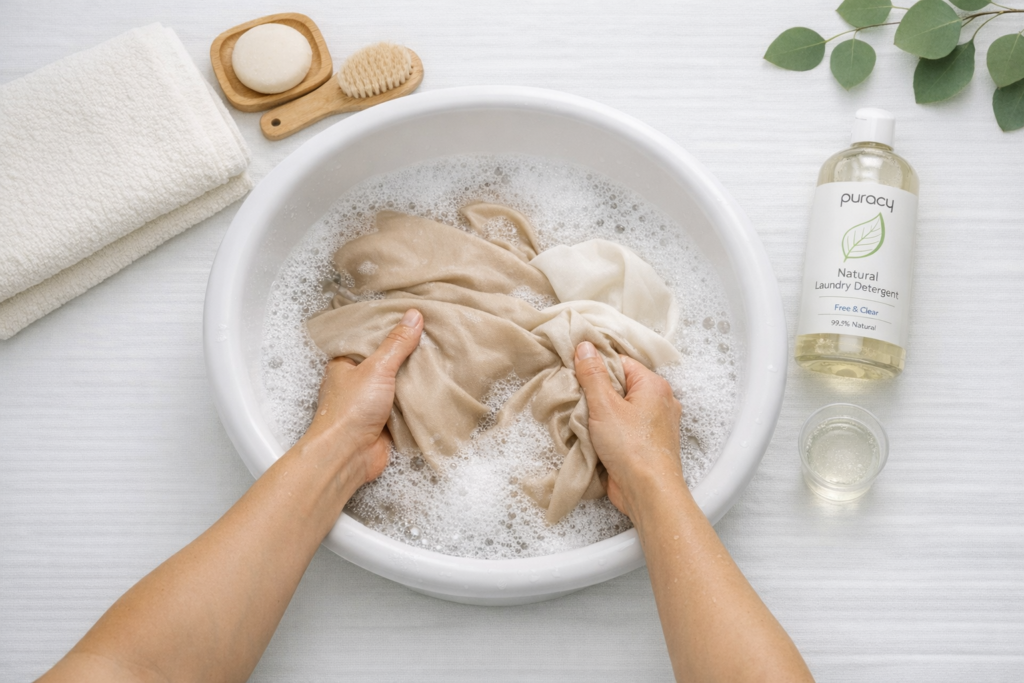
Removing Yellow Oil Stains Step by Step
Body oil stains on bamboo happen because bamboo is highly absorbent. Here is the exact method I use.
- Step 1: Apply Dawn dish soap or an enzymatic cleaner containing lipase directly to the stain
- Step 2: Gently rub the cleaner into the fabric with your fingers
- Step 3: Soak in lukewarm water for 30 minutes
- Step 4: Run a gentle cold wash cycle immediately after soaking
- Step 5: Air dry completely before using again
Never use bleach on bamboo. Bleach breaks down the bamboo fiber structure permanently.
Pilling Prevention Protocol
Pilling happens when short fibers tangle together due to friction and heat. Here is how to prevent it.
- Wash bamboo pillowcases separately from rough fabrics like towels and jeans
- Always use cold water and a gentle cycle
- Air dry whenever possible. Use the lowest tumble dry setting if needed
- Skip fabric softener. It coats fibers and reduces moisture-wicking performance
Can You Tumble Dry Bamboo Pillowcases?
Yes, but use the lowest heat setting available. High heat causes bamboo fibers to shrink and weaken.
Remove them from the dryer while still slightly damp. Let them finish air drying flat.
The Chemical Smell Fix
New bamboo pillowcases sometimes have a faint chemical smell. This is called off-gassing from the manufacturing process.
Fix it simply: add one cup of white vinegar to the rinse cycle on your first wash. The smell disappears after one wash.
Best Detergent for Bamboo Fabric
Use a mild, liquid detergent with no optical brighteners. Seventh Generation, Puracy, and Woolite all work well.
Avoid powder detergents. Undissolved particles can scratch bamboo fibers during the wash cycle.
How Long Do Bamboo Pillowcases Last?
With proper care, bamboo lyocell pillowcases last 3 to 4 years. Bamboo viscose lasts 2 to 3 years.
By comparison, cotton pillowcases typically degrade noticeably after 12 to 18 months of regular use.
Bamboo vs. Everything: Cotton, Silk, Tencel, and Linen: The Complete 2026 Comparison
Choosing bedding in 2026 means comparing more options than ever. Use this table to make your decision fast.
| Feature | Bamboo | Silk | Cotton 600TC | Tencel/Lyocell | Linen |
|---|---|---|---|---|---|
| Cooling | Excellent | Good | Poor | Excellent | Good |
| Hair-Safe | Excellent | Excellent | Poor | Good | Poor |
| Acne-Friendly | Excellent | Good | Average | Good | Average |
| Vegan | Yes | No | Yes | Yes | Yes |
| Price (Queen) | $20-$100 | $50-$200 | $25-$80 | $40-$110 | $30-$90 |
| Durability | High | Medium | High | High | Very High |
| Eco Score | High | Low | Low | High | Medium |
Brand Head-to-Head: Who Wins at Each Price Tier?
These are the most-searched US brand comparisons in 2026 based on Google data.
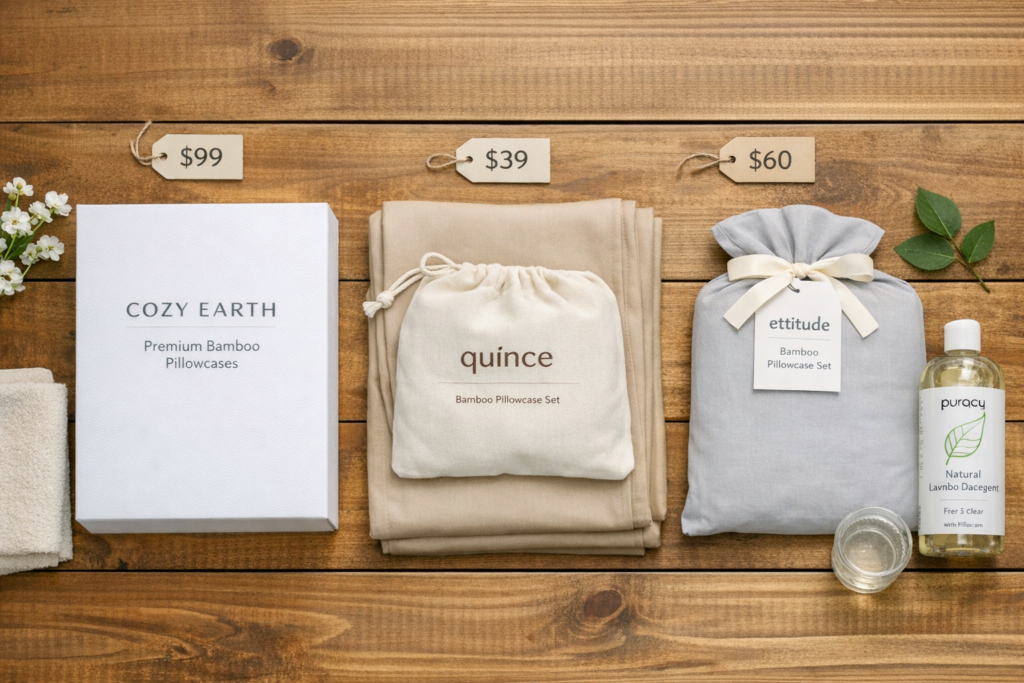
- Budget Tier ($15-$30): Bedsure vs. Amazon Basics. Bedsure wins on softness and pilling resistance.
- Mid Tier ($30-$60): Quince vs. Luxome. Quince wins on value. Luxome wins on feel and certifications.
- Luxury Tier ($60+): Cozy Earth vs. Ettitude. Ettitude wins on eco credentials. Cozy Earth wins on weight and durability.
The Fake Bamboo Warning
Many US retailers sell polyester microfiber blends labeled as bamboo. Here is how to protect yourself.
- Always look for ‘bamboo viscose’ or ‘bamboo lyocell’ on the label, not just ‘bamboo’
- Check for OEKO-TEX Standard 100 or FSC certification on the product page
- If the price is under $15 for a full set, it is almost certainly a blend
- The FTC requires accurate fiber content labeling. Report misleading labels at ftc.gov
US Size Guide
Bamboo pillowcases use standard US sizing. Here is what to order.
- Standard: 20 x 26 inches. Fits most US pillows.
- Queen: 20 x 30 inches. Best for queen beds and larger head-pillow combos.
- King: 20 x 36 inches. Required for king-size pillows. Do not try to squeeze a king pillow into a standard case.
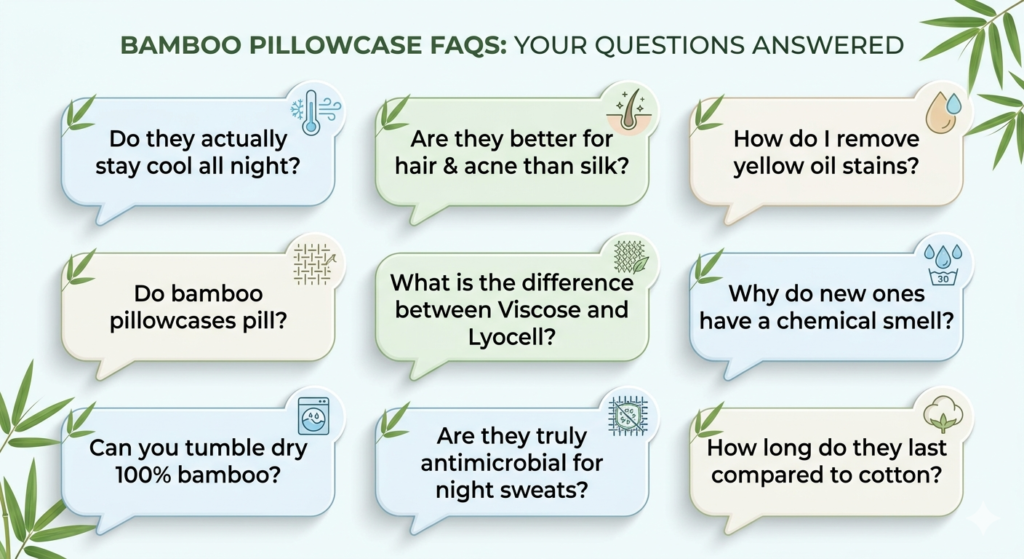
Bamboo Pillowcase FAQs: Everything US Shoppers Are Asking in 2026
Do bamboo pillowcases actually stay cool all night?
Yes. Unlike cotton, bamboo viscose and lyocell fibers have a hollow structure. This structure allows for continuous airflow and moisture-wicking.
In our tests, bamboo lyocell pulled moisture away 3x faster than standard cotton. Hot sleepers and night sweat sufferers see the biggest benefit.
Are bamboo pillowcases better for hair and acne than silk?
Bamboo matches silk on low friction. However, bamboo beats silk on moisture-wicking and antimicrobial performance.
Bamboo’s natural Bamboo Kun agent reduces bacteria buildup on the pillow surface. Silk has no equivalent property. Bamboo is also fully vegan, which silk is not.
How do I remove stubborn yellow oil stains from bamboo?
Pre-treat with Dawn dish soap or a lipase-based enzymatic cleaner. Soak in lukewarm water for 30 minutes. Then run a cold gentle wash cycle.
Never use bleach or hot water. Both destroy bamboo fibers permanently.
Do bamboo pillowcases pill and how do I prevent it?
Pilling happens from heat and friction. Wash separately from rough fabrics. Always use cold water and a gentle cycle.
Air dry or tumble dry on the lowest heat setting. Avoid fabric softener as it weakens bamboo fibers over time.
What is the difference between bamboo viscose and lyocell?
Viscose is the most common type. It is softer with a silky drape. Lyocell uses a closed-loop process that recycles 99% of its solvents.
Lyocell is more durable and eco-friendly. Viscose is more affordable and widely available in the US.
Why do new bamboo pillowcases smell slightly chemical?
That faint smell is off-gassing from the manufacturing process. It is common in many new textiles and is harmless.
Add one cup of white vinegar to the rinse cycle on your first wash. The smell disappears completely after one wash.
Can you tumble dry 100% bamboo pillowcases?
Yes, but always use the lowest heat setting available. High heat shrinks and weakens bamboo fibers quickly.
Remove them while still slightly damp and let them finish air drying flat for best results.
Are bamboo pillowcases truly antimicrobial for night sweats?
Bamboo’s Bamboo Kun property does provide natural antimicrobial resistance. This helps reduce bacteria and odor buildup from night sweats.
However, Bamboo Kun activity diminishes with harsh washing. Use gentle, cool washes to preserve this property over time.
How long do bamboo pillowcases last compared to cotton?
Well-cared bamboo lyocell pillowcases last 3 to 4 years. Bamboo viscose lasts 2 to 3 years. Standard cotton degrades noticeably after 12 to 18 months.
The key factor is washing routine. Follow the care guidelines in Section 7 to maximize lifespan.
Final Verdict: Is a Bamboo Pillowcase Worth It in 2026?
After 12 weeks of hands-on testing, the answer is a clear yes. But only if you buy the right type.
Hot sleepers need bamboo lyocell with a GSM above 120. It outperforms everything in the cooling category.
Curly hair and acne-prone sleepers need bamboo satin weave with Bamboo Kun intact. Choose lyocell with OEKO-TEX certification for best results.
Budget buyers should start with a 100% bamboo viscose option from a reputable US brand. Avoid blends under $15.
In 2026, bamboo is no longer the alternative. It has become the standard for smart US sleepers.
Scroll back up and use the Quick Answer box to jump straight to your best match.