
The short answer: A bamboo coffee table is a sound buy when the build is solid or thick laminated bamboo, the legs join firmly, and the top carries a sealed finish. Thin-panel and folding versions tend to wobble, mark, and carry little weight, so judge the build, the joints, and the stated load limit before ordering.
A search for a bamboo coffee table returns shops rather than guidance. Page one is mostly sellers, marketplaces, and roundups repeating one set of claims: bamboo is tough, resists scratches and water, harms nothing, and beats steel. Read the product notes on those same pages and the story flips: tops that mark or flake, legs that rock, load limits that forbid leaning, and fixings that baffle the buyer. The two halves cannot both hold, and the explanation is simple. One label covers several different builds, and the build governs nearly everything about how the table behaves once it is in a living room.
This guide separates the builds from each other: the materials used, how long they last, the weight they carry, the size to pick, whether they survive outside, how they mark, how they stand against wood and glass, what they cost, how to look after them, and whether the green claims survive scrutiny. Each claim is tested against the source named beside it, and when sources part ways, the split is shown rather than smoothed over.
Are bamboo coffee tables durable?
A well-built bamboo coffee table holds up well indoors, but the build, not the bamboo, decides that. Solid and strand-woven tables with locked joints can serve 15 to 25 years with care, while thin-panel and folding tables often rock, mark, and wear out within a few years.
The raw material is genuinely strong. Figures from the Wood Database, quoted by Woodworking Advisor, put bamboo culms at about 115 to 309 megapascals in tension, and, on the Janka scale, natural bamboo reads about 1,410 to 1,610, while red oak sits near 1,220. Strand-woven bamboo, where fibres are pressed into a dense block, tests harder still, often past 3,000 on the Janka scale, according to EngineerFix. Those figures belong to the material. They do not belong to every table carrying the bamboo name, because most cheap bamboo coffee tables use neither solid nor strand-woven bamboo.
Four builds cover most of the market. Solid bamboo uses thick boards or poles, and gives the strongest and heaviest table. Laminated bamboo glues thin strips into boards, which is how most mid-priced tables are made, and the result turns on the glue used, the strip thickness, and how it is finished. Strand-woven bamboo shreds the fibres and presses them with resin into a dense, very hard block, the hardest of the four builds. Thin-panel bamboo uses thin sheets over a light frame or hollow core, which is how most folding and flat-pack tables are made, and those are the tables buyers complain about most.
Buyer complaints follow the build, not the plant. Rocking tops the list in roundups and retailer reviews: folding tables that tremble in use, legs that rock when assembly is slightly off, and budget tables whose stability the same roundup questions. After that come tops that mark or flake, load limits below what buyers expect, and assembly trouble: awkward fitting, shelf pieces that refuse to line up, screws that fight the holes, and now and then hardware absent from the box. One Amazon buyer received a table with no screws or hardware at all, and was left with a table in pieces. These failures gather at the cheap end, exactly where thin panels and screw-held butt joints live.
The joints deserve more attention than most buyers give them. EngineerFix suggests testing for rock before buying and looking hard at how the legs meet the top: a mortise and tenon joint, a shaped peg seated in a matching hole, holds fast, while a butt joint held by glue or screws signals a lighter build. A table that rocks in the shop will rock more once it is home.
How long a bamboo coffee table lasts depends on the build and the care, and sources give ranges rather than one figure. Editorial estimates run from 5 to 15 years for ordinary tables, 15 to 25 years for quality solid bamboo kept indoors, and 5 to 7 years for budget flat-pack tables. No measured study gives one figure.
Mojo Boutique gives 5 to 15 years, placing quality pieces at the top of the range and weaker pieces at the bottom. Azula Designs gives 20 to 30 years for quality indoor bamboo furniture with proper sealing. Bamboo Furniture Talk puts indoor tables kept with care at 15 to 25 years, and budget bamboo at 5 to 7. WoodenStreet gives 10 to 15 years or more. None of these rests on a measured study; each is an editorial estimate. The fair reading is that a good solid or laminated bamboo table, indoors and maintained, serves for years, while a cheap flat-pack bamboo table offers only a short life. The site’s own bamboo furniture coverage shows the same split: our bamboo flooring guide puts strand-woven bamboo with the hardest surfaces available, and the same hardness logic applies to a strand-woven tabletop.
Are bamboo coffee tables good quality?
Quality in a bamboo coffee table rests on three things: the build, the joints, and the finish. A good table is built from solid or thick laminated bamboo, and its joints fix the legs firm, with a sealed finish. A poor one pairs thin panels with screw-held butt joints and a finish that marks at the first wet glass.
Begin with the material specification, the most useful detail on a listing and the one most listings omit. A useful listing names the build, solid, laminated, or strand-woven, and states a thickness. A listing that says only bamboo, with no build detail, leaves you guessing, and the guess usually goes against you. Test whether the top is a solid board or a thin panel over a frame: tap it, lift it, and study the edge. A thin edge with a visible hollow core means a thin-panel table.
Next, the joints and the legs. Legs fixed with a single screw each will loosen with use, and most rocking starts there. Mortise and tenon joints, dowelled joints, and corner blocks all hold better than butt joints. Where the table carries a lower shelf, look at how it fastens: a shelf slotted into the legs outlasts one held by small screws alone. Give the table a gentle sideways push on a flat floor. Any rocking now grows worse once books and mugs sit on it.
Then the finish. Slide a hand over the top. The sealed finish feels smooth and firm, and water beads on it. A thinly finished or unsealed top feels dry and slightly rough, and it marks the first time a wet glass rests on it. The finish also governs cleaning: a sealed top wipes clean, while an unsealed one turns every spill into a stain, which the water section below covers in full.
One more check before buying: confirm the table is really bamboo. Some listings headed bamboo coffee table sell wood with bamboo-style trim. LOOMLAN, for instance, lists a Chelsea House Sheraton table under that heading that is really wood with faux bamboo accents. Vintage listings mix real bamboo, faux bamboo, rattan, and bamboo-style metal. The product name proves nothing. The materials list does.
What styles of bamboo coffee tables are there?
Bamboo coffee tables come as rectangular, round, and oval tops, in two-tier and nesting sets, with glass tops, and as low folding or floor tables. Let the room pick the shape: rectangular for a long sofa, round or oval where people pass the corners, nesting sets for small rooms, and a lower shelf where the room needs storage.
Rectangular tables are the default and the simplest to size, because the two-thirds rule below works straight off the sofa length. Round and oval tables fit smaller rooms and homes with children, since no corners jut into walkways, but they offer less surface for their footprint, so they suit a reading chair or a small sofa better than a long three-seater. Two-tier tables add a lower shelf for books, remotes, and throws, the handiest extra a coffee table can carry in a small living room. Nesting sets provide a small table that slides beneath a larger one, for rooms that sometimes want a second surface and sometimes do not.
Glass-top bamboo tables call for a separate decision. The bamboo frame brings the look and the light weight, and the glass brings a hard surface that wipes clean and does not ring. The glass should be tempered, which runs 4 to 5 times stronger than annealed glass, and the usual thickness is 3/8 inch (10 mm), with 1/4 inch (6 mm) for small tables and 1/2 inch (12 mm) for large ones, according to EngineerFix. Check that the glass rests on rubber bumpers rather than straight on the bamboo: with no bumpers it rattles, slides, and marks the frame. Several roundups report glass tops that mark easily and feel delicate under heavy use, so a glass top trades easier cleaning against a surface that still wants care.
Folding and floor tables sit at the lightest end of the range. Low Japanese-style tables work as laptop desks and tea tables, and folding tables pack away when the room wants the space. Both are light-duty by design, with the lowest load limits and the most rocking in the range. They serve well as second tables, and poorly as the only table.
How much weight can a bamboo coffee table hold?
A bamboo coffee table holds only what its own build allows, and the figures found run from 66 pounds for a folding camping table to 150 pounds for an indoor table, with a two-tier table rated at 110 pounds on top and 50 pounds on its shelf. Check the stated capacity before you buy.
The roundups that praise bamboo coffee tables for load-bearing trip over themselves in the next sentence. Storables says yes to its own question, then straight away warns against extremely heavy objects. The product notes tell the truth: one table is not suitable for leaning or putting heavy weight on, another carries a limited weight capacity, and a third may not suit heavy items because of its limits. The material is strong. The products differ, and the joints and the top thickness settle what a given table carries, not the word bamboo.
The capacities stated for real tables in the research behind this guide follow. Read each as a specification for that product only, not as a general rule for bamboo.
| Table | Weight limit stated |
|---|---|
| TelTopia folding bamboo coffee table | 150 pounds maximum |
| Sophia and William bamboo coffee table | 110 pounds on top, 50 pounds on the shelf |
| Debenhams 2-tier bamboo and glass coffee table | 50 kg on the tabletop, 5 kg on the shelf |
| Debenhams Gymax boho table | 50 kg top, 20 kg shelf |
| KingCamp BamAura 4Fold 6040 camping table | 66 pounds (30 kg) |
| Ameriwood Home Parsons bamboo coffee table | 50 pounds on the tabletop |
Two points stand out in that table. First, the spread is wide: 50 pounds at the low end against 150 pounds at the high end, a threefold gap between tables sold under one name. Second, the shelf always rates far below the top, usually half or less, so the lower shelf suits books and throws, not heavy objects. Folding tables sit at the light end by design, and buyers overload them most often, because a folding table looks sturdier than it is.
The working rule is plain. A listing with no weight capacity means a light-duty table. A listing with one deserves belief, so stay under it, because the figure already allows for the joints, the weak point of the table. Never lean on a coffee table, and never stand or sit on one: the limits above cover static loads spread over the top, not a person putting full weight on one edge.
What size coffee table do I need?
Size the table to the sofa, not the room. The table should run half to two-thirds as long as the sofa, sit level with the seat or up to 2 inches lower, and stand 12 to 18 inches away from the sofa. A typical table measures 48 by 24 inches and stands 16 to 18 inches high.
Length matters most, because a table too long crowds the room and a table too short looks lost. Measure the sofa first, then take two-thirds: a 72-inch sofa takes a table about 48 inches long, and a 90-inch sofa takes one about 60 inches long. The table should reach at least half the sofa length, or it reads as a side table that wandered into the middle of the room. For a loveseat the same rule scales down: a 48-inch loveseat takes a table about 32 inches long. Round and oval tables measure by diameter, and the same two-thirds rule applies.
A coffee table should sit level with the sofa seat or up to 2 inches lower, which for most sofas means 16 to 18 inches high. A table much lower than the seat is awkward to reach, and a table higher than the seat crowds the knees. Measure the seat height first, then shop to that number.
The clearance rule is the one buyers forget. Leave 12 to 18 inches between table and sofa: space for legs, and near enough to reach a mug without standing. Beyond 18 inches the table drifts out of reach; under 12 inches the room feels cramped. Keep enough room to pass the table without turning sideways, which usually means at least 30 inches of walkway around it. For exact dimensions by table type, The Size gives a full coffee table dimensions guide, including standard sizes in centimetres.
One more sizing mistake deserves naming: buying the table before measuring the rug. A coffee table half on and half off a rug will rock, and a table smaller than the rug looks stranded. The table should sit wholly on the rug or wholly off it, with the rug running a few inches past the table on every side. Measure the rug, the sofa, and the walkways before ordering, since listings photograph tables in large rooms that shrink every table.
Can I use a bamboo coffee table outdoors?
Bamboo coffee tables belong indoors. A covered patio or veranda works only when the table is sealed and covered while not in use, but open-air use cuts its life short. Bamboo left outside untreated usually lasts up to 2 years, while a treated table holds on for about 5, before fading, splintering, and rot take hold.
Moisture and sun together do the damage. Bamboo soaks up water, swells, and then contracts as it dries, and that cycle leaves boards cracked, split, and warped. Sunlight bleaches the colour and dries the surface, which brings splintering. Rain finishes the job: standing water seeps into the joints and the end grain, and decay sets in. Bambrise states the figures plainly: untreated bamboo furniture left outside usually gives up within 2 years, and treated pieces hold on for about 5. Thanh Cong Craft paints the same picture: untreated bamboo under direct sun and rain usually lasts under two years.
A covered patio is another matter, and the one outdoor use that makes sense. Modish Store advises against keeping bamboo furniture in the open outdoors, but allows a covered veranda, patio, or balcony out of direct sun and rain, with a waterproof cover while not in use. Storables gives the same advice: bamboo resists insects and moisture, yet long exposure to harsh weather damages the table, so indoors or a covered outdoor area is best. For a covered patio, seal the table first, keep it away from direct rain and sun, cover it while not in use, and bring it indoors for winter or long wet spells. Thanh Cong Craft advises a fresh seal every 5 or 6 months for bamboo left in sun and rain.
Buyers who are let down outdoors usually start from listings that call bamboo tables waterproof and eco-friendly with no qualification. Someone who leaves a table on an uncovered patio after reading that claim will see warping, fading, and rot inside two years, and the table is not to blame: it is an indoor bamboo table used outdoors. When a table must live outside, buy one built for outdoors, in teak, metal, or resin, and keep the bamboo table in the living room.
Does a bamboo coffee table scratch easily?
Most bamboo tabletops mark easily, and after wobble that is the complaint buyers raise most. The roundups that call bamboo scratch-resistant undercut themselves, since their own product notes list surfaces that mark or flake unless handled with care. Strand-woven bamboo stands apart, being far harder than ordinary laminated bamboo.
The contradiction is plain once you look for it. HomeGardenHelp and Storables both name resistance to scratches and dents as a bamboo benefit. Then their own product notes say the opposite: one tabletop is not very durable and may scratch or chip easily, another is prone to scratches if not careful, and a third has a glass top that may scratch easily. Pixelfy repeats the same warning. Greenington’s care manual, written by a maker of solid bamboo furniture, puts it plainly: lift objects to avoid scratches, and never drag or slide anything across the surface. That is the honest rule, and it covers every bamboo tabletop that is not strand-woven.
The practical protection is dull and it works: coasters beneath every mug and glass, placemats beneath plates and hot dishes, felt pads beneath anything heavy, and lifting objects instead of sliding them. The guide to making bamboo coasters sets out an easy way to build a set that matches the table, since a coaster costs less than refinishing a top. The same rule guards the finish against heat: a hot mug or dish set straight on the top can mark it, so add a trivet next to the coaster.
Rings from glasses are the other common mark, and the cause is the same: a wet glass left resting on the surface. Midhill, in its guide to lacquered bamboo care, says white rings appear once a wet glass has sat on the surface for over 15 minutes, and heat over 80 C can blister lacquer in a few seconds. A white ring is moisture caught in the finish, not harm to the bamboo, and it often fades by itself as the finish dries. Prevention is the fix: wipe spills straight away, never let a wet glass sit on the top, and keep coasters close to every seat.
Will a bamboo coffee table warp? A sealed table in a stable indoor climate resists warping, but an unsealed or damp table can warp, swell, crack, or split as it takes in water and dries again. The finish and the room humidity matter more than the bamboo itself, so keep spills wiped up and the room near 50 percent humidity.
Is bamboo furniture waterproof? No, bamboo is not waterproof. Bamboo has a natural silica layer that lends some water resistance, but processing usually wears that layer away, and the table resists water only as well as its finish does. Spills wiped at once do no harm, while standing water will mark, swell, and warp the top.
That last point deserves stating plainly, because it is the most common misunderstanding in the topic. Bamboo is not waterproof, and no bamboo coffee table is waterproof. The finish does the protecting: a sealed, lacquered, or oiled surface that keeps water out of the bamboo below. The same logic covers other bamboo surfaces around the home, which is why the bamboo cutting boards guide calls for sealing and oiling: an unsealed bamboo board soaks up water and warps, and an unsealed bamboo table behaves the same, only slower. Greenington’s own care manual tells owners to clean spills immediately, use coasters and trivets, and keep the table out of direct sunlight day after day. A listing that calls a bamboo table waterproof is selling the finish, not the bamboo.
Is bamboo better than wood for a coffee table?
Bamboo beats wood on renewability and weight, and wood beats bamboo on scratch resistance and longevity. The bamboo table is the lighter of the two at the same size, and its plant regrows in a few years. Oak and maple stand up to scratches better and last longer, so the right material turns on what the table must survive.
The comparison follows, with the figures as the sources actually state them.
| Property | Bamboo | Wood (oak, maple) | Glass |
|---|---|---|---|
| Renewability | Matures in 3 to 5 years, then regrows from the roots | Hardwoods need 20 to 100 years to mature | Sand-based, energy-intensive to make, fully recyclable |
| Weight | 30 to 40 percent lighter than the same size in solid hardwood (Midhill) | Heavy; a solid oak or maple table is hard to shift alone | Heavy for its size; tempered glass adds weight |
| Scratch resistance | Marks easily, apart from strand-woven bamboo, which is very hard | Stands up to scratches better; sands and refinishes well | Scratches easily; fingerprints show on every surface |
| Water resistance | Not waterproof; the finish decides it; spills need wiping at once | Sealed hardwood handles spills well; bare wood stains | Waterproof surface; rings are not an issue |
| Stain resistance | Poor on unsealed tops; white rings from wet glasses | Good when sealed; stains if the finish wears through | Excellent; nothing soaks in |
| Lifespan | 5 to 15 years is normal; good solid bamboo indoors can reach 25 | Decades; oak and maple tables often pass down the generations | Frame decides lifespan; glass itself lasts indefinitely |
| Price | Folding tables near 90 to 95 dollars; solid bamboo runs to several hundred | At the same size, solid hardwood usually costs more | Wide range; tempered glass adds cost |
| Care | Dust, wipe with a damp cloth, dry at once, always use coasters, keep humidity 40 to 55 percent | Dust, wipe with a damp cloth, re-oil or re-wax now and then | Glass cleaner and a cloth; check the frame, not the glass |
| Best use | Bright rooms, small spaces, rented homes, buyers who value renewability | Family rooms, hard everyday use, homes keeping furniture for decades | Modern rooms, easy cleaning, homes that want a wipeable surface |
Two things to note about the table. First, the weight figure, that bamboo runs 30 to 40 percent lighter than the same size in solid hardwood, is Midhill’s, a Singapore furniture maker, and appears here credited to that source. The lifespan figures are where the sources part ways most: the bamboo figures are an attributed editorial range rather than a measured one, while hardwood’s claim of decades is the long-settled pattern for oak and maple furniture. Pick the material by the use: bamboo suits a light table for a bright room, hardwood suits the table that must stand up to children, dogs, and daily use for decades, and glass suits the home where easy cleaning counts most.
Bamboo and rattan get mixed up, and listings blend them freely. Rattan is a vine that is woven, light and bendy, and it goes into chairs and panels. Bamboo is a hollow stem of grass, used as poles and boards, and in a table it is solid and stronger than rattan. A rattan coffee table is not a bamboo coffee table, whatever the listing calls it.
How much does a bamboo coffee table cost?
No one price covers a bamboo coffee table, since the price tracks the build. Budget folding tables sell near 90 to 95 dollars, solid bamboo tables run to several hundred dollars, and vintage designer pieces average about 2,000 dollars on 1stDibs. What the price buys is thicker bamboo, stronger joints, and a harder finish, not a name alone.
The price points observed in the research behind this guide show how broad the range runs. At the budget end, the Nnewvante bamboo coffee table listed at 91.19 dollars and the Garvee at 94.99 dollars, both as of 2026-11-11, and both are folding or flat-pack tables. At the other end, vintage bamboo coffee tables on 1stDibs average 2,157 dollars, with the lowest at 10 dollars and the highest at 32,500 dollars, and McGuire bamboo coffee tables average 1,900 dollars, typically 550 to 5,600 dollars. Between those poles lies the ordinary retail band: solid bamboo tables from furniture makers, which run to several hundred dollars, though no reliable survey fixes one mid-range figure, and this guide makes up none.
The money goes into the build, and the gap is worth spelling out, because the distance between a 90-dollar table and a 900-dollar table is not branding. A cheap table means thin-panel bamboo, screw-held butt joints, a thin finish, and flat-pack assembly whose hardware sometimes never arrives. A dear table means bamboo that is solid or strand-woven, joints that are mortise and tenon, and a hard sealed finish, and it arrives already assembled or with only the legs to fit. A mid-priced table means decent-thickness laminated bamboo, dowelled joints, and a sealed finish, which most buyers will find the best value: it stands up indoors and does not rock on day one.
Cost per year of use beats the price on the tag. A 90-dollar folding table that wobbles and scratches in its first year is worse value than a 400-dollar laminated table that serves ten years indoors. Judge by cost per year, not by the price on the tag, and cost per year turns on the build, the joints, and the care. The cheapest table suits only light, short-term use: a spare room, a rented flat, or a first home. The mid-priced table suits the living room the household lives in day to day.
How do I clean and look after a bamboo coffee table?
A bamboo coffee table needs a soft cloth, barely damp, with a little mild soap when needed, then drying at once. The top must never be soaked, and bleach, abrasive cleaners, and dragging objects stay off it. Keep the room at 40 to 55 percent humidity, and give the top fresh oil or sealant once water stops beading.
Each rule rests on a reason. Bamboo takes in water, swells, then shrinks as it dries, which brings cracking, splitting, and warping, so the top stays dry and spills get wiped straight away. Chemical cleaners and bleach eat at the finish and the bamboo beneath, so mild soap and water are all the table needs. Silicone polish leaves a film that makes later refinishing harder, so it stays off the table. Dragging objects over the top scores the finish, and that finish is the only barrier keeping water out, so objects get lifted, not slid. Humidity counts because dry air shrinks bamboo and damp air swells it: Greenington’s care manual says holding relative humidity between 40 and 55 percent cuts down sharply on checking or warping, and EngineerFix suggests 50 to 60 percent, so around 50 percent is the practical target.
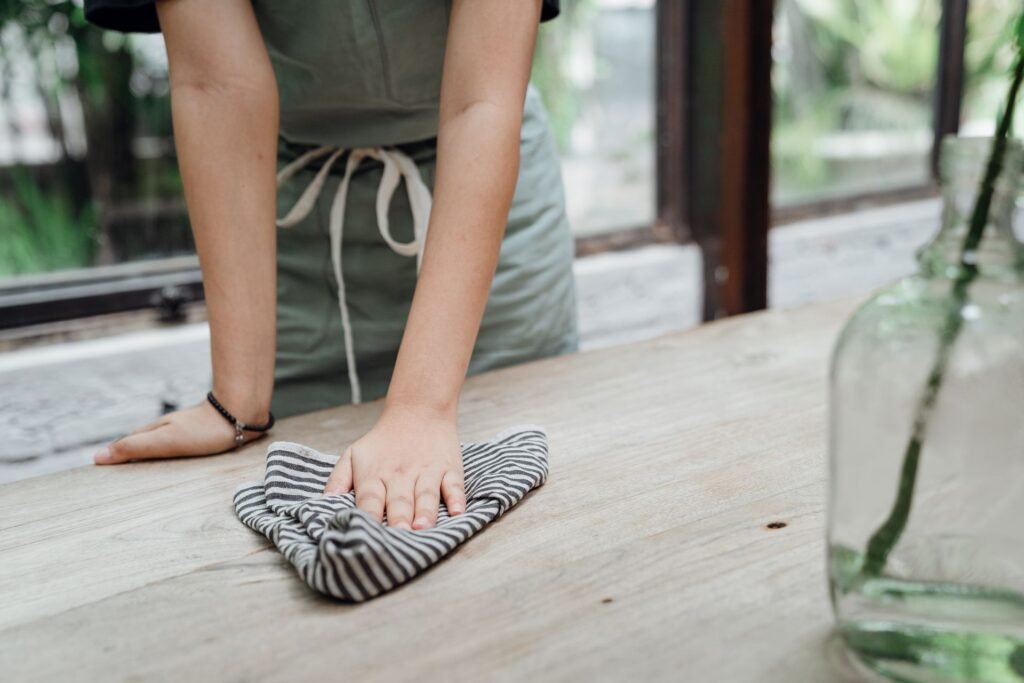
A short routine covers it: dust once a week with a dry, soft cloth, then wipe marks with a cloth barely damp and a drop of mild soap, then dry straight away with a second cloth, and put coasters and trivets under everything on the table so the routine stays rare. The same care logic fits every bamboo surface in the home, since the material is the same: our bamboo cutting boards guide covers the same wipe-damp-and-dry routine for boards, and the guide to cleaning bamboo flooring covers the same rules for floors, with the same warnings against soaking and strong cleaning agents.
Re-oiling and re-sealing are upkeep, not repairs. An oiled bamboo top needs another coat of oil once water stops beading, which for a table used daily means about once or twice a year. A lacquered top goes longer between re-seals, yet a damaged spot cannot be fixed the way an oiled top allows: damaged lacquer means refinishing the whole top. Bamboo Furniture Talk gives 50 to 150 dollars every couple of years for re-sealing, a single-source figure to read as a rough guide, not a price. The finish also fixes the colour: natural bamboo goes darker with age and sun, and carbonized bamboo, heated until it turns a darker brown, is a finish, not a different species. Our carbonized bamboo guide sets out the difference and the rooms each finish suits.
Two habits to avoid: leaving the table in strong sunlight day after day, which bleaches and dries the surface, and leaving it in a damp room or by a damp wall, which makes the boards swell and the joints loosen. Both are warned against in the Greenington manual, and both cause the slow damage that shows up months later, a crack or a wobble with no clear cause. A table kept indoors, away from direct sun, at steady humidity, with spills wiped at once, lasts.
Is bamboo a sustainable choice for furniture?
The bamboo plant is sustainable, but the finished table is only as green as its glue and finish. Bamboo reaches maturity in 3 to 5 years and shoots again from its roots with no replanting needed. Laminated bamboo, however, is bonded with formaldehyde-based resins, so seek out FSC-certified bamboo and a low-formaldehyde finish before calling any table eco-friendly.
The facts about the plant are strong and undisputed. Bamboo reaches maturity in 3 to 5 years, while hardwoods need 20 to 100 years, and it grows back from the same root system after cutting, with no replanting. That is the green story told on every bamboo product page, and it holds true as far as it goes. The catch is that the plant and the product are different things. A laminated table is strips of bamboo glued together, and the glues in common use are formaldehyde-based resins. MDPI published a 2026 comparison of adhesives for glued laminated bamboo: PVA, urea-formaldehyde, and polyurethane are the adhesives named, and the resins that hold up best under load and damp, urea-formaldehyde with its melamine and phenol-modified forms, give off formaldehyde, an indoor-air pollutant that is regulated. A second MDPI study from 2026 adds that many engineered bamboo products still rely on petrochemical adhesive systems, above all urea-formaldehyde, phenol-formaldehyde, and melamine-urea-formaldehyde. Both papers are linked below, and both explain why this guide will not label a laminated bamboo table eco-friendly without qualification.
One check actually works for a buyer: certification. Seek out FSC certification, which audits where the bamboo came from, and ask the seller which adhesive and finish went into the table. FSC-certified bamboo plus a low-formaldehyde adhesive plus a water-based finish adds up to a defensible eco choice. No certification and no answer about the glue adds up to a claim nobody has verified. Solid bamboo needs less glue than laminated bamboo, and strand-woven bamboo is bound with resin as well, so the same question follows it too.
One more eco claim to set aside: bamboo furniture does not come free of chemicals by default, and the no pesticides or fertilizers claim on product pages has no verification in the research behind this guide. Commercial bamboo plantations use inputs in some regions, and no source traced the claim to a farming standard or a study. Put honestly: the plant grows fast and renews itself, the real environmental cost sits with the glue and the finish, and only certification settles the claim.
What do I check before buying a bamboo coffee table?
There is no one best bamboo coffee table, since the right choice turns on the room, the sofa, and the use it will get. Start with the material specification, then the joints, the finish, the stated load limit, and the return policy. Any table that passes all five checks is worth buying at any price.
The checklist follows, in the order that counts.
First, the material specification. The listing should name the build, solid, laminated, or strand-woven, and state a thickness. A listing that says only bamboo, or a materials list that says wood with bamboo-style detailing, is a reason to walk away. Look at the top edge for a hollow core, which signals thin-panel construction.
Second, the joints. A mortise and tenon joint or a dowelled joint outlasts a butt joint held by screws. Test the table with a gentle sideways push on a flat floor: rocking now means worse rocking at home. Look at how the lower shelf fastens, and confirm each leg attaches with more than one screw.
Third, the finish. Slide a hand over the top: the sealed finish feels smooth and firm, and water beads on it. Find out whether the finish is lacquer or oil, since an oiled top allows spot repairs and a lacquered top does not. Judge the colour in daylight rather than in a photograph, because it often differs a little from the pictures.
Fourth, the stated load limit. No figure on the listing means a light-duty table. A figure on the listing deserves belief, so keep under it. Check the shelf limit on its own, because it usually runs far below the top, and keep in mind that the figures cover static loads spread over the top, not leaning or standing on it.
Fifth, the glass, when the table has a glass top. The glass should be tempered, 3/8 inch thick for a standard table, and resting on rubber bumpers. Check that bumpers are included: several roundups report glass tops arriving without them, which leaves the glass rattling and scratching the frame.
Sixth, the assembly. Most budget bamboo coffee tables arrive flat-packed and need putting together, and some need two people or arrive with hardware missing, so read the instructions and count the parts before you start. Solid bamboo tables from furniture makers often arrive assembled or need only the legs attached.
Seventh, the return policy. A seller that takes back an assembled table is backing its quality claim with money. A seller that refuses returns on assembled furniture asks you to trust its word. Measure the sofa, the rug, and the walkways before ordering, and hold the table to those numbers when it arrives, before the return window closes.
What sellers claim, and what the evidence supports
Steel beats bamboo outright, and bamboo beats steel only by weight. In tension, bamboo culms reach 115 to 309 megapascals, while mild steel reaches 400 to 550, so steel wins outright on absolute strength. Per unit of weight, bamboo leads on strength, which is why the claim survives, yet a bamboo table is no stronger than steel.
Bamboo coffee table marketing carries a full set of claims, and most of them fail a check. The popular ones follow, each with a verdict.
| Claim | Verdict | Why |
|---|---|---|
| “Stronger than steel” | Misattributed | Holds only as strength-to-weight. Bamboo culms test at 115 to 309 MPa in tension, against 400 to 550 MPa for mild steel, so steel is far stronger outright. |
| “Waterproof” | Not supported | A natural silica layer gives bamboo some water resistance, but processing usually damages it. The finish protects the top, and standing water harms it. |
| “Scratch-resistant” | Not supported | The roundups making this claim list surfaces that mark or flake easily in their own product notes. Strand-woven bamboo stands apart as the exception. |
| “Excellent load-bearing capacity” | Unverified as a blanket claim | Load limits belong to the individual table, not to the material. Observed figures run from 50 pounds to 150 pounds, a threefold spread. |
| “Needs no pesticides or fertilizers” | Unverified | It is marketing copy repeated without a study or a farming standard behind it. Commercial bamboo plantations use inputs in some regions. |
| “Global bamboo market $98.7 billion by 2027” | Unverified | Stated as “market research indicates” with no firm, report, or link named. The underlying report was not located. |
| “Lasts almost 19 years” / “up to 50 years” | Unverified | Both figures appear on blogs with no source behind them. Use the sourced ranges instead: 5 to 15 years is typical, and quality solid bamboo indoors can reach 25. |
| “Bamboo kun makes it naturally antibacterial” | Not supported | No test, paper, or standard is cited for furniture. The same claim for bamboo textiles was found not supported in the site’s earlier socks research. |
| “Lightweight and easy to move” | True, with one exception | Most bamboo tables run 30 to 40 percent lighter than the same size in solid hardwood, per Midhill. Solid bamboo pieces can still be heavy, and some need two people to assemble. |
| “Eco-friendly bamboo” | Needs qualification | The plant grows fast and renews itself. Laminated bamboo is bonded with formaldehyde-based resins. Seek FSC certification and a low-formaldehyde finish. |
A pattern runs through these verdicts: the claims that flatter bamboo are usually marketing lines, repeated with no test, standard, or method behind them. The figures that come from standards and measured data, tensile strength, Janka hardness, per-product load limits, outdoor lifespan, mostly show a smaller advantage than the marketing promises. That does not make bamboo coffee tables bad. It makes the marketing unreliable, which is why this guide rests on the verifiable numbers and marks the rest as claims.
What real users found
We did not test these tables ourselves, and this guide makes no claim that we did. What follows is what real buyers reported after living with bamboo coffee tables, drawn from Amazon and Wayfair reviews, retailer review pages, and hands-on review blogs. Each finding names its source, and the links go to the page where the buyer wrote it.
Wobble is the complaint buyers raise most often. One Amazon buyer of an eHemco bamboo-leg coffee table set wrote that both tables were really wobbly because the legs did not fit the hardware they came with, and screws had worked their way out onto the floor within days. A Wayfair buyer of a solid wood coffee table with a bamboo frame reported the same, writing that the legs were a little wobbly. Pixelfy, summarising buyer feedback on the Nnewvante folding table, notes that it may wobble or shake slightly in use. Sources: Amazon reviews quoted on desertcart (eHemco table); Wayfair review page.
Scratches come second. The same eHemco buyer wrote that the surface gets scratches pretty easily, and warned not to put keys on the table. A buyer of the Tiita rattan and bamboo glass-top table wrote that it arrived scratched in a couple of spots, though not badly enough to return. Pixelfy reports that the Nnewvante tabletop is not very durable and may scratch or chip easily if not handled with care. Sources: Amazon reviews quoted on desertcart (eHemco table) and desertcart (Tiita table); Pixelfy.
Assembly trips buyers up more than the instructions suggest. An Amazon buyer of a Bamworld table reported that the package arrived with no screws or hardware at all, leaving a deconstructed table. A Furniture Wave buyer wrote that the screws were very difficult to drive into the holes, and a washer was lost in transit while a bracket arrived damaged. Accio, analysing Amazon reviews of Japanese-style bamboo folding tables, found difficult assembly and poor build quality the most common complaints. Sources: Amazon review quoted in our research; Furniture Wave review quoted in our research; Accio trend analysis of Amazon reviews.
Weight limits surprise buyers who expect a coffee table to take a lean. The e-a-a roundup warns that the Koyasiry table is not suitable for leaning or putting heavy weight on, and Storables flags the Nnewvante table for limited weight capacity. One HOOBRO buyer wrote that the bolts do not stay tight, so the table is often wobbly. The pattern matches the capacities in this guide: the build sets the limit, not the bamboo. Sources: e-a-a; Storables; Amazon reviews quoted on ShopAbunda (HOOBRO table).
Not every report is a complaint. A buyer of the Buffalo Tools folding bamboo table wrote that it is well made, with components of good quality, and that the four legs adjust for length. A buyer of a bamboo folding floor table wrote that the top layer had split slightly with daily use, yet the table still held up strong and was worth the price. Pixelfy, after using the Bamboo54 handmade coffee table for a few weeks, called it well-constructed and solid. The satisfied buyers almost all bought thicker, solid, or well-braced tables. Sources: Amazon reviews quoted on desertcart (Buffalo Tools table) and desertcart (folding floor table); Pixelfy.
The pattern across these reports matches this guide: wobble, scratches, and low weight limits cluster in thin, folding, and flat-pack tables, while solid and well-braced tables draw the satisfied reviews.
Frequently Asked Questions
Are bamboo coffee tables suitable for outdoor use?
Only in a covered area, never out in the open. Bamboo coffee tables belong indoors. A covered patio or veranda is acceptable when the table is sealed and covered while not in use. Untreated bamboo left outside usually gives up within 2 years, and a treated table holds on for about 5, before fading, splintering, and rot take hold.
Can bamboo coffee tables support heavy objects?
It turns on the individual table, not on bamboo as a material. Capacities stated for real tables run from 50 pounds to 150 pounds, with shelves rated far below tops. Check the stated capacity of the table you are buying, keep below it, and never put weight on a coffee table by leaning or standing.
How do I maintain a bamboo coffee table?
Dust once a week with a dry, soft cloth, then wipe marks with a cloth barely damp and a little mild soap, then dry straight away. Use coasters and trivets, lift objects rather than dragging them, hold the room at 50 percent humidity, and give the top fresh oil or sealant once water stops beading on the surface.
Is a bamboo coffee table a sustainable choice?
As a plant, yes: bamboo reaches maturity in 3 to 5 years and shoots again from its roots with no replanting needed. As a finished table, the glue and the finish decide it. Laminated bamboo is bonded with formaldehyde-based resins, so seek out FSC-certified bamboo and a low-formaldehyde finish before calling it eco-friendly.
Can bamboo coffee tables be assembled easily?
Most budget tables arrive flat-packed and need putting together, and some call for two people or arrive with hardware missing. Read the instructions and count the parts before you start. Solid bamboo tables from furniture makers often arrive assembled or need only the legs attached.
What are the benefits of bamboo coffee tables?
Bamboo tables weigh less than hardwood tables of the same size, the plant regrows in 3 to 5 years, and the warm natural look suits bright rooms. The trade-offs are marking, water sensitivity, and a shorter life than hardwood. The benefits are real, but they are weight and renewability benefits, not durability benefits.
What makes bamboo a good material for a coffee table?
Bamboo is strong for its weight, lighter than hardwood, and fast-growing, which makes it a good material for a light, bright, modern coffee table. What makes a good coffee table is not the material alone: it is the build, the joints, and the finish. A well-made bamboo table is a good table; a thin-panel one is not.
What is the standard size of a coffee table?
A typical rectangular coffee table measures 48 by 24 inches and stands 16 to 18 inches high. The table should run half to two-thirds as long as the sofa, sit level with the seat or up to 2 inches lower, and stand 12 to 18 inches from the sofa. Measure the sofa first, then shop to those numbers.
What is the standard coffee table height in cm?
The standard coffee table height is 41 to 46 cm, which is 16 to 18 inches. The height should sit level with the sofa seat or up to 5 cm lower. A table much lower than the seat is awkward to reach, and a table higher than the seat crowds the knees.
How long does bamboo furniture last?
It turns on the quality and the care. Editorial estimates put typical bamboo furniture at 5 to 15 years, quality solid bamboo indoors with care at 15 to 25, and budget bamboo at 5 to 7 years. No measured study gives a single figure, so the range is the honest answer, not one number.
Are there tea tables made of bamboo?
Yes. Low Japanese-style bamboo tables are made for tea, and they double as laptop desks and floor tables in small rooms. They are light-duty by design, with low load limits, so they suit a second table or a quiet corner, not a main living-room coffee table.
What type of wood is best for a coffee table?
It turns on the use. Oak and maple suit heavy daily use and long life, because they resist scratches and can be refinished. Bamboo suits a light table in a bright room where weight and renewability count. Glass suits rooms where easy cleaning counts most.