
The short answer: Clumping bamboo grows in tight, slowly widening clusters and is considered non-invasive, making it the safer choice for most gardens. Running bamboo spreads through long underground rhizomes that can travel far, so it needs a root barrier or a large space. The difference is the rhizome: short and curved for clumpers, long and straight for runners.
Bamboo has the most confusing reputation of any garden plant. Some gardeners plant it and get a gorgeous evergreen screen within a few seasons. Others get a decade-long war with underground stems that pop up under the fence, in the lawn, and in the neighbor’s flower bed. Both stories are true, and the difference almost always traces back to one choice: clumping or running.
This guide explains that choice the way it actually works. Not the nursery slogan version, and not the fear version. Just the rhizome science, the honest pros and cons, what containment really costs, and how to tell which type you are looking at before you plant it.
What is the difference between clumping and running bamboo?
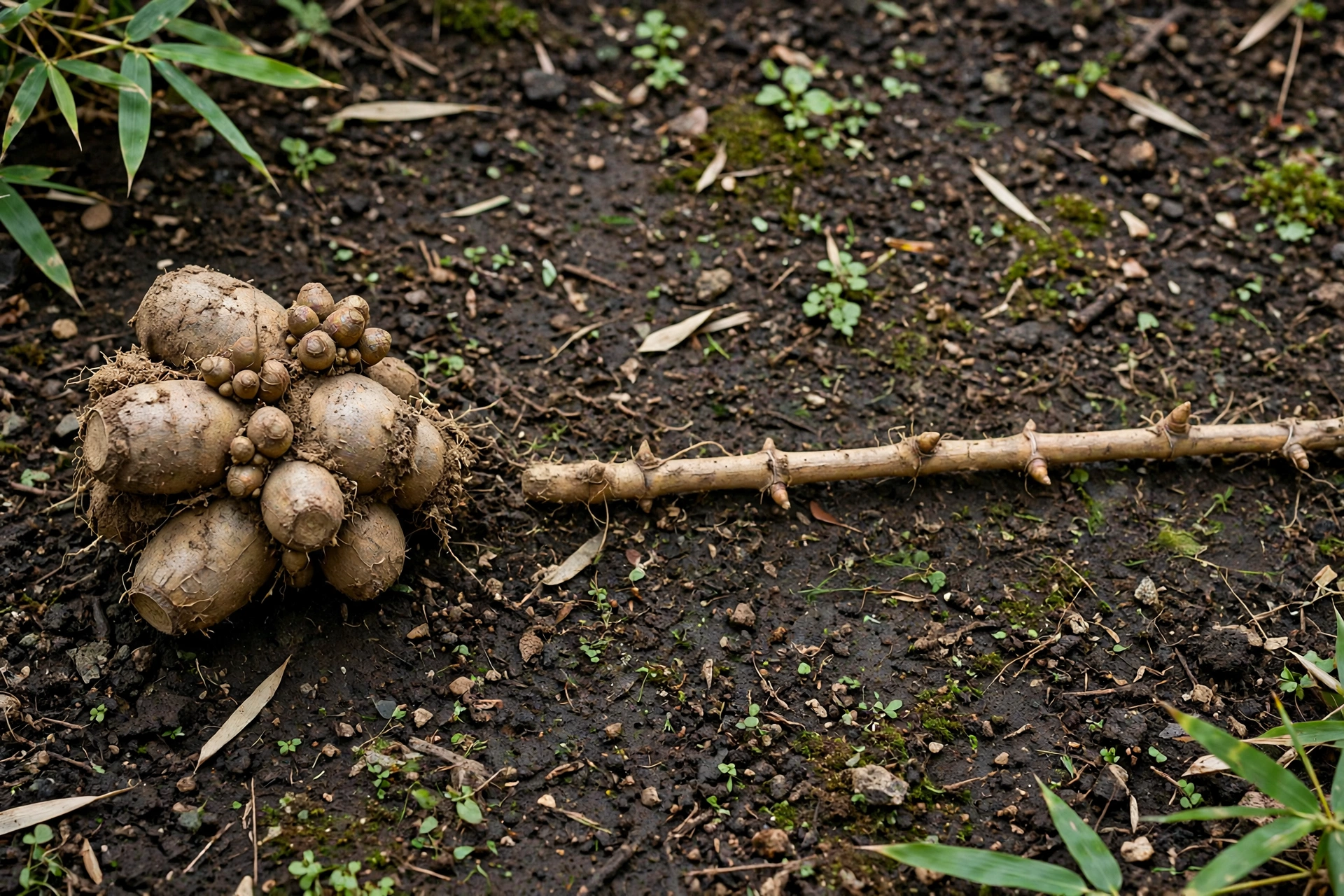
Everything about bamboo behavior comes down to what happens underground. A rhizome is an underground stem, not a root. It has nodes and internodes just like the culms above ground, and it is the part of the plant that decides where each new shoot will emerge. Botanists describe two rhizome systems, and they behave like different plants.
Clumping bamboo grows from short, thick rhizomes that curve upward almost immediately. Each new culm emerges right next to the parent, so the plant builds a tight, dense clump that widens slowly around the same central point. Botanists call this the pachymorph (“thick form”) and sympodial growth pattern. Because each rhizome tip turns upward to become a culm instead of continuing to travel, the clump has a defined edge. The GuaduaBamboo rhizome guide notes that most clumping bamboo reaches a certain footprint, usually around 10 to 20 feet across, and then simply stops spreading outward.
Running bamboo grows from long, thin rhizomes that push horizontally through the soil, sprouting new culms from buds along their length as they go. This is the leptomorph (“thin form”) and monopodial pattern. There is no built-in stopping mechanism: the rhizome keeps extending year after year and throws up culms wherever it finds soil. The University of Maryland Extension puts it bluntly: running-bamboo rhizomes “can run indefinitely unless damaged at the growing tip” (UMD Extension, “Containing and Removing Bamboo”).
Here is the comparison side by side:
| Feature | Clumping bamboo | Running bamboo |
|---|---|---|
| Rhizome shape | Short, thick, curved (pachymorph) | Long, thin, straight (leptomorph) |
| Growth pattern | Sympodial: each tip turns up into a culm | Monopodial: rhizome travels, culms sprout from side buds |
| Spread habit | Defined clump that widens slowly | Open-ended spread through soil |
| Typical depth | Top 60 cm of soil | Top 10 to 30 cm of soil |
| Primary climate | Tropical and subtropical (with one big exception, below) | Temperate |
| Barrier needed? | No | Yes, or lots of room |
| Maintenance | Low | High: inspection and root pruning |
The depth rows in that table come from the GuaduaBamboo rhizome guide. Notice something counterintuitive: the aggressive spreader is the SHALLOW one. Most running-bamboo rhizomes stay in the top 10 to 30 cm of soil, which is exactly why containment is possible at all. That fact shapes everything in the barrier section below.
A note on the jargon, since you will meet all of it in bamboo literature: pachymorph versus leptomorph describes the SHAPE of the rhizome, while sympodial versus monopodial describes its BEHAVIOR. In practice they pair up exactly (pachymorph equals sympodial equals clumping; leptomorph equals monopodial equals running), so “clumping vs running” is all you need for garden decisions. Keep the Latin terms in your back pocket for reading genus descriptions.
How can you tell which type you have?
Knowing the science is one thing. Standing in your yard looking at a bamboo that might have come with the house is another. Here are the practical tests, from easiest to most certain.
Look at the shoot spacing. A clumper’s new shoots come up within the footprint of the existing clump, close to the parent culms. A runner’s new shoots appear scattered, sometimes well away from the visible plant. If fresh shoots are popping up several feet from the nearest culm, you are looking at a runner.
Dig a small test hole. Push a hand trowel into the soil about 15 cm deep, a foot or two from the base. Long, thin, straight rhizomes heading away from the plant mean running. Short, thick, curved pieces clustered near the base mean clumping. Because running rhizomes live shallow, you will usually find the answer within a few minutes of gentle digging.
Check for sulcus grooves. The most common running bamboo genus, Phyllostachys, has a distinctive mark: a narrow indentation (a sulcus groove) running along the internodes between the joints, alternating sides at each node. The Bambu Batu running vs clumping guide calls it the easiest identification clue in bamboo: if you find the groove, you almost certainly have a Phyllostachys, and therefore a runner. No groove does not prove you have a clumper (plenty of other runners lack it), but it rules the most common suspect in or out.
Read the nursery tag, and keep it. The scientific name is the only identification you can fully trust. Bambusa, Fargesia, Dendrocalamus, or Chusquea on the tag means a clumper. Phyllostachys, Pseudosasa, Sasa, or Pleioblastus means a runner. If the label only says “bamboo” with no scientific name, do not buy it until the seller can tell you the genus. That one habit prevents most bamboo disasters.
A common source of confusion: many plants sold as indoor “bamboo” are not bamboo at all. Lucky bamboo is Dracaena sanderiana, a totally different plant. If what you are trying to identify is a houseplant in a vase of water, see our lucky bamboo care guide first, because the clumping versus running question only applies to true bamboo.
Which bamboo is better for a privacy screen?
This is the question that splits the bamboo world in two, and the honest answer is: it depends on how much time and work you are willing to trade.
Running bamboo closes a gap fastest. Nothing in the plant world builds an evergreen screen as quickly. Because the rhizome system expands outward aggressively, a runner fills the space between plants far sooner than a clumper, and the culms tend to grow upright and dense, which is exactly what you want for a vertical screen. Lewis Bamboo, which has sold bamboo for decades, argues that runners make the better screen even in narrow urban sites, and that clumpers disappoint: narrow at the base, weeping over at the tops, with gaps between plantings. That is worth quoting honestly, because it comes from long experience (Lewis Bamboo, “Clumping vs Running Bamboo”). It is also worth noting that Lewis Bamboo sells running bamboo, so the recommendation aligns with their catalog. A second nursery, Bambu Batu, lands in the middle: runners do fill in faster, but clumpers like Bambusa multiplex hedge just fine with proper spacing and the right species choice.
Clumping bamboo screens without the risk. A clumper never sends a rhizome under your fence, so you can plant it exactly where you want it and forget about containment. What it costs you is speed and density. The clump fills a circle, not a row, so a hedge of clumpers has a slightly scalloped edge, and it takes longer to reach full density. For most homeowners planting within a few feet of a boundary, the trade is worth it: a screen that takes one more season to close beats a screen that eats the neighbor’s lawn.
The real deciding factors:
- Space to the property line. If you have less than about 15 to 20 feet of clearance to a fence, foundation, or septic field, plant clumping bamboo or install a serious barrier with a runner. This is not an official number; it is a judgment call drawn from how far rhizomes are documented to travel, and it is the single most common mistake.
- Time pressure. Need a screen next year? Only a runner can do it, and only with containment installed on planting day, not “eventually.”
- Willingness to maintain. A running-bamboo screen is a system: barrier plus annual inspections plus root pruning. If that sounds like a chore you will skip, do not plant a runner.
- Climate. In zones 8 and warmer you have great clumping screen options. In cold zones the cold-hardy clumper Fargesia is the exception (more on that below), and runners are the default choice.
One more consideration if the screen sits where pets roam: true bamboo is on the safe list. Our own bamboo and cats guide confirms that the ASPCA lists true bamboo (Phyllostachys aurea) as non-toxic to cats, dogs, and horses. Whatever screening type you choose, check the scientific name against that list before planting.
Which bamboo is better for a small garden?
Clumping bamboo, and it is not close. A small garden has no margin for error: the plant will sit near a fence, a patio, a path, or a neighbor. Clumping bamboo expands slowly outward from a fixed center, so the footprint you plant is essentially the footprint you keep, just wider each year. Most sources put the mature width of a clump at roughly 10 to 20 feet across, and many species stay well under that.
Running bamboo in a small garden is a design mistake that shows up in year three, not year one. The nursery plant looks like a tidy pot of canes. Underground, the rhizomes are already exploring. Bambu Batu describes the pattern well: in the first year the plant “sleeps,” in the second it “creeps,” in the third it “leaps.” By the time you notice shoots in the flower bed, the rhizome network that made them is already much bigger than the visible plant.
That said, small gardens can host runners successfully in one arrangement: inside a properly installed rhizome barrier with annual inspection, exactly as described in the containment section below. It is a commitment, not a one-time installation.
Is clumping bamboo really non-invasive?
Mostly yes, but the word “non-invasive” does more work than it should. Here is the honest version.
University extension sources consistently describe clumping bamboo as non-invasive. UMD Extension writes that clumping bamboos are “considered non-invasive,” and their pachymorph rhizomes produce dense, compact root systems with no long-distance spread. For the dense tufted clumpers, the kind most gardeners buy (think Bambusa multiplex or Fargesia), this is exactly right.
But there are three wrinkles worth knowing.
First, the two-type model is a simplification. Some clumpers are “open clumpers” with long-necked rhizomes that send new culms a meter or more from the parent before turning upward. Guadua angustifolia is the textbook example: the recorded distance between a mother culm and a new shoot ranges from 0.85 to 1.70 meters (GuaduaBamboo rhizome guide). From above ground, an open clumper can look suspiciously like a runner. The difference is that it still keeps a defined perimeter and stops expanding, but if you buy an open clumper expecting a two-foot footprint, you will be surprised.
Second, some authorities list clumping genera among invasives. The University of Maryland lists invasive bamboo in four genera: Phyllostachys, Pleioblastus, Pseudosasa, and, notably, Bambusa. That last one is a clumping genus. The point is not that your Bambusa hedge will invade the neighborhood; it is that “clumping” alone is not a magic word. Species, climate, and local regulation all matter. In Maryland, two species are currently regulated by the Department of Agriculture: Golden Bamboo (Phyllostachys aurea) and Golden Groove Bamboo (Phyllostachys aureosulcata).
Third, laws are catching up. In 2023 Maryland passed a bill (HB0090) authorizing counties and municipalities to regulate invasive bamboo, including prohibiting a person from planting it or allowing it to grow without proper upkeep and containment. Whether or not your state has such a law, the trend is clear: planting a known spreader with no containment is becoming a legal question, not just a gardening one. Check your local ordinances before planting any runner.
The myth-busting bottom line: clumping bamboo is the responsible default, but “clumping” is a description of the rhizome, not a certificate of harmlessness. Buy named species, check the scientific name, and know whether your variety is a tight clumper or an open one.
How do you stop running bamboo from spreading?
This is the most important section of the article for anyone who already owns running bamboo or is determined to plant it. Here is the part most guides bury: a rhizome barrier does not stop rhizomes. It redirects them. Extension sources are explicit about this. The barrier’s job is to turn the rhizome upward so it emerges from the soil where you can see it and cut it. UMD Extension’s guidance is worth reading in full before you dig anything (UMD Extension, barrier section).
Here is what a proper barrier installation looks like, combining the university guidance with experienced nursery practice:
- Depth. UMD Extension recommends a 30- to 36-inch wide roll of material, sunk so the buried portion sits below the shallow rhizome zone. NC State Extension says at least 18 inches deep for standard situations. Commercial nurseries like Lewis Bamboo give zone-based guidance: 24 inches in colder zones (4-7) for bamboo up to about 25 feet tall, 30 inches for larger timber bamboo, 36 inches in hot zones (9-11) or sandy soils. If you cannot name your species or its mature height, use the deeper row for your zone.
- Above ground. Leave 6 to 8 inches of the barrier (or at least a couple of inches, per NC State) above the soil line. This is the inspection strip: rhizomes that hit the barrier and climb over it will be visible here, and you cut them. Soil and leaf litter can build up against the inside of the barrier and let rhizomes walk over, so keep this strip clean.
- Material. Minimum 60 mil (thousandths of an inch) high-density polyethylene (HDPE) or polypropylene. Go to 80 mil for mature or vigorous colonies. Avoid wood, thin plastic, concrete, and sheet metal; they develop holes and fail over time.
- Installation angle. Install the barrier vertically or tilted slightly outward at the top, never angled inward toward the bamboo. A barrier tilted inward steers rhizomes downward, where they dive under it.
- Seams. Overlap the ends generously and clamp or join them securely. Any gap is an escape hatch.
- The alternative method: a trench. Digging a trench around the colony and leaving it exposed lets you see and cut rhizomes as they cross. It only works if no rhizomes are already established outside the line, and an ax or mattock is the right tool for cutting them.
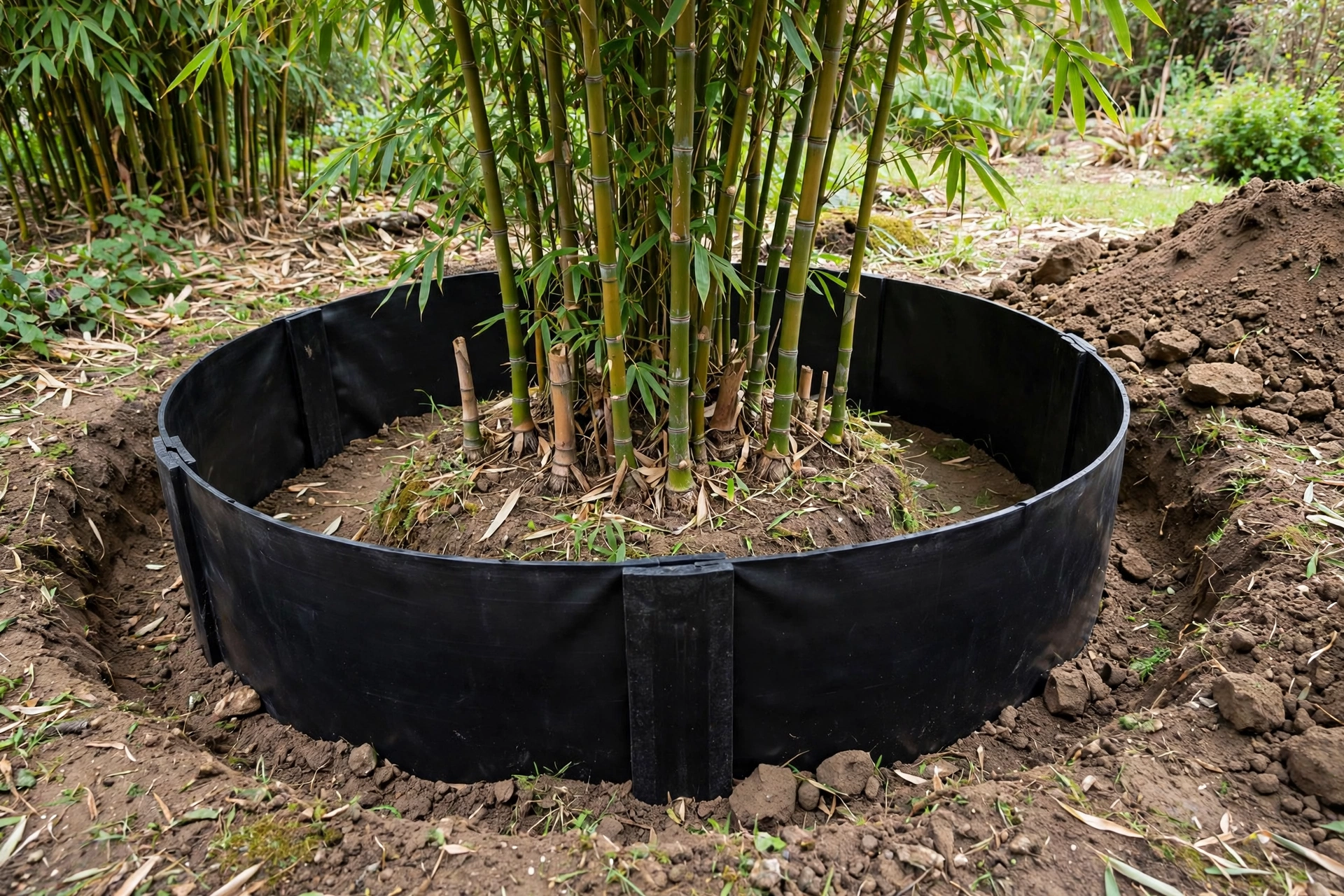
And now the part people skip: the barrier is a system, not a one-time fix. NC State Extension recommends inspecting the barrier line once or twice a year and removing any visible rhizomes. Clemson Extension notes that barriers “reflect” rhizomes rather than stopping them. No barrier is permanent. If you install a barrier and never inspect it, you have bought yourself a false sense of security, not containment.
The container myth. A popular piece of advice says to just plant running bamboo in a pot. UMD Extension is blunt: growing running bamboo in a container is not a viable long-term alternative, because the rhizomes escape through the drain holes and eventually break the pot walls themselves. Above-ground planter boxes with a proper barrier design are a different thing; a standard nursery pot is not.
Retrofitting a barrier around an existing planting is a bigger job. If the bamboo is already in the ground and spreading, installing a barrier now means trenching through an active rhizome network, cutting every rhizome that crosses the trench line, and removing or killing everything outside it. The University of Maryland guidance is explicit: no depth stops a rhizome that is already outside the barrier. Do the outside cleanup first, then trench, then install. The best time to install a barrier is planting day; the second-best time is this weekend.
What does NOT work. Cutting the culms down without dealing with the rhizomes. The plant stores enormous energy underground, so cutting the visible stems just triggers a flush of new shoots, often MORE of them. One Ask Extension case from Maryland tells the story: a homeowner hired a crew that chopped the culms but left the roots, and the bamboo grew straight back. Eradication means removing or starving the rhizome system, which takes years, not an afternoon.
Can you remove running bamboo once it has spread?
Yes, but it is a project, not a weekend task. UMD Extension lays out the honest options.
Starvation by cutting. Continually removing the foliage deprives the plant of photosynthesis, forcing it to spend its underground energy reserves on re-sprouting. New shoots appearing in spring can be kicked over while tender; later in the season you will need loppers or a saw. The catch: the process takes years, and any shoots growing outside your control (a neighbor’s side, a hidden corner) keep feeding the rhizome system and undo your work.
Rhizome excavation. Faster but far more disruptive. Cut the culms, then dig out the rhizomes with hand tools or hire a contractor with a mini-excavator. Any missed fragment can re-sprout, so you follow up by cutting new shoots at soil level as they appear. For large patches, check whether your local government requires an excavation permit, and use erosion control near water.
Chemical control, as a last resort. UMD Extension recommends non-selective systemic herbicides (glyphosate is one example) applied with care, since they will damage any desirable plant the spray touches. Bamboo leaves are waxy, so a spreader-sticker helps the spray adhere. Near wetlands or open water, use only products labeled for that environment.
Start with the neighbor. Most spreading-bamboo problems are really neighbor problems. You cannot fully remove bamboo that is spreading from an adjacent property without the landowner’s cooperation. Talk to them early, bring the extension resources, and offer to share the cost of a barrier or removal. In Maryland and a growing number of other places, the law now gives you backup: the 2023 Maryland bill lets local governments require proper upkeep and containment, and several other states have similar rules or permit requirements.
Which is more cold-hardy, clumping or running bamboo?
The general rule is: runners are the cold-hardy ones. Running bamboo is temperate bamboo, native to places like central China and Japan where winters bring snow and frost. Bambu Batu’s tropical versus subtropical guide puts it plainly: temperate (running) bamboo typically tolerates freezing winters and temperatures near or below 0 F. That is why, historically, most of the bamboo you could grow in the northern US was running bamboo.
But the general rule has the most famous exception in all of bamboo gardening: Fargesia. This genus of clumping bamboo is native to the Himalayan foothills, belongs to the temperate Arundinarieae tribe, and tolerates temperatures of -10 to -20 F, depending on the species. Fargesia murielae (umbrella bamboo) is hardy to about -20 F. Bambu Batu calls Fargesia the glaring exception to the rule that clumpers are warm-climate plants, and in parts of Europe and Canada, where there are no native bamboos, Fargesia is the most popular ornamental bamboo there is.
There is a trade-off, and it matters: Fargesia dislikes heat. In zones 7 and warmer, especially with hot humid summers, it struggles and often fails. Bambu Batu’s genus guide notes that these plants prefer cool summers and often grow better in shade. So the cold-climate clumper is real, but it is not a universal answer; it is a cool-climate specialist.
Meanwhile the warm-climate clumpers (most Bambusa species, Dendrocalamus, Guadua) are the opposite: superb in zones 9 to 11, marginal in zone 8, and dead in a hard freeze. A few Bambusa varieties tolerate the low 20s F, which is why they work across the Deep South, Southern California, and Florida.
The honest summary:
| Type | Typical cold tolerance | Example |
|---|---|---|
| Running (temperate) | Often near or below 0 F | Phyllostachys aurea |
| Clumping (cold-hardy) | -10 to -20 F | Fargesia murielae |
| Clumping (subtropical) | 20s F, some to about 20 F | Bambusa textilis |
| Clumping (tropical) | Above freezing, most not hardy below about 30 F | Dendrocalamus asper |
Do not treat this table as a planting permit. Within every genus, species and cultivars differ, and microclimates (wind exposure, snow cover, soil moisture) shift the real limits. Use it to narrow the list, then check the specific variety’s rating.
How do you propagate clumping vs running bamboo?
The rhizome difference decides this too.
Clumping bamboo: division. Because the rhizome mass is compact, the most reliable way to make a new clumper is to dig up part of a mature clump and divide it. Only divide well-established plants (Bambu Batu suggests waiting until the plant is 4 or 5 years old), work in early spring as new shoots emerge, and keep each division watered until it settles. This method preserves the parent’s traits exactly.
Running bamboo: rhizome cuttings. The plant’s spreading habit becomes your advantage. Cut sections of rhizome with several nodes and buds, lay them horizontally in soil, and keep them moist. Bambu Batu calls this the easiest and most reliable propagation method for runners, and it is the reason Phyllostachys aurea is one of the cheapest bamboos in every nursery: it practically propagates itself.
Culm cuttings: the tropical clumper option. For warm-climate clumpers like Bambusa and Dendrocalamus, stem cuttings taken from young culms can root surprisingly well, especially in humid conditions. Running bamboo generally does not respond to this method.
Seed: the hard road. Most bamboo species flower only once in decades, and some take a human lifetime. Seed propagation is possible but impractical for home gardeners, so bamboo is almost always propagated vegetatively in the nursery trade.
Once you have your new plant, the rest of the process (planting depth, watering, feeding) is covered in our complete guide to growing bamboo. The type decides the containment; the care is mostly the same.
Which bamboo genera are clumping and which are running?
A cheat sheet, because this is the question every nursery tag answers. Genus determines rhizome type, and within a genus every species shares the same growth habit.
| Type | Typical cold tolerance | Example |
|---|---|---|
| Running | Phyllostachys | The classic runner; ~50 species; sulcus grooves identify it; includes Golden Bamboo (P. aurea) and Yellow Groove (P. aureosulcata) |
| Running | Pseudosasa | Arrow Bamboo (P. japonica); medium-sized ornamental |
| Running | Sasa | Dwarf ground-cover types, Japanese origin; vigorous spreaders |
| Running | Pleioblastus | Mostly dwarf, small in stature but quick to spread |
| Running | Arundinaria | Three species native to the US Deep South; vigorous runners |
| Clumping | Bambusa | 100+ species; tropical to subtropical; includes Seabreeze (B. malingensis) and B. textilis |
| Clumping | Dendrocalamus | Giant timber bamboos, to 100+ feet; tropical |
| Clumping | Fargesia | Cold-hardy clumper, to -10 or -20 F; dislikes heat and humidity |
| Clumping | Guadua | Open clumper; new shoots 0.85 to 1.70 m from the parent |
| Clumping | Chusquea | Solid culms; mixpodial habit, unusual even among clumpers |
| Clumping | Himalayacalamus | Himalayan foothills; colorful cold-hardy species |
Keep this table on your phone when you shop. If the tag names any genus in the top half and your garden is small or near a boundary, either walk away or buy a barrier on the same trip.
What real users found
We did not test these bamboos ourselves. What follows is what real gardeners reported after planting clumping and running bamboo, with the source for each finding.
Reddit gardener, barrier defeated: A gardener who planted running bamboo seven years ago installed a black ground barrier, a fence, and cinderblocks to hold it back, but the barrier failed and shoots now grow in both his yard and his neighbor’s. Commenters agreed containment rarely holds once rhizomes escape. The Cool Down
Reddit user, golden bamboo revenge: A Texas homeowner planted Golden Bamboo against his fence after a neighbor refused to redirect a blinding security light. Within six months the light was hidden behind a bamboo screen, within a year the neighbor complained it was spreading into his yard, and two years after the owner sold, the whole backyard was bamboo. TwistedSifter
Reddit user, fifteen years of spread: One gardener posted a photo of bamboo planted fifteen years earlier and wrote that it got out of control so fast, despite family warnings. A neighbor replied that sharp shoots invaded their lawn for years and walking barefoot was not fun, and one commenter gave up and moved house instead. The Cool Down
Mumsnet gardener, Fargesia surprise: A gardener bought Fargesia murielae, five feet tall after four years, after being assured it was non-invasive and planted it straight into the ground. Three years later its roots were creeping everywhere and breaking through paving, so they installed a root barrier and said it would have been easier at planting time. Mumsnet
UBC forum gardener, Fargesia screen: A gardener who needed screening fast chose clumping bamboo, specifically Fargesia Rufa, after comparing options. They report it is evergreen, cold hardy, grows incredibly quickly, and because it clumps there is no need to maintain the roots to stop it spreading, which is why it beat cedar hedges for speed. UBC Botanical Garden Forums
UK Reddit user, fence damage: A homeowner reported that a neighbor’s bamboo grew through the fence and under the ground, pushing up the block paving drive, while soil piled against the fence rotted the posts. Respondents said the neighbor is legally liable for damage caused without a root barrier and advised a letter before action. OK! Magazine
Frequently asked questions
How far does running bamboo spread per year?
It varies enormously by species, climate, and soil. Extension sources document rhizomes running “a hundred or more feet” from the parent in established colonies (UMD Extension), and established stands are known to reach neighboring yards. The GuaduaBamboo rhizome guide records Phyllostachys bambusoides extending its rhizome network 4 to 6 meters per growing season. Do not trust any single number you read; the honest answer is “fast enough that you contain it before you plant it.”
How deep should a bamboo barrier be?
It depends on your climate and the bamboo’s size. UMD Extension recommends a 30- to 36-inch roll of 60-mil (or thicker) HDPE or polypropylene, with 6 to 8 inches above ground. NC State Extension gives a minimum of 18 inches deep. Nursery guidance scales it by zone: about 24 inches in colder zones for bamboo up to 25 feet tall, 30 inches for larger bamboo, and 36 inches in hot zones or sandy soils. When in doubt, go deeper.
Can running bamboo damage foundations?
It can damage structures, though usually indirectly. Extension sources document rhizome systems pushing under hardscape and into neighboring yards, and one garden column describes bamboo runners buckling a sidewalk next to a fence. The rhizome tip is a sharp, armored point that can push through compacted soil and gravel. Keep running bamboo well away from foundations, septic fields, and paved areas, or keep it behind a maintained barrier.
Can I grow running bamboo in a pot?
Not as a long-term solution. UMD Extension is explicit: container planting is not viable long-term for running bamboo, because rhizomes escape through the drain holes and eventually break the walls of the pot. An above-ground planter built with proper barrier material is a different thing from a nursery pot, but a pot is a delaying tactic, not containment.
Is it legal to plant bamboo?
In many places, yes, but regulation is growing. Maryland’s 2023 law lets counties and municipalities regulate invasive bamboo, including requiring proper upkeep and containment, and the state regulates two species (Phyllostachys aurea and P. aureosulcata). Several other states have permit requirements or bans for certain species. Check local ordinances before planting a runner.
Which bamboo grows fastest?
Running bamboo fills space fastest because its rhizome system expands outward while throwing up culms. Clumping bamboo can still grow tall quickly; it is the SPREAD that is slow, not the height. New culms of both types reach their full height in their first year and never grow thicker afterward, so a clump gains height through each year’s taller shoots, not through the old culms growing.
Does bamboo spread by seeds?
No, not in any practical sense. Bamboo spreads by rhizomes, not by casting seed. Most species flower only once in decades. This is one reason bamboo is “invasive” in a localized sense (it colonizes by underground spread) rather than leaping across landscapes like true seed-spreading invasives. Bambu Batu makes this argument in detail: it will not go wild and take over mountainsides, but it can absolutely take over your yard.
Should I plant bamboo along a shared fence?
If it is a runner, talk to the neighbor first. The most expensive bamboo mistakes in the research were all neighbor disputes: rhizomes crossing property lines, barriers installed on only one side, and resale-value headaches when the bamboo shows up in a home inspection. Plant clumping bamboo along the fence with confidence. Plant running bamboo along a shared fence only with a barrier, annual inspections, and a neighbor who knows what is growing next to their yard.
Is clumping bamboo good for privacy?
Yes, with the right species and spacing. Clumpers like Bambusa multiplex make excellent hedges, and they do it with no barrier and no maintenance beyond normal care. They fill in a little slower and a little less densely than runners, and the hedge edge is slightly scalloped rather than perfectly straight. For most homeowners, that is a fair trade for never thinking about rhizomes again.
The bottom line
Choose the rhizome, not the plant. If you want a bamboo you can plant and mostly forget, buy a named clumping species suited to your zone, check the scientific name on the tag, and skip the barrier aisle. If you want the fastest possible evergreen screen and you have the space or the willingness to install and maintain a real barrier system, running bamboo will reward you. The disaster stories come from people who planted a runner with a clumper’s plan. Now you know the difference, so that will not be you.