
The short answer: A bamboo bath mat is a good buy when you want a surface that dries and wipes clean instead of needing laundry, and you will lift it to dry the floor beneath after showers. It is not absorbent, it can slip without rubber feet, and it can mold if it stays damp. Slatted wood mats and fiber mats behave differently.
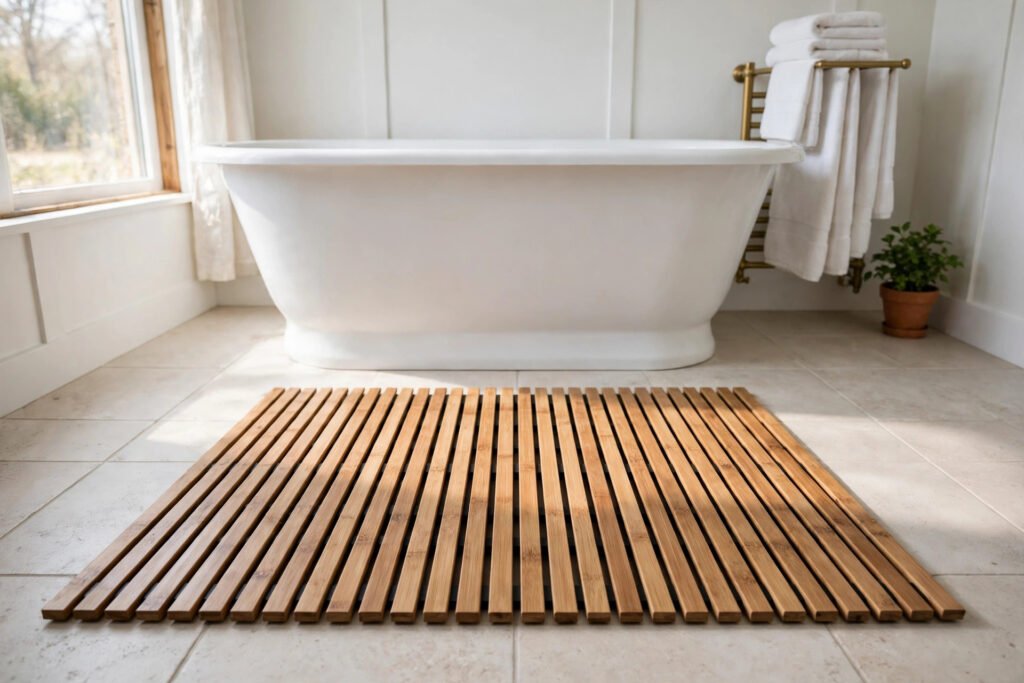
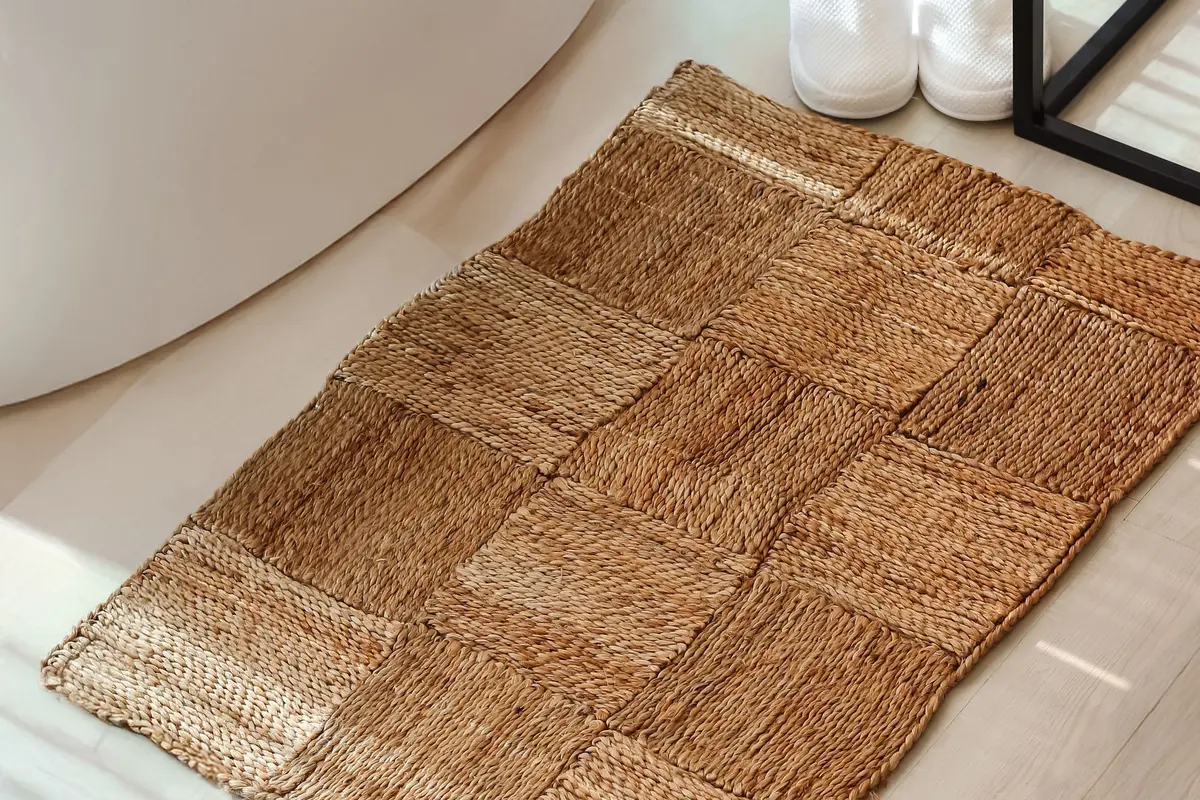
Search for a bamboo bath mat and you will meet two different products under one name, and most pages never say so. The first is a slatted wooden mat, hard bamboo strips fixed side by side with gaps between them, usually with rubber feet underneath. Water drains through the gaps or runs off the surface, and the mat itself stays mostly dry. The second is a bamboo fiber textile mat, a soft woven rug made from bamboo viscose blended with cotton, which absorbs water like any fabric mat and goes in the washing machine. Care advice for one is wrong for the other, so this guide gives every answer for each type.
We did not test bamboo bath mats ourselves, and this guide claims no testing of its own. The evidence here comes from the testing that exists, Family Handyman’s test of 14 bath mats, which named the ZPirates bamboo mat its Best Bamboo pick, a long-term review of that mat, retailer and forum reviews, and the most honest seller and editorial guides we found. Where the sources disagree, this guide says so instead of picking the friendlier number.
Are Bamboo Bath Mats Good?
Yes, in the right bathroom. A slatted bamboo bath mat is good when your bathroom is ventilated, you step out dry, and you will lift the mat to dry the floor beneath it. It is a poor choice for a windowless bathroom or for anyone who wants a mat that soaks up water. The fiber type suits that need better.
A slatted bamboo mat does three things well. First, its surface dries fast, because water drains through the gaps instead of soaking in. Second, it needs no laundering: a wipe with a damp cloth is the whole routine, which is why Family Handyman calls the ZPirates mat easy to clean and durable enough to last through the years. Third, it looks like a spa, warm wood tones against tile, which is why most buyers choose it over a plain rubber mat. Mumsnet, recommending the Klass Home wooden mat, calls it a hygienic alternative to a fabric rug because it is so easy to clean.
What it does badly is just as clear. It does not absorb water, it feels hard under bare feet, it can slip if water gets underneath it, and it can mold if the underside and the floor beneath it are never lifted and dried. Natural Steps, a bath-mat seller that argues against its own product category, puts it plainly: bamboo bath mats do not have the softness of cotton or microfibre, are not as slip-free as rubber, and do not absorb water like memory foam. That is the trade-off, and the rest of this guide is the detail behind it.
The verdict turns on your bathroom and your habits. Buy a slatted bamboo mat when your bathroom has a window or a working fan, when you towel off before stepping out, and when you will lift the mat after showers so the floor beneath can dry. Do not buy one when your bathroom stays steamy and windowless, when you step out soaking wet, or when you want a mat you can throw in the wash and forget. For that buyer, a fiber mat, or a plain cotton mat, is the better tool. If absorbency is the priority, our bamboo towels guide covers the textile side of bamboo in the bathroom.
Do Bamboo Bath Mats Absorb Water?
Slatted wood mats do not absorb water, and fiber mats do. A slatted mat lets water drain through the gaps or run off the surface, so it dries fast and never feels wet like fabric. A fiber mat is a woven textile that absorbs water like cotton. One absorbency answer cannot cover both types.
The confusion is widespread because a popular bamboo claim gets applied to the wrong type. “Bamboo absorbs three times its weight in water” is a fiber claim, describing bamboo viscose textile, and Mumsnet repeats it for the Panda bamboo mat, which is 60 percent cotton and 40 percent organic bamboo, a soft woven rug, not a wooden slat mat. Applied to slatted wood, the claim is simply wrong: wood slats do not absorb, water pools or drains through. A related claim, that bamboo absorbs nearly two and a half times more liquid than a high-end cotton towel, comes from a single guide citing a bamboo company’s own testing, and it contradicts every named source on slat mats, so this guide does not repeat it as fact.
What the lack of absorbency means in practice is a small daily routine. After a shower, wipe the slats down and lift the mat so the floor beneath can dry, because the water the wood does not absorb runs onto the ground instead. House Digest makes the same point: wooden mats do not absorb water droplets, so you have to wipe them down after use, and the floor beneath needs wiping too. That is why a slatted mat suits people who dry off before getting out of the shower, and nobody who steps out dripping. The same water behaviour shows up in the rest of the house: our bamboo flooring guide covers how bamboo handles standing water, and the lesson is the same, bamboo tolerates splashes and hates standing water.
Do Bamboo Bath Mats Get Moldy?
Yes, they can, and mold is the most common real complaint about them. A slatted mat molds when water stays trapped underneath it, when the bathroom is hot and poorly ventilated, or when the mat is never lifted. A fiber mat molds the way any damp textile molds, when it stays wet and unwashed.
Natural Steps is blunt about it: despite being touted as anti-mildew, you cannot leave a bamboo bath mat damp, and bamboo is most likely to become moldy in humid conditions between 25 and 35 degrees C, so hot bathrooms without good ventilation may not suit bamboo bath and shower mats. Sustainability Matters Daily agrees, warning that a mat can feel hard underfoot and may develop mould if water remains trapped underneath. Slatted mats let water drip through the cracks and pool on the floor underneath, and if the mat is never lifted, that trapped puddle grows pink mold and black mildew in the grout.
Prevention is a routine, not a product feature. Lift the mat after every shower so the floor and the underside can dry, wipe the slats with a mild cleanser and a damp cloth, and inspect the joints, the feet, and the underside for darkening or cracking. If a mat does mold, dry it in the sun, brush the growth off outdoors, wash it with a mild cleanser, and oil it again once it is fully dry. If black spots stay between the slats after cleaning, or the mat smells after drying, replace it: a mat that cannot be cleaned safely is finished. The cleaning section below gives the full routine for both types.
Are Bamboo Bath Mats Slippery?
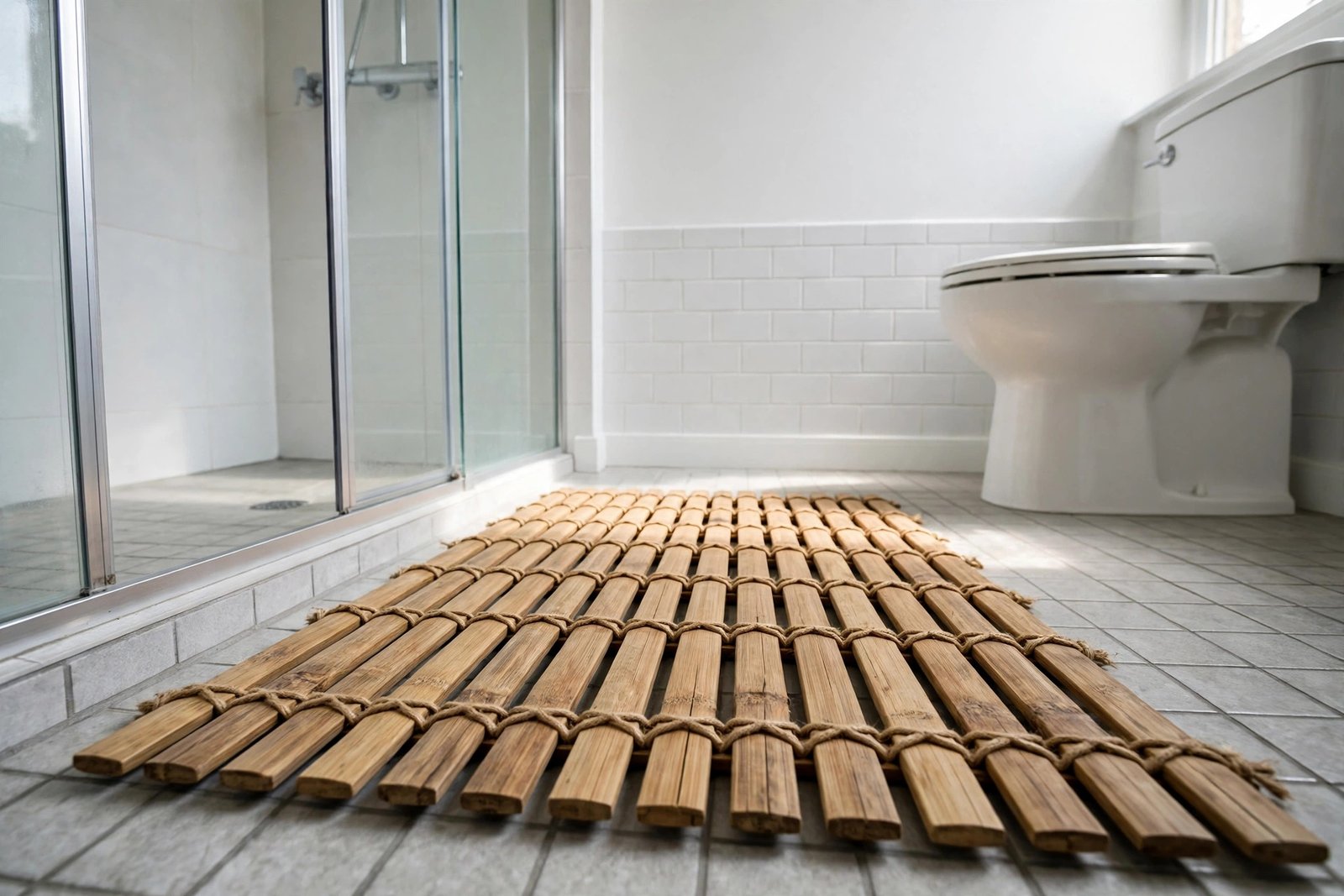
Yes, they can be, and slipping is the top safety objection to them. A slatted mat slips when water gets underneath it, because smooth bamboo on smooth tile has little grip. A fiber mat slips when its backing wears out. The risk is manageable, but only with working rubber feet and a dry floor.
The evidence is consistent across sources. Natural Steps answers its own question directly: yes, if water gets underneath them, which it will, they can become slippy, and the hazard depends on how smooth the surface is and whether the mat has rubber anti-slip feet. ShopSavvy, summarising reviewer feedback on the iDesign Formbu mat, reports mixed opinions: plenty of buyers love how it looks, some mention that the top surface can be slippery when wet, and one person noted slipping when stepping on it right after a shower. Family Handyman, in its own testing, found that the ZPirates mat’s rubber pads do not provide the best non-slip grip. The risk is real enough that one retailer’s bamboo bath mat was recalled in New Zealand in 2014 because, in the regulator’s words, if the bath mat slips it could cause you to fall.
Before buying, check three things. First, rubber feet: look for several thick rubber pads on the underside, not two thin strips, and press them to check they grip your tile. Second, slat spacing: closely spaced, rounded slats give your feet more contact than wide gaps. Third, your own routine: towel off before stepping out, keep the floor beneath the mat dry, and never place a slatted mat on a wet floor. A mat that slides when you push it on a dry floor will slide worse on a wet one, so test it before the first shower, not during it.
Are Bamboo Bath Mats Hygienic?
A bamboo bath mat is hygienic when it is kept dry and cleaned often, and it is not hygienic just because it is bamboo. A slatted mat that is wiped, lifted, and dried after use stays clean. A slatted mat that sits in a puddle, or a fiber mat that stays damp, is no more hygienic than any damp mat.
The antibacterial claim is where the marketing overreaches. Raw bamboo contains a bio-agent called bamboo kun, and sellers use that fact to call finished mats naturally antibacterial. The claim does not survive contact with the evidence: Natural Steps states plainly that processing can remove bamboo’s natural antibacterial property and that it has no particular evidence for it in commercially produced products. One trade article cites a laboratory test that found zero measurable antimicrobial activity in finished bamboo viscose textiles, though the primary source for that test was not observed, so this guide treats the counter-claim as unverified too.
What decides hygiene is the cleaning routine. Microbiologist Jason Tetro, quoted by Family Handyman, advises cleaning fabric and plush bath mats about once a week and hard, nonporous bath mats every few days. For a slatted mat that means wiping it down every few days and lifting it so the floor beneath dries. For a fiber mat it means machine washing on the maker’s schedule. The same logic applies to bamboo textiles elsewhere in the home: our guide to bamboo sheets for skin and sleep covers what bamboo fiber does and does not do for sensitive skin.
Can You Put a Bamboo Bath Mat in the Shower?
Mostly no, and the disagreement on this question is a good test of a source. Sellers market slatted bamboo mats for in-shower use, and some listings show them inside showers. Independent guides advise against it, because standing water damages bamboo. Use a slatted mat outside the shower or tub, not inside it.
YourNiftyHome states the rule plainly: bamboo bath mats are not waterproof and should not be put in the shower, and every kind of bamboo will develop molds and mildews if it gets water damaged. Natural Steps reaches the same conclusion, noting that slatted mats are difficult to clean into the crevices where damp conditions favour bacteria growth. The sellers are not lying about the mat surviving a shower or two; they are silent about what months of standing water do to it.
One narrow exception: a slatted mat with a full non-slip rubber underside, used in a shower with good drainage and lifted out to dry after every use, can work for someone who wants a wooden surface underfoot in the shower. That is a maintenance commitment, not a purchase: the mat must come out, drain, and dry, every single time. A fiber mat in the shower is a worse idea, because it soaks up water and needs washing far more often. For most bathrooms the better setup is a slatted mat on the floor outside the tub, where it does its job, dries fast, and lasts.
How Do You Clean a Bamboo Bath Mat?
Clean a slatted mat by wiping it, never by soaking it. Dust it weekly, wipe it with a mild cleanser and a barely damp cloth, and dry both sides before putting it back. Clean a fiber mat in the washing machine on cold, with mild detergent, and air dry it. The two routines are opposites.
For a slatted mat, the routine in full is short. Dust it once a week with a cloth or a soft brush, then wipe it with a mild cleanser and a damp cloth, and towel dry it straight away. Rinse away soap residue before it becomes a slippery film, and use only cleaners approved by the maker, because harsh chemicals strip the seal that keeps water out. Every three to six months, clean between the slats with a soft bristle brush, towel dry, and polish the wood with linseed oil to stop it cracking, and keep the mat away from radiators and heated floors, which make bamboo brittle. Lift the mat every time you clean so the floor underneath dries too. Never put a slatted mat in the washing machine or the dishwasher, and never soak it: the soaking swells the wood and loosens the joints. The same gentle approach works for bamboo elsewhere in a wet room: our guide to cleaning bamboo flooring covers the same wipe, do not soak rule for bamboo floors.
For a fiber mat, the routine is the laundry routine. Machine wash cold with a mild detergent, skip bleach and fabric softener, and air dry it rather than tumble drying, which can shrink the fibers and wear the backing. Wash it about once a week, and more often if it stays damp or starts to smell. If the care label says otherwise, follow the label: blends vary, and a mat that is mostly cotton behaves like cotton. The same gentle washing rules apply to bamboo bedding, covered in our bamboo bedding care guide. One caution applies to both types: a mat that smells after washing and full drying, or that shows black spots between the slats or in the weave, has mold in places cleaning cannot reach, and it is time to replace it rather than wash it again.

How Long Do Bamboo Bath Mats Last?
There is no single verified lifespan, because the published figures disagree by a factor of three or more. The maker of the ZPirates mat claims up to four years, and a long-term reviewer found it still holding its shape after several months. Other published figures run from one to two years up to five to seven years.
The figures conflict because they measure different things. A manufacturer claim describes a well-made mat kept dry and oiled. A market report’s twelve to twenty-four months describes the average mat in the average bathroom, including thin mats in steamy rooms. A five-to-seven-year figure describes a thick, sealed mat in a ventilated bathroom that is lifted and dried after every shower. None of these is a measured study with a method behind it, so this guide does not present any one of them as the answer.
What you can judge is the build. A mat that lasts is made of thick slats, not thin strips, with joints that do not flex when you stand on it, a sealed finish that beads water, and rubber feet that stay attached. A mat that fails early shows the signs in order: the finish wears off, the slats loosen, the wood warps or discolours, black spots appear between the slats, and the mat starts to smell even after cleaning and full drying. Replace it when it rocks on a flat floor, when it splinters, when the slats move under your weight, or when cleaning no longer removes the smell or the spots. A fiber mat is finished when its backing delaminates, the weave thins, or it stays musty after washing.
Bamboo Bath Mat vs Stone: Which Is Better?
Stone wins on absorbency and bamboo wins on warmth, and the better mat is the one that matches what bothers you most. A stone or diatomite mat absorbs water and dries fast, which solves the puddle problem bamboo leaves behind. A bamboo mat feels warmer underfoot, weighs less, and costs less.
A stone mat, usually diatomaceous earth pressed into a slab, works by absorption: water soaks into the porous surface and evaporates, so the floor stays dry without wiping. The trade-offs are weight, hardness, and fragility: stone slabs are heavy, hard underfoot, and can crack or chip if dropped, and they need sanding now and then to keep absorbing. A bamboo mat works by drainage: water runs through the gaps and off the surface, so the mat dries fast but the floor needs wiping. The trade-offs are maintenance and mold risk, because the mat must be lifted and the floor dried, and the wood must be oiled. Sustainability Matters Daily compares the two directly and lands in the same place: choose bamboo for firm footing and fast surface drainage, and stone when absorbency is the priority.
Buy stone when your bathroom has no window, when you step out soaking wet, or when you will not lift a mat to dry the floor. Buy bamboo when your bathroom is ventilated, when you dry off before stepping out, and when you want a lighter mat that costs less and looks warmer. Neither type is maintenance-free: a stone mat that is never sanded stops absorbing, and a bamboo mat that is never lifted grows mold.
Bamboo Bath Mat vs Cotton: Which Is Better?
Cotton wins on absorbency and softness, and bamboo wins on drying speed and easy care, so the better mat depends on what you step out of the shower to do. A cotton mat soaks up water, feels soft, and goes in the washing machine. A slatted bamboo mat does not absorb, feels hard, and needs wiping instead.
The comparison is really between two jobs. A cotton mat’s job is to absorb: it takes the water off your feet and holds it until laundry day, which is why it suits people who step out wet and want the floor dry without wiping. Its costs are laundering, slow drying in a humid bathroom, and the musty smell a damp cotton mat develops when it is not washed often enough. A slatted bamboo mat’s job is to drain: it keeps your feet off a wet floor and dries itself quickly, which is why it suits people who towel off first and want a mat that needs no laundry. Its costs are the daily wipe and lift, the hard feel, and the mold risk when the routine slips.
Fiber bamboo mats sit between the two. A bamboo viscose and cotton blend absorbs water like cotton, feels soft, and goes in the washing machine, which makes it the closest bamboo answer to a cotton mat. If you like the idea of bamboo but want absorbency, buy the fiber type, not the slatted type, and check the blend on the label: a mat that is mostly cotton behaves like cotton. If you already own cotton mats and like them, there is no reason to switch: bamboo’s advantage is drying speed and wipe-clean care, and cotton’s is dry feet.
Are Bamboo Bath Mats Worth It?
Yes, when the price buys a well-made mat and you will do the small daily routine. A slatted bamboo mat is worth it when it has thick slats, a sealed finish, and proper rubber feet, and when your bathroom is ventilated enough to let it dry. It is not worth it as a cheap thin mat in a steamy bathroom.
On price, list prices seen for popular slatted mats run from about 24 dollars to about 30 dollars, with the ZPirates mat listed at 23.99 dollars and the SereneLife mat at 30.40 dollars in a 2023 roundup, and the Klass Home wooden mat listed at 20 pounds in the UK. Those are dated list prices, not current prices, so check the listing before buying. Larger mats cost more, and foldable and roll-up mats cost more than fixed ones of the same size. The value case is not the low price: a well-made mat, kept dry and oiled, lasts for years and needs no laundering, while a cheap mat that molds in a year costs more per year than a good one that lasts four.
Judge value by the build, not by the price tag. Press the slats to check they do not flex, look for a sealed finish that beads water, count the rubber feet and press them to check they grip, and check the returns policy before buying, because a mat that slides on your tile is a mat you will return. A mat that passes those checks at 30 dollars is better value than a mat that fails them at 20. If the routine, lift, wipe, dry, oil, sounds like a chore you will not do, spend the money on a cotton or stone mat instead: the best mat is the one whose care routine you will actually follow.
What Size Bamboo Bath Mat Should You Buy?
Measure the space first, then buy the mat that fits it with room for air. Common slatted-mat sizes are 24 by 16 inches, 34 by 18 inches, 18 by 31 inches, and 25.3 by 15.7 inches, and most bathrooms need the smallest of those. A mat that fits with a gap around it dries faster and lifts more easily.
For a standard tub, a 24 by 16 inch mat placed lengthways along the tub is the usual fit. For a double vanity, a 34 by 18 inch mat covers two standing spots. For a narrow gap between a tub and a wall, an 18 by 31 inch mat turned sideways fits where a square mat will not. Measure the width of the space and subtract at least two inches on each side for air and lifting: a mat that touches the wall on both sides traps water at its edges. Foldable and roll-up mats suit small bathrooms and rentals, because they store flat when the floor needs mopping. A fixed mat suits a bathroom where the mat never moves. If the mat will sit on heated floors, check the maker’s guidance first: bamboo can become brittle near radiators and heated floors.
What Real Users Found
We did not test these mats ourselves, and this guide makes no claim that we did. What follows is what real buyers reported after living with bamboo bath mats, drawn from retailer reviews, forum-sourced recommendations, a long-term review, and a tested roundup. No Reddit threads about bamboo bath mats were found, so none are cited here.
Mold is the complaint buyers raise most often, and it follows the same pattern every time: the mat was left damp, the underside was never dried, and the mold appeared where the mat met the floor. Natural Steps warns that slatted mats can be difficult to clean into the crevices where damp conditions favour bacteria growth, and one cleaning guide notes that slatted wood mats let water drip through the cracks and pool underneath, so if the mat is not lifted and the tile dried after every shower, pink mold and black mildew grow in the grout. The same failure shows up in other bamboo bathroom products: a buyer of a bamboo bathtub caddy reported mold after normal use, and the maker replied that the caddy had been misused because it needs to be kept dry.
Slipping divides buyers, and the split runs along the rubber feet. ShopSavvy, summarising reviews of the iDesign Formbu mat, reports mixed opinions: many buyers love how it looks, some say the top surface can be slippery when wet, and one person slipped stepping on it right after a shower. Two Amazon reviewers of the SereneLife mat disagree on the same page: one writes that it is super smooth and feels great underfoot, and the other writes not to use it as a bath mat because it would be slippery. Slipperiness is not a property of the mat alone: it is the mat, the feet, the floor, and whether the buyer steps out wet.
Durability splits the same way, by build. A long-term reviewer who used the ZPirates mat for several months reports that it held its shape, that it uses no nails or screws, which are common culprits for rust and weakening in other bath mats, and that the bamboo slats are interlocked for a stable surface, with non-skid rubber pads underneath and an air-circulating design that helps keep the surface dry. Goods.Observer records that review, including the maker’s claim of a lifespan of up to four years. Family Handyman, which tested 14 mats, named the ZPirates mat its Best Bamboo pick, praised its stain and dirt resistance and its easy wipe-clean care, and reported 4.4 stars for it. The two sources disagree on how many ratings sit behind that score, one citing over 6,000 and the other more than 64,000, so this guide cites the score and names both counts rather than picking one.
On the other side, buyers of thinner mats report the strips coming loose with repeated water exposure, and Natural Steps warns that excessive water will cause bamboo to warp and discolour over time. The satisfied buyers almost all bought thicker, well-braced mats with proper feet, and the complaints cluster in thin, lightly built ones, which matches this guide’s buying advice: the build decides the experience, not the word bamboo on the listing.
Comfort gets the most honest answer from buyers. The mat is hard underfoot and it does not absorb, and buyers who wanted softness were disappointed. Mumsnet forum users draw the line clearly: the Panda bamboo mat, a thick woven fiber mat, is praised as really thick and absorbent, while the Klass Home wooden mat is praised as a hygienic alternative to a fabric rug because it is so easy to clean. The happy buyers are the ones who bought the type that matches what they wanted.
The pattern across these reports matches this guide: mold and slipping cluster where the mat is never lifted and the feet are poor, durability follows the build, and comfort follows the type. A thick slatted mat with good feet, in a ventilated bathroom, with a buyer who lifts and dries it, draws the satisfied reviews.
Bamboo Bath Mat Claims, Checked
Most of what is said about bamboo bath mats is marketing, repeated from listing to listing without a test behind it.
| Claim | Verdict | What the sources actually say |
|---|---|---|
| “Bamboo bath mats are waterproof” | Not supported | Bamboo is not waterproof. A finish slows moisture absorption, but seams, end grain, and screw holes stay vulnerable. |
| “Bamboo bath mats do not get moldy” | Not supported | They mold when they stay damp, when water pools underneath, or when the bathroom is hot and unventilated. |
| “Naturally antibacterial, thanks to bamboo kun” | Not supported as a product claim | Raw bamboo contains bamboo kun. No evidence was found that it survives processing into finished mats. |
| “Bamboo absorbs three times its weight in water” | Misattributed | That describes bamboo viscose fiber textile, not wood slats. Slatted mats do not absorb water. |
| “Absorbs 2.5 times more than a cotton towel” | Not supported for slat mats | One guide cites a bamboo company’s own testing. It contradicts every named source on slat mats. |
| “30 percent stronger than solid oak” | Unverified | Appears only in one product listing’s copy, with no source given. Do not repeat it. |
| “Bamboo bath mats are machine washable” | True for fiber mats only | Fiber mats wash cold and air dry. Slatted mats must never be soaked, machine washed, or put in a dishwasher. |
| “Bamboo bath mats are slippery when wet” | True, with conditions | They slip when water gets underneath, or when the rubber feet are poor. Good feet and a dry floor change the answer. |
| “Dries in 2 to 4 hours” | Unverified | Published drying times contradict each other. Slatted mats dry faster than fabric because they do not absorb water. |
| “Lasts up to 4 years” | Manufacturer claim | The ZPirates maker’s claim, not a measured result. Other published figures run from 1 to 2 years up to 5 to 7 years. |
| “Automatically eco-friendly” | Needs qualification | Fast growth is real. Adhesives, coatings, manufacturing, and transport still matter, and supply-chain claims can mislead. |
| “Fine to use in the shower” | Contested | Sellers say yes. Independent guides say no, standing water causes mold, swelling, and discoloration. |
A pattern runs through these verdicts: the claims that flatter bamboo are usually marketing lines, repeated with no test or method behind them. The figures that come from testing and named sources mostly show a smaller advantage than the marketing promises. That does not make bamboo bath mats bad. It makes the marketing unreliable, which is why this guide rests on the verifiable points and marks the rest as claims.
Frequently Asked Questions
Are bamboo bath mats waterproof?
No. Bamboo is not waterproof, and no finish makes a bamboo bath mat waterproof. A sealed finish slows moisture absorption, but seams, end grain, and screw holes stay vulnerable. A slatted mat handles splashes well because water drains off it, and it fails when it sits in standing water. Treat it as water-resistant.
Do bamboo bath mats work on tile floors?
Yes, when the mat has rubber feet and the tile is dry. Tile is smooth, so grip comes from the rubber pads, not from the bamboo. Test it first: push it with your foot on dry tile, and if it slides, it will slide worse when wet. Lift it after showers so water does not pool beneath it.
Do bamboo bath mats work?
Yes, for the job they are built for: keeping your feet off a wet floor while the mat itself dries quickly. They do not work as absorbent mats, because slatted mats do not absorb water, and they do not work in showers, because standing water damages them. Used outside the tub, with the mat lifted and the floor dried after use, they work well.
Are bamboo bath mats antibacterial?
Not as finished products, on the evidence available. Raw bamboo contains a bio-agent called bamboo kun, but processing can remove it, and no evidence was found that it survives into commercial mats. A bamboo mat is hygienic when it is kept dry and cleaned often, not because the bamboo kills bacteria.
Why do people use bamboo bath mats?
People use them for fast surface drying, wipe-clean care, and the warm spa look, and because they need no laundering. A slatted mat dries itself between showers, wipes clean in seconds, and suits a bright bathroom. People also choose them for the renewable story, though the sustainability case needs the qualifications in the claims table.
What are bamboo bath mats for?
Bamboo bath mats are for standing on after a shower or bath, outside the tub. Slatted mats are also used in saunas, around pools, in outdoor showers, and for camping, where a quick-drying wooden platform beats a fabric mat. They are not for inside the shower, and not as a replacement for a towel.
Teak vs bamboo bath mat: which should I choose?
Choose teak when you want natural oils that resist water better and you will pay more for them. Choose bamboo when you want a lighter mat that costs less and looks warmer. Both are wooden slat mats, both need lifting and drying, both need oiling, and both mold when they stay damp. Teak’s advantage is water resistance, not maintenance-free use.
Do bamboo bath mats need oiling?
Slatted mats do, every three to six months, and fiber mats do not. Oil stops the wood drying out and cracking, keeps the finish working, and protects the joints. Clean between the slats with a soft brush, towel dry the mat, polish it with linseed oil, then let it dry fully before putting it back.
When should I replace a bamboo bath mat?
Replace a slatted mat when it rocks on a flat floor, when it splinters, when the slats move under your weight, or when black spots or a smell stay after cleaning and full drying. Replace a fiber mat when its backing comes apart, when the weave thins, or when it stays musty after washing. A mat that cannot be cleaned safely is finished.
Are bamboo bath mats better than cotton?
They are better at drying fast and at wipe-clean care, and worse at absorbency and softness. Cotton soaks up water and feels soft, and it needs laundering. Bamboo drains water and dries itself, and it needs wiping and lifting. Choose cotton for dry feet and softness, and bamboo for speed and no laundry.