
The short answer: Yes, a bamboo mattress pad is a good buy if you want a cooler, more breathable surface and mattress protection, not a softer bed. The bamboo is only in the cover, the fill is polyester fibre, so it adds surface comfort but almost no support, and most pads wash in a machine, but a few do not.
Many listings use ‘bamboo mattress pad’ for a thin, cover-and-fill layer, and it is also the product most shoppers misunderstand. The name promises a natural bamboo layer that changes how the bed feels. The reality is a thin quilted layer with a bamboo-derived cover over polyester fill, and it changes the surface you touch far more than the support underneath you. That single fact explains almost every complaint buyers report, from the pad going flat in weeks to the washing mistakes that rip it in one cycle.
We did not test bamboo mattress pads ourselves, and this guide claims no testing of its own. The evidence comes from reviewer testing at Sleepopolis and Mattress Clarity, a 60-night test at Mattress Nut, buyer reviews published on Target product pages, and the most honest independent guides we found, including Mattress Miracle, HomeSoCool, and ViscoSoft. Where sources disagree, this guide says so. Prices are quoted as reported by the sources named in this guide, so treat them as a snapshot, not a live price. The bamboo mattress benefits buyers ask about are real but narrow, and the first section of this guide sets out exactly where they start and stop.
What is a bamboo mattress pad?
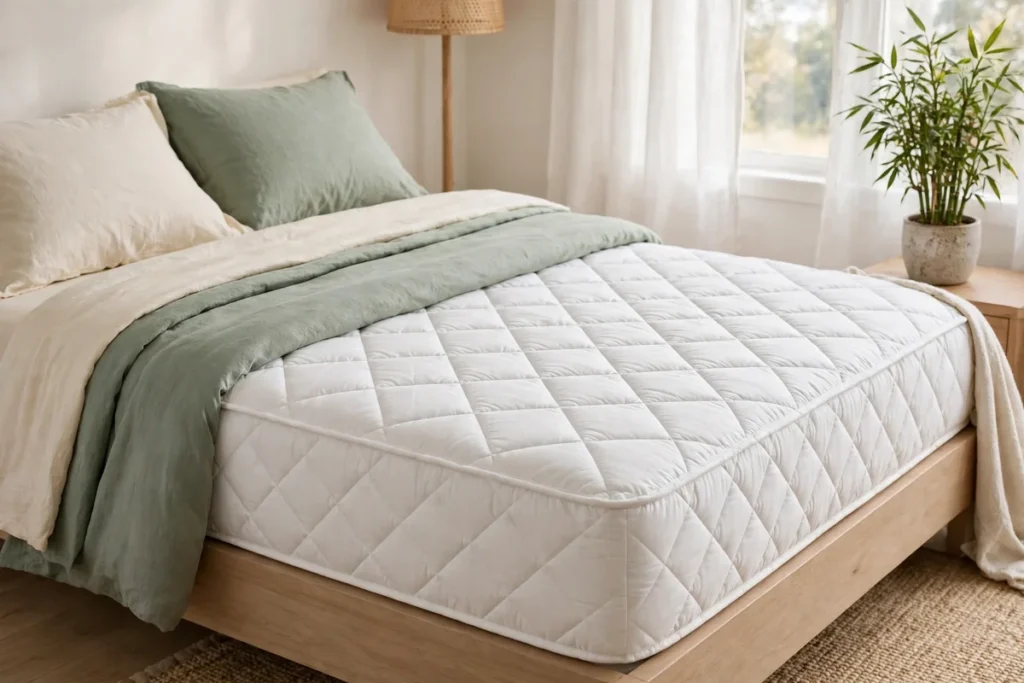
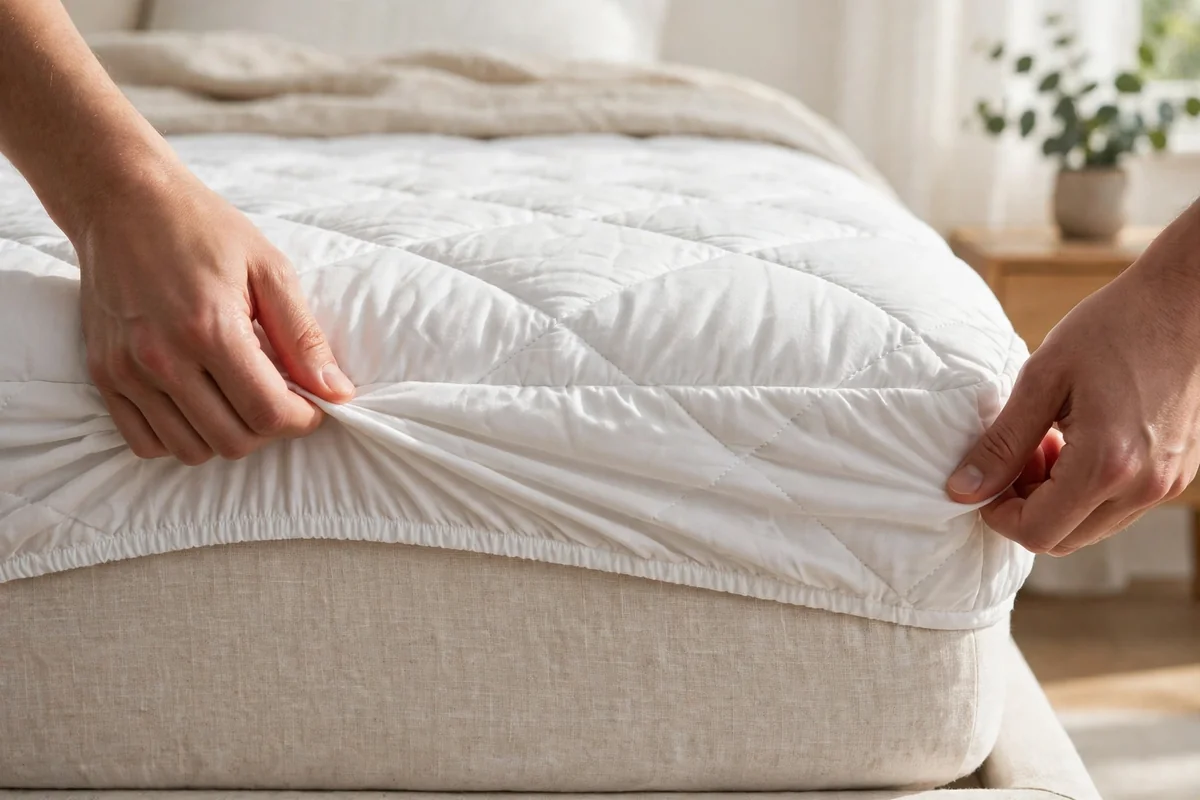
A bamboo mattress pad is a thin quilted layer that sits on top of your mattress under the fitted sheet. It has an elastic skirt that grips the corners of the mattress, a top fabric made partly from bamboo-derived viscose or rayon, and a fill of polyester fibre batting quilted into channels. A bamboo mattress pad cover is the top fabric you sleep against, and the fill underneath is what gives the pad its small amount of softness. The bamboo is never the fill, and no pad in the pads reviewed is stuffed with bamboo.
The fibre itself is processed, not natural. Raw bamboo is chemically broken down into rayon or viscose before it is woven, and the US Federal Trade Commission requires sellers to write ‘viscose made from bamboo’ rather than plain bamboo. Our guide to bamboo viscose vs cotton explains the same processing in fabric terms. So when a listing says “bamboo mattress pad”, read it as shorthand for a bamboo-cover pad, not a pad made of bamboo. Typical blends recorded across the sources for this guide are 40 percent bamboo viscose and 60 percent microfiber or polyester, as on the BEDLORE topper tested by Mattress Nut, 30 percent rayon from bamboo on the ExceptionalSheets pad, and 20 percent viscose from bamboo with 80 percent polyester on the Utopia Bedding protector. The premium exception is the Cozy Earth pad, whose cover is 100 percent bamboo viscose.
A pad is thin by definition. Mattress Miracle, Sleepopolis, and Tom’s Guide all put a pad under 1 inch thick, while a topper runs 2 to 4 inches. Adorearth puts a pad under 2 inches, which shows how loose the naming is, and HomeToSight calls 3 and 4 inch foam layers “pads”, which blurs the line completely. There is no enforced naming standard, as SleepRanked puts it: “Read the build, not the label.” The thickness, the fill type, and the price are the real tells, and the next section gives you the table that settles them.
What is the difference between a bamboo mattress topper and a bamboo mattress pad?
This is the question that confuses buyers most, and it is the question the whole purchase turns on. What is the difference between a bamboo mattress topper and a bamboo mattress pad? A pad is a thin quilted layer, under 1 inch, that protects the mattress surface and adds a little softness. A topper is a thick comfort layer, 2 to 4 inches, that sits on the mattress and changes how the bed feels and supports you. A protector is thinner still, with no cushioning at all, and exists only to block spills and stains. Is there a difference between a bamboo mattress topper and a bamboo mattress pad? Yes, and it is the difference between changing the surface and changing the support. ViscoSoft states it plainly: “Bamboo is a surface material, not a support material.” The cover decides the coolness and softness of the top, while the fill or foam beneath decides how the layer holds your body.
Searches show how mixed up the words are. People type “bamboo mattress pad topper” as one phrase, and listings sell the same product under both names. A bamboo mattress topper is the thicker product, and what is a bamboo mattress topper in practice is usually a slab of memory foam, latex, or thick fibre fill with a bamboo cover, while a pad is the thin quilted layer with an elastic skirt. HomeSoCool puts it plainly: the pad is the thin quilted layer with an elastic skirt, and the topper is the thicker slab of foam or fill that sits loose on the mattress. “Pads change the surface you touch. Toppers change how the bed supports you.” Mattress Miracle draws the same line: a topper is a thick layer that adds real cushioning, while a pad is a thin layer that mainly protects the surface. “If you want a softer sleeping surface, you want a topper.” For surface protection with a little softness, a pad does the job.
The table below is the decision in one place.
| Type | Thickness | What it does | Washable | Typical price |
|---|---|---|---|---|
| Bamboo mattress pad | Under 1 inch | Protects the surface, adds a little softness | Usually machine washable | About $27 to $107 |
| Bamboo mattress topper | 2 to 4 inches | Changes how the bed feels and supports you | Cover only, foam never goes in the washer | About $100 to $300 and up |
| Bamboo mattress protector | Almost flat | Blocks spills and stains, adds no cushioning | Usually machine washable | Varies by size |
Note: the Cozy Earth pad is a premium exception at roughly $140 to $230, above the usual pad range, because its cover is 100 percent bamboo viscose.
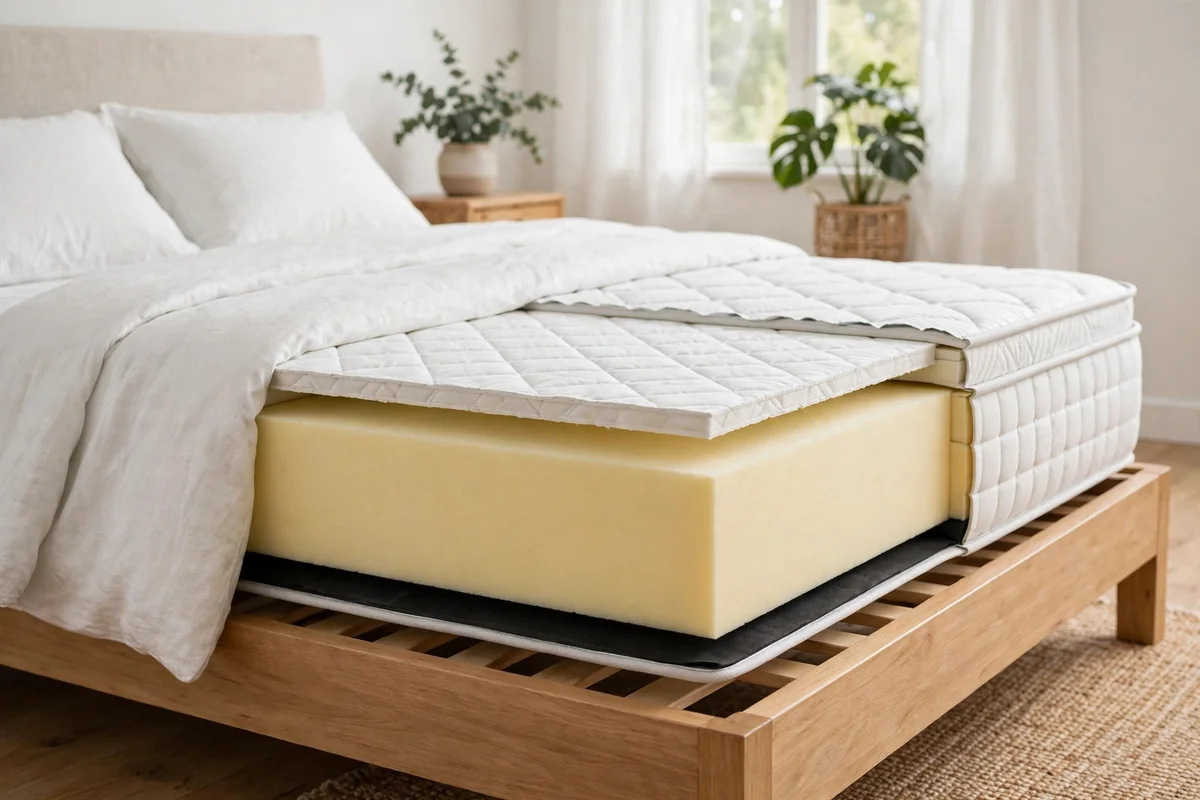
Three signs tell you a listing is really a pad, from Tom’s Guide: it costs less than $100 for a queen, it is completely machine washable and not just the cover, and it has down-alternative or microfiber fill. Tom’s Guide is blunt about the consequence: these pads are not really toppers, because they are too slight to change how a bed feels, and they usually have a down-alternative fill and cost much less than foam toppers. And Tom’s Guide adds that it does not recommend buying a mattress pad, because pads are ‘too thin and unsupportive to change the firmness or softness of your bed.’ That is the honest shape of the pad question. If your mattress is too firm, a pad will not fix it. If your mattress is fine and you want a cooler, cleaner surface with a little extra softness, a pad is the right product. Are you supposed to put a sheet over a bamboo mattress topper? Yes, the topper goes on the mattress, then the fitted sheet goes over the topper, and the sheet holds the topper in place.
The comparisons shoppers run tell the same story.
| Comparison | Short answer |
|---|---|
| bamboo mattress topper vs memory foam | A question about the fill inside the topper, because a bamboo topper is usually a memory foam topper with a bamboo cover. |
| bamboo mattress topper or memory foam | The same choice phrased differently: you are choosing between foam and fibre, not between bamboo and foam. |
| bamboo mattress topper vs latex | Foam against latex; latex holds its shape longer but costs more. |
| bamboo mattress topper vs wool | A bamboo cover against a wool-filled topper; wool regulates temperature well but needs more care. |
| bamboo mattress topper vs cotton | A cover-fabric comparison; bamboo viscose wicks faster while cotton washes harder. |
| bamboo mattress vs memory foam | A different question, about a whole mattress rather than a layer. |
| bamboo vs cotton mattress pad | A cover-fabric comparison: bamboo viscose wicks moisture and feels silkier, cotton breathes well and washes harder, and neither changes the support underneath. |
Our guide to bamboo vs cotton sheets covers the same fabric trade in sheets, where the difference is easier to feel.
Are bamboo mattress pads good?
Yes, for most sleepers, with two conditions: buy it for the surface, not for support, and accept what it cannot do. Ask it for a cooler, cleaner sleep surface, light protection for your mattress, and a little extra softness, and it delivers. Ask it to fix a firm mattress, to cool you all night, or to last five years, and it will disappoint you. That is the honest shape of the answer to “are bamboo mattress pads good”, and it is the same answer the independent guides give: Mattress Miracle calls a pad the right buy for surface protection with a bit of softness, and Tom’s Guide warns just as plainly that a pad will not change your bed’s firmness. The question “are bamboo mattress good” is usually the same question with a word missing, and the answer is the same: good as a surface layer, not as a comfort fix.
The bamboo mattress pad benefits buyers mention most are real. The cover wicks moisture and breathes, so the sleep surface stays drier than a polyester-covered pad. The quilting adds a small amount of softness, which Sleepopolis rated on the eLuxury bamboo pad: on a mattress rated 6 out of 10 firmness, the pad made it feel like 5 out of 10, an estimated 15 percent softer, with a floating feel rather than the hug of foam. The pad protects the mattress from sweat, dust, and light spills, which stretches the mattress itself. And most fibre-fill pads go in the washing machine, which is more than most foam toppers offer.
- bamboo mattress topper benefits are different and bigger, because a topper adds real cushioning.
- bamboo mattress protector benefits are different again, because a protector adds waterproofing a pad does not have.
- bamboo mattress cover benefits sit in the middle: a cover changes the touch and the breathability, nothing structural.
- bamboo mattress benefits are a cooler touch, a cleaner bed, and a mattress that stays newer for longer.
The limits are just as real. Cooling is partial, and the next section measures it. Flattening is the most repeated durability complaint: the Mattress Nut 60-night test found the BEDLORE topper’s centre compressed by roughly 30 percent by week four, and by week eight the tester was “essentially sleeping on my original mattress with a thin comforter between us”. Support is absent: the same test scored support 3.0 out of 10 and edge support 4.0 out of 10, and a 220 pound stomach sleeper bottomed out completely within two weeks. And washing is not always simple, which the wash section covers in full.
| Pros | Cons |
|---|---|
| Cover breathes and wicks moisture, less clammy than polyester | Adds almost no support, will not soften a firm mattress |
| A little extra softness on the surface, about 15 percent on one tested pad | Fibre fill flattens in weeks and bunches inside the quilting |
| Protects the mattress from sweat, dust, and light spills | Most pads are not waterproof, spills reach the mattress |
| Most fibre-fill pads are machine washable | King sizes may not fit a home washer, and washing can rip the pad |
| Cheaper than a foam topper, usually under $100 for a queen | One tested fibre-fill pad lasted 12 to 18 months |
| Fits under a fitted sheet with an elastic skirt | Corners can pop off at night on tall or pillow-top mattresses |
So are bamboo mattress toppers good as a purchase? That is a different product, and the answer depends on which product you mean.
| Product | Is it good? |
|---|---|
| are bamboo mattress toppers good | Yes, when you need real cushioning, because a topper is thick enough to change how the bed supports you. |
| are bamboo mattress protectors good | Yes, when you need spill protection, because a protector blocks liquid a pad lets through. |
| are bamboo mattress covers good | Yes, as a surface layer, for the same reasons a pad is good, and with the same limits. |
The pad itself suits a sleeper whose mattress already feels right and who wants a cooler, cleaner surface with a little extra softness. It does not suit a sleeper who wants a softer bed, a sleeper with a sagging mattress, or a sleeper over about 200 pounds who needs real support, because the fill gives way under that weight. Expert roundups such as Sleepopolis and Mattress Clarity give the highest ratings to the pads with honest trial periods and clear care labels, not the cheapest ones, and the happiest buyers are the ones who bought a surface layer, not a mattress fix. One Target buyer of the ViscoSoft pad wrote: “This is by far the best mattress pad I have ever purchased! Thick and plush, it feels like a warm hug, or sleeping on a cloud. Washes up well.”
Do bamboo mattress pads keep you cool?
Partly, and the honest answer depends on what kind of hot sleeper you are. Do bamboo mattress toppers keep you cool? A topper with a bamboo cover breathes better than a solid foam topper, but the foam underneath still holds heat. Do bamboo mattress protectors keep you cool? A plain protector breathes about as well as its cover, but a waterproof protector with a plastic film runs warmer, because the film blocks airflow by definition. Do bamboo cooling mattress toppers work? They work as moisture managers, not as coolers, and the difference matters. A bamboo mattress pad cooling effect is real but small and short-lived, and the numbers below are the only measured ones we found.
The measured cooling effect
The best measurement comes from the Mattress Nut 60-night test of the BEDLORE topper, which used thermal monitoring under the lower back for three weeks. Average skin temperature on the BEDLORE registered 91.2F, compared to 93.8F on a basic memory foam topper reviewed at the same time. That is a measurable difference of 2.6F, but the tester is clear it is not revolutionary, and during a July heat wave with a bedroom temperature of 78F, he woke up sweaty three out of five nights. His summary is the honest framing for this whole section: “The bamboo cover helps with moisture evaporation, but the polyester fill traps body heat. If you’re a hot sleeper living in a warm climate, this won’t solve your problems. It’ll just delay them by 30 minutes.” HomeSoCool says the same thing in one line: “A breathable cover helps a sweaty sleeper more than it helps a hot one, because moving moisture and moving heat are not the same job.”
The wider evidence backs the small effect. The Roundup, reviewing bamboo mattresses, cites a study comparing bamboo with cotton and viscose rayon on a sweating manikin, which “found no evidence that bamboo manages either moisture or temperature better than cotton (Gericke et al., 2010)”. SleepWise Reviews lists the LuxClub bamboo pad as “not suitable for extreme heat”. People ask to explain bamboo mattress topper benefits focusing on cooling features. The cover wicks moisture, and nothing in the fill cools. And are bamboo mattress toppers cooling as a category? The cover helps, the fill decides, and a fibre fill traps heat while a gel foam topper starts cooler and warms up during the night. Are bamboo mattress toppers hot? They can be, when the fill is dense foam or a waterproof film sits underneath.
What should a hot sleeper buy?
If you sweat at night but do not feel too warm, a bamboo pad is a good buy: the cover wicks moisture and the sleep surface stays drier. If you climb into bed feeling too warm, a pad will not fix it, and you need gel foam, phase-change fabric, or an actively cooled system instead. A bamboo mattress topper for cooling is really a moisture manager: the cover wicks moisture and helps with damp, not with heat. One Target buyer of the eLuxury pad learned it the hard way: “Also it did nothing to cool off this hot sleeper.” Our guide to are bamboo sheets good covers the same cooling question for sheets, where the fabric is the whole product and the effect is easier to judge.
How to wash a bamboo mattress pad?
The short version is cold, gentle, low heat, and never bleach, but the long version matters, because washing is where most pads die. How to wash a bamboo mattress pad depends first on what kind of pad you own. A fibre-fill pad usually goes in the washing machine whole. A foam-core pad never does. A premium pad like Cozy Earth is spot-clean or dry-clean only, which is the sharpest care trade-off in this category. Check the label before the first wash, not after the first rip. Can a bamboo mattress pad be washed? Yes, if the label says machine washable, and no, if it is a foam core or a premium spot-clean pad. How do you wash a bamboo mattress pad if the label is missing? Treat it as spot-clean only until you can confirm the fill, because a wrong wash ruins a foam pad in one cycle.
How to wash it, step by step
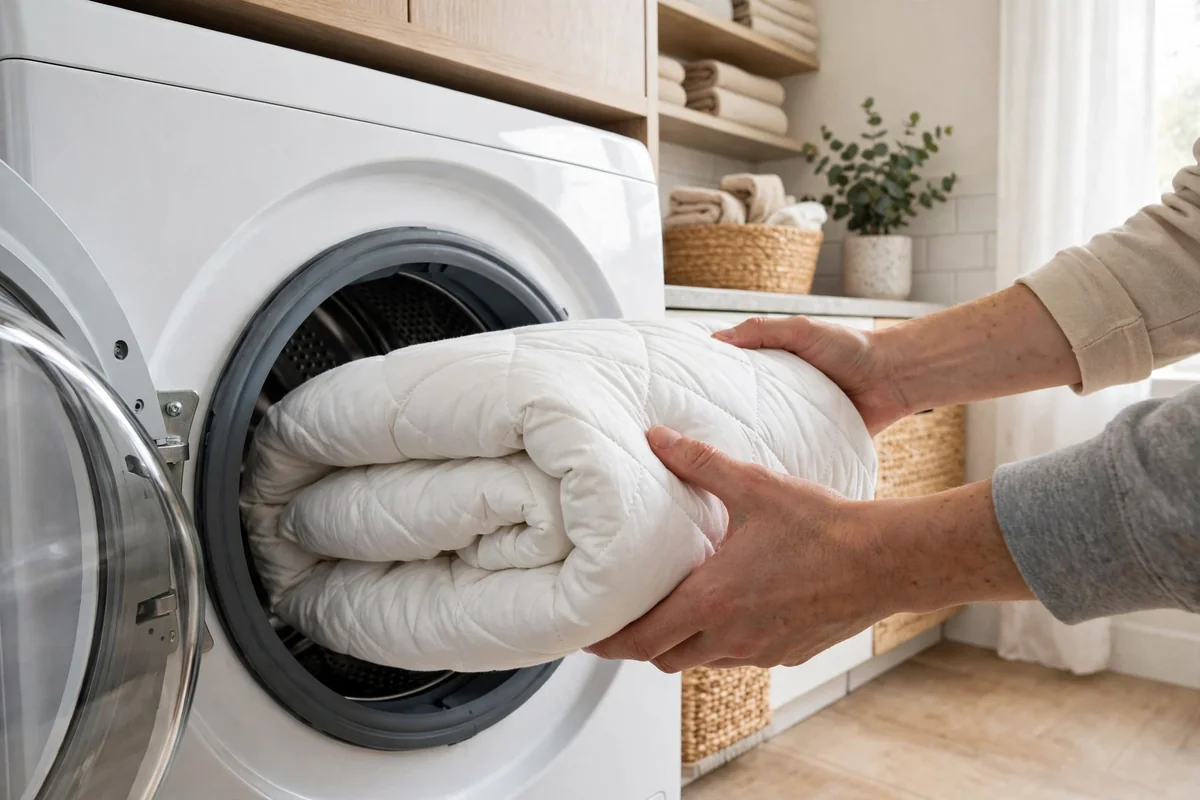
How to wash a bamboo mattress pad, step by step, for a fibre-fill pad with a machine-washable label. First, check the washer: a king size pad may not fit a home washer at all, and a pad crammed into a small drum comes out lumpy because the drum cannot tumble it properly. Second, wash cold on a gentle cycle with mild detergent, and skip bleach and fabric softener, which weaken bamboo viscose. Third, dry low or hang it, and add tennis balls or dryer balls to refluff the fill. Fourth, check the quilting after the wash, because popped stitches let the fill migrate freely. Turmerry gives the same rule for bamboo-derived fibre: “Cold, gentle cycle, mild detergent without bleach or whiteners”, and “Low heat or air-dry”. HomeSoCool adds the reason: “Viscose loses strength when it’s wet, so hot water and a hard spin are how quilting stitches tear.” The same cold and gentle rule applies to the rest of bamboo bedding, and our how to wash bamboo sheets guide covers the sheets the same way. Our bamboo bedding benefits and care guide covers the sheets and bedding that go with the pad, so the whole bed follows the same cold, gentle care rule.
Wash and dry questions
The wash questions buyers ask are mostly the same question in different words, and the answers split by product.
| Question | Answer |
|---|---|
| how to clean a bamboo mattress pad | The same job as washing it, unless the pad is spot-clean only; then dab stains with a damp cloth and mild detergent, never soak it. |
| how to wash a bamboo mattress topper | It depends on the topper: a fibre-fill topper washes like a pad, while a foam topper never goes in the washer, and only its cover washes. |
| how to clean a bamboo mattress topper | The same split as washing: fibre fill washes, foam never does, and only the cover washes. |
| how to wash a bamboo mattress cover | Wash the cover alone after unzipping it, cold and gentle, then air dry it. |
| how to wash a bamboo mattress protector | The same cold gentle rule, with low heat drying; a hot wash or a high dryer setting can crack, peel, or melt the waterproof layer. |
| how to wash a bamboo waterproof mattress protector | The same cold gentle wash with low heat drying, and never an iron. |
| how to clean a bamboo mattress cover | The same cover-only wash. |
| can you wash bamboo bed cover | The cover yes, the fill or foam inside no. |
| can you wash bamboo mattress pad | Yes, if the label says machine washable and the pad fits the drum. |
| can you wash bamboo mattress toppers | Only fibre-fill ones, never foam. |
| can you wash bamboo mattress cover | Almost always yes. |
| can you wash bamboo mattress protector | Yes, on cold and gentle, with low heat drying. |
Owners also ask can you wash bedlore bamboo mattress topper, and the answer is yes, with limits: the BEDLORE topper is machine washable, but the Mattress Nut wash test shows what repeated washing does to it, with pilling after the second wash, two quilting stitches popped after the third, and fill that clumped and never quite returned to its original loft. How to wash a bedlore bamboo mattress topper is therefore cold, gentle, low heat, and with the expectation that each wash costs a little loft.
Drying is where the second set of questions lives.
| Question | Answer |
|---|---|
| bamboo mattress protector drying instructions | Usually low heat or air dry. |
| can bamboo mattress protector go in dryer | Yes on low heat for most, no for a waterproof film that heat can damage. |
| can you put bamboo mattress protector in dryer | Yes on low heat, never on high, because high heat cracks the waterproof layer. |
| can you put bamboo mattress topper in dryer | Only a fibre-fill topper, on low heat with dryer balls, and never a foam topper. |
| can you put bamboo mattress covers in the dryer | Yes on low heat, and take the cover out while slightly damp so it does not shrink. |
| can you machine wash bamboo mattress topper | Yes, cold and gentle, for the cover only. |
Wash failures to avoid
Three wash failures show up again and again in buyer reviews, and they are worth naming before you buy. First, the king that will not fit: “Very thick and plush, but so much that the king size cannot be washed in your home washing machine”, and “It will not fit in my washer that’s for sure.” Second, the wash that destroys the pad: a ViscoSoft buyer followed the washing instructions, the first wash came out perfectly, and the second one “fell apart in the washer” and “had to throw it away”. The Spruce reviewer of the ExceptionalSheets pad had the same experience in one wash, finding a rip on the backside after the dryer. Third, the air-dry problem: an Ella Jayne buyer wrote, “It’s machine washable, but must air dry flat. I’m not sure who has the space or time to air dry a queen sized mattress cover.” How often to wash is the last question, and the guides disagree: Mattress Miracle says every 2 to 3 months, HomeToSight says every 3 to 6 months, so wash when the pad smells or feels damp, not by the calendar alone.
Are bamboo mattress toppers good for back pain?
A topper can help back pain when the problem is a mattress that is too firm or a little too soft, and a pad cannot. Are bamboo mattress toppers good for back pain is a question with a split answer, because it depends on the fill. A memory foam or latex topper adds real cushioning and pressure relief, so it can ease the pressure points that make a back ache. A fibre-fill pad adds almost nothing, so it cannot help a back that hurts because the mattress is wrong. Tom’s Guide draws the line plainly: “If it contains no foam: Memory foam and latex foam give mattress toppers a boost of support and comfort. Without it, bamboo mattress toppers won’t make a lot of difference to your mattress’ feel.” And: “It’s thinner than 2 inches: The ideal bamboo mattress topper thickness is over 2 inches, as anything thinner won’t make much of a difference.” The bamboo mattress topper for back pain searches show buyers looking for that foam thickness, and the best bamboo mattress topper for back pain is the one with enough foam to change the support, not the one with the most bamboo in the cover.
Weight and support
Weight decides whether a topper helps or fails. The Mattress Nut test of the BEDLORE topper is the clearest evidence: support scored 3.0 out of 10, and the tester’s partner, who weighs 220 pounds and sleeps on his stomach, “bottomed out completely within two weeks, complaining of hip pain from sinking through to the firm mattress beneath”. Side sleepers over 230 pounds will bottom out, and back sleepers over 200 pounds “will sink too deeply into the fill, creating a valley that strains the lower back”.
Mattress Miracle gives the same rule for toppers: heavier sleepers over 200 pounds may sink through a 4 inch topper, and side sleepers benefit most from 3 inches. A pad will not fix a sagging mattress at all. HomeSoCool answers that question directly: a quilted pad adds a softer, more breathable surface and nothing structural, and if there is a dip you can see from the doorway, ‘the pad will follow that dip’ and you will feel it straight through the fill. That means a new mattress, not another layer. Mattress Miracle lists the signs that the mattress itself is the problem: visible sagging deeper than 1.5 inches, back pain that fades during the day, and a mattress over 8 years old.
Two cautions
First, a bamboo mattress topper for fibromyalgia can ease pressure points for some sleepers, but no topper treats fibromyalgia. That is comfort, not treatment, and anyone with persistent pain should see a clinician instead of shopping for another layer. Second, the Niagara topper video reviewed for this guide claims back pain relief, but its description gives no materials breakdown, thickness, price, or test result, so its claims are marketing, not evidence. The honest rule is simple: if your back hurts because the mattress is too firm, a foam topper of 2 to 4 inches can help. If your back hurts because the mattress sags, buy a mattress, not a layer.
How long does a bamboo mattress pad last?
In Mattress Nut’s 60-night test of one fibre-fill pad, the verdict was 12 to 18 months with daily use. How long does a bamboo mattress pad last depends on the fill, and the guides that give evidence agree on the shape of it. Mattress Nut tested the BEDLORE topper for 60 nights and concluded: “don’t expect it to last more than 12-18 months with daily use. It’s a short-term fix, not a permanent solution.” The same test found that polyester fiberfill toppers “typically lose 40-50% of their loft within the first six months of use, compared to 10-15% for latex or high-density memory foam alternatives”. Mattress Miracle gives the same split as a lifespan range: fibre-fill 1 to 2 years against memory foam 3 to 4 years. A foam topper lasts longer than a fibre pad, and a latex topper lasts longer still, but every pad in this category is a short-life product, and any guide that promises years from a budget fibre pad is guessing.
How flattening shows up
Flattening shows up in three ways. First, centre compression within weeks: the BEDLORE centre compressed by roughly 30 percent by week four, and by week eight the tester was sleeping on the original mattress with a thin comforter between them. Second, fill migration: the fill moves inside the quilt channels and leaves thin patches, which owners have to work back by hand, and one Target buyer of the ViscoSoft pad found “areas where the fill in the pouches was bunched up where folded” after only two nights. Third, permanent flattening at 12 to 18 months, when fluffing no longer restores the height. The Mattress Nut tester found himself “fluffing and shaking it out every three days to redistribute the polyester”, and HomeSoCool notes that “fibre fill packs down where your hip lands, and you’ll shake it out every few months”.
Fit and pocket depth
Fit is the other durability question, because a pad that will not stay put wears out faster and sleeps worse. HomeSoCool calls it the most common complaint across its five listings: “Corners that let go at 3 a.m. are the most common complaint across all five listings.” The pocket depths on the listings run from 6 to 18 inches on the HYLEORY up to 21 inches on the PATSBA, and those are advertised numbers that assume nothing else is on the bed. A protector and a fitted sheet together swallow an inch or more, so measure your mattress, then add the protector and the sheet, before you order.
The failures show up four ways: a skirt too shallow for a tall mattress, so the corners pop off overnight; shrinking after a cold rinse; no elastic at all, so the pad will not stay put; and unstitched layers sliding and bunching under the sheet, which one Ella Jayne buyer described exactly: “The top layer of pad is not stitched to the bottom layer thus it moves under while you are sleeping. It bunches up under the sheets.” The fix is to prefer full-perimeter elastic or silicone grip strips, and the BEDLORE topper is the positive example: its elastic skirt is about 1.5 inches wide with silicone grip strips inside, and after 60 nights it had not popped off once.
Three habits that stretch the life
Fluff the fill every few days so it does not settle into clumps, and shake the pad out to redistribute the fibre. Wash the pad on schedule, cold and gentle, so body oils never soak into the fill, and dry it low with dryer balls to refluff it. And rotate the pad monthly so the same spot does not take all the wear, which is the same rotation advice Mattress Miracle gives for toppers. Replace the pad when fluffing no longer restores its height, when the fill has migrated into thin patches you cannot work back, or when the quilting stitches have popped and the fill moves freely. A pad you fight with every night is not a pad you keep. The bamboo mattress pad reviews that stay positive after a year are almost always about premium pads with denser fill or foam, not about budget fibre pads, and the price gap is the lifespan gap.
Is bamboo a good mattress protector?
Yes, as a cover fabric, and no, as a waterproof barrier, and the two answers need separating. Are bamboo mattress protectors any good? Yes, for breathability and comfort, and no, as a waterproof barrier on their own. Is bamboo a good mattress protector starts with what a protector does: it blocks spills, sweat, and stains from reaching the mattress, and it adds no cushioning. A bamboo mattress protector is a protector with a bamboo-derived cover, usually 20 to 40 percent viscose from bamboo blended with polyester, and the bamboo part makes the surface softer, more breathable, and less clammy than a plain polyester protector. The bamboo mattress protector cooling question has the same answer as the pad: the cover breathes, but a waterproof film underneath blocks airflow, so a waterproof bamboo protector runs warmer than a plain quilted pad.
Waterproofing
Waterproofing is where the claims need care. Are bamboo mattress protectors waterproof? Some are, most are not, and the label decides. A protector with a TPU film is waterproof; a quilted pad with a bamboo cover is not, and the TechRadar review of the Nolah bamboo pad states it plainly: the pad is “neither waterproof nor water resistant, so if you’re looking for those properties, this is not the right item for you”. The Niagara Side-Shield protector claims 100 percent waterproof with 360-degree protection and deep pockets from 6 to 21 inches, but its own description limits the claim: “not designed for heavy-duty use. It is best for everyday spills and accidents, making it ideal for pet owners and parents.” The Malouf Sleep Tite Pr1me protector claims to protect from up to one liter of liquid, and Mattress Clarity scores it 4.5 out of 5, but the same review records customers who experienced leaks and water damage despite the one liter claim. A bamboo mattress protector with zipper is usually an encasement that zips all the way around the mattress, which protects against dust mites and bed bugs as well as spills, and it is the version to buy when allergies are the reason for the purchase.
Bamboo vs cotton
The comparison questions shoppers ask have short honest answers. Which is better, a bamboo or a cotton mattress protector? Bamboo viscose feels silkier and wicks moisture faster, cotton breathes well, washes harder, and costs less, so bamboo wins on touch and cotton wins on care and price. Bamboo mattress protector vs cotton is the same question, and the answer does not change with the wording. Bamboo mattress cover vs cotton is the same fabric choice on a cover rather than a protector. Which is better, cotton or bamboo mattress topper? For a topper the cover matters less than the fill, so the foam or fibre inside decides the comfort.
Are bamboo mattress covers good? Yes, for the same reasons a bamboo protector is good: softer touch, better wicking, and no plastic feel, with the same limit that a cover alone changes nothing structural. Bamboo mattress protector waterproof is the question to ask before you buy, because a film makes it waterproof and also makes it warmer, and bamboo mattress protector reviews are the place to check whether owners found it truly waterproof or only water resistant. Searches such as bamboo mattress protector reddit are common; read verified-purchase reviews instead. If you need spill protection for kids, pets, or night sweats, buy a protector with a TPU film and accept that it runs warmer and may crinkle. If you need a cooler surface and light protection, buy a quilted pad and accept that spills will reach the mattress.
What is the best bamboo mattress pad to buy?
There is no single best bamboo mattress pad, because the right one depends on your mattress depth, your sleep temperature, and whether you need waterproofing or just a cooler surface. Any guide that names one winner without asking those questions is selling you a pad, not advising you. The honest way to choose is a short checklist, and every bamboo mattress pad reviews roundup worth reading checks the same points. The best bamboo mattress pad review is the one that names the fill type, the cover blend, the pocket depth, and the trial period, not the one with the most stars.
The checklist
- First, fill type. Fibre fill suits buyers who want a washable pad and a little softness, and who accept a short life, about 12 to 18 months in one 60-night test. Foam suits buyers who want real cushioning, but foam means a topper, not a pad, and the foam never goes in the washer.
- Second, cover content. Look for the fibre percentages on the label: 40 percent bamboo viscose or above breathes better, and a label that only says “bamboo” without percentages is hiding the blend.
- Third, pocket depth. Measure the mattress, then add the protector and the fitted sheet, and buy a pocket deeper than that total, because a skirt that is too shallow pops off at 3 a.m.
- Fourth, washability. Check the bamboo mattress pad washing instructions on the label before you buy, and check the bamboo mattress protector washing instructions too if you are buying a protector, because the care label decides whether the pad survives its first wash.
- Fifth, trial and warranty. A 30-night trial is the minimum worth accepting, and the Cozy Earth pad carries a 10-year warranty.
- Sixth, size. The usual US sizes are Twin, Twin XL, Full, Queen, and King, and the searches show how buyers think about size: bamboo mattress pad queen, bamboo mattress pad king, and bamboo mattress pad twin xl for pads, bamboo mattress topper queen, bamboo mattress topper king, bamboo mattress topper full, and bamboo mattress topper twin for toppers, and bamboo mattress protector queen and bamboo mattress protector king for protectors. Buy the size that matches your bed, not the size on sale. The best bamboo mattress topper queen is the one that fits a queen bed with room for the sheets.
- Seventh, certifications. OEKO-TEX Standard 100 on the fabric means the finished textile was tested for harmful substances, and the Cozy Earth pad carries it. CertiPUR-US applies to foam, so a foam topper with that label was tested for ozone depleters, heavy metals, formaldehyde, and phthalates.
Prices
Price is the last check, not the first. The table below gives the US prices observed for this guide. The eLuxury figures are as reported by Sleepopolis on 11 November 2026.
| Product | Type | Price as listed | Washable |
|---|---|---|---|
| eLuxury bamboo pad | Fibre-fill pad | Twin $91.99, Queen $102.99, King $106.99 | Machine washable, dryer friendly |
| Cozy Earth bamboo pad | Premium pad, 100% bamboo viscose cover | Roughly $140 to $230, depending on source and size | Spot-clean or dry-clean only |
| BEDLORE bamboo topper | Fibre-fill topper | About $44 for a queen | Machine washable, dries with tennis balls |
| Budget fibre pads | Fibre-fill pad | About $27 to $50 | Machine washable |
Two warnings belong with those prices. First, the Cozy Earth prices disagree across sources: one page lists $143 to $199 by size, the same page’s drawbacks section says $199 to $399, and Sleep Foundation lists $229, so the table shows a rounded range of roughly $140 to $230, and you should check the live store before you buy and treat every figure here as a snapshot. Second, a cheap pad with no trial and no certification is not a bargain; it is the pad most likely to go flat in a month, and a $44 pad replaced every 18 months costs more over time than a denser pad that lasts twice as long. The best bamboo mattress topper is the same story at a higher price: the foam topper costs more up front and lasts longer, so the yearly cost can be lower. The best bamboo mattress protector is the one with a TPU film and a clear wash label, and the best bamboo mattress cover is the one with the highest bamboo viscose percentage you can verify on the label.
Where shoppers look
Where to buy is a question with a boring answer: from any large retailer with a clear return policy, because the trial matters more than the shop. Before you buy, it helps to know how other shoppers search, because the search terms show what people actually compare.
| Search | What shoppers are doing |
|---|---|
| bamboo mattress pad amazon | Checking the price on Amazon. |
| bamboo mattress topper amazon | Checking the price on Amazon. |
| bamboo mattress topper on amazon | Checking the price on Amazon. |
| bamboo mattress topper for sale | Looking for a sale price. |
| bamboo mattress topper near me | Looking for a local stockist. |
| bamboo mattress protector near me | Looking for a local stockist. |
| bamboo mattress topper reviews | Reading reviews before ordering. |
| best bamboo mattress topper reviews | Reading the best-reviewed toppers before ordering. |
Read the reviews before you order, because a review tells you how one pad behaved for one reviewer, not how the whole category behaves, so read the one-star reviews first.
Shoppers in Australia and the UK ask best bamboo mattress topper australia, best bamboo mattress protector australia and best bamboo mattress protector uk. Check shipping and the local return policy before ordering.
Social searches show where shoppers discover these products now: bamboo mattress topper on tiktok. Searches such as bamboo mattress protector reddit are common; read verified-purchase reviews instead.
Small-space searches show the edge cases: bamboo mattress topper for caravan beds, a bamboo mattress topper for cot mattresses, and a bamboo mattress protector for cot mattresses for parents who need waterproofing on a small bed.
The sizes and shopping terms buyers search most are:
| Search | What it means |
|---|---|
| Bamboo mattress pad queen | A queen-size pad. |
| King bamboo mattress pad | A king-size pad. |
| Full bamboo mattress pad | A full-size pad. |
| Twin xl bamboo mattress pad | A twin XL pad. |
| Best bamboo mattress pad | The pad buyers rate highest; there is no single winner. |
| Bamboo mattress topper benefits | The benefits buyers ask about: cushioning and a bamboo cover. |
| Bamboo mattress Protector Waterproof | A waterproof protector with a film layer. |
| Amazon Bamboo Mattress Topper | A topper bought on Amazon. |
Bamboo mattress topper how to wash is one of the first searches buyers run after delivery, and the answer is in the wash section above: fibre fill washes, foam never does. Pair the pad with the rest of the bed: our bamboo memory foam pillow guide covers the pillow that goes with it, and our best bamboo pillowcases guide covers which bamboo pillow cases stay cool and which ones pill.
Frequently Asked Questions
Are bamboo mattress protectors waterproof?
Some are, most are not, and the label decides. A protector with a TPU film is waterproof, while a quilted pad with a bamboo cover is not, and the Nolah pad is neither waterproof nor water resistant. Check the label for a film layer, and do not trust the word protector alone, because it describes the job, not the waterproofing.
Which is better, a bamboo or a cotton mattress protector?
Bamboo viscose feels silkier and wicks moisture faster, while cotton breathes well, washes harder, and costs less. Bamboo wins on touch, cotton wins on care and price. For a hot sleeper who sweats, bamboo is the better cover, and for a buyer who wants the simplest wash routine, cotton is the better buy.
Which is better, a memory foam or a bamboo mattress topper?
They are not two different products. A bamboo topper is usually a memory foam topper with a bamboo cover, so the real choice is foam against fibre or latex. Foam gives pressure relief and support, fibre gives washability and a lower price, and latex holds its shape longer. Pick the fill first, then the cover.
Do you put a fitted sheet over a bamboo mattress topper?
Yes, and you need deep-pocket sheets. The topper goes on the mattress, then the fitted sheet goes over the topper and holds it in place. A 12 inch mattress plus a 3 inch topper needs 16 to 18 inch pockets, and a standard sheet will pop off overnight.
Which is better, cotton or bamboo mattress topper?
Bamboo feels silkier and wicks faster, cotton is simpler to wash and cheaper, and the fill inside decides the comfort either way. Choose the fill first, and let the cover be the tiebreaker, not the reason, because a topper with the wrong fill will not feel right whatever the cover is.
Can you wash bamboo mattress pad?
Yes, if the label says machine washable and the pad fits your washer, because a king size pad may not fit a home washer. Can bamboo mattress cover be washed? Yes, unzip it and wash it the same way, cold and gentle. Check the label first, because a foam core or a premium spot-clean pad never goes in the washer.
Are bamboo mattress toppers machine washable?
Are bamboo mattress toppers washable? Only the fibre-fill ones, and the fill decides. Can bamboo mattress toppers be washed whole? A fibre-fill topper washes like a pad, but a foam topper never goes in the washer, and only its cover washes. Can you machine wash bamboo mattress topper covers? Yes, cold and gentle, and foam breaks down in water.
Can bamboo mattress protector go in dryer?
Yes on low heat for most protectors, and no on high heat, because high heat can crack, peel, or melt the waterproof film. Can you put bamboo mattress protector in dryer on a hot setting? Never. Air dry is the safest choice for a waterproof protector, and low heat is the warmest setting worth using.
What is a bamboo mattress topper?
A bamboo mattress topper is a thick comfort layer, 2 to 4 inches, that sits on the mattress and changes how the bed feels. The bamboo is in the cover as viscose or rayon, while the inside is memory foam, latex, or fibre fill. It adds cushioning and pressure relief, which a thin pad cannot do.
Do bamboo mattress toppers work?
Yes, when the problem is comfort. A foam topper softens a firm mattress and eases pressure points, and a fibre topper adds a little softness. They do not work as a mattress fix: they cannot rebuild worn coils, restore collapsed foam, or level a sagging mattress. If the mattress sags, replace the mattress, not the layer.
Are bamboo mattress toppers hot?
They can be. Do bamboo mattress toppers make you hot? A bamboo cover breathes, but dense foam underneath holds heat, and a waterproof film below the cover blocks airflow. Fibre-fill toppers sleep cooler than solid foam, and gel foam starts cooler then warms up. Hot sleepers should pick fibre fill or gel foam, not solid foam.
Is a bamboo mattress pad an alternative to a bamboo mattress?
No, it is a layer for the mattress you own, not a replacement for one. A bamboo mattress is a full mattress with bamboo in its cover or comfort layers, while a pad only changes the surface you touch. If your mattress is worn out or sagging, a pad will follow the dip, and only a new mattress fixes it.
How often should you wash a mattress protector?
Every 2 to 3 months is one guide’s rule, and every 3 to 6 months is another’s, so the honest answer is that sweat, allergies, and pets move the number. Wash a protector when it smells or feels damp, not by the calendar alone, and wash it at once after any spill, illness, or accident.
How often do you need to wash your mattress pad?
Every 2 to 3 months with normal use is one guide’s rule, and every 3 to 6 months is another’s, so wash more often if you sweat at night, share the bed with pets, or have allergies. Wash the whole pad at once after a spill, and air it well between washes.
Are bamboo mattress pads hypoallergenic?
Bamboo viscose is not proven hypoallergenic. Dust-mite resistance is a seller claim, not a tested result, and the foam or fill underneath can off-gas, so air a new pad before use. Wash the cover often, and pick a zippered encasement protector if dust mites are the problem. Our allergy guide covers the question in full.
Bamboo viscose or lyocell: which is better for a mattress pad?
There is no tested winner. Most bamboo mattress pads in the listings reviewed use viscose or rayon, not lyocell, and no pad we found compares the two in sleep testing. Read the label: viscose and rayon are chemically processed bamboo pulp, while lyocell is typically made in a closed-loop process. The fill decides the comfort, not the fibre name.
Are bamboo mattress pads safe for kids?
Yes, a bamboo mattress pad is safe for kids when it is a fibre-fill pad with a washable bamboo cover and no loose fill. Choose a pad that fits the mattress snugly with no gaps, wash it before first use, and skip waterproof vinyl layers for young children unless a doctor advises it.