
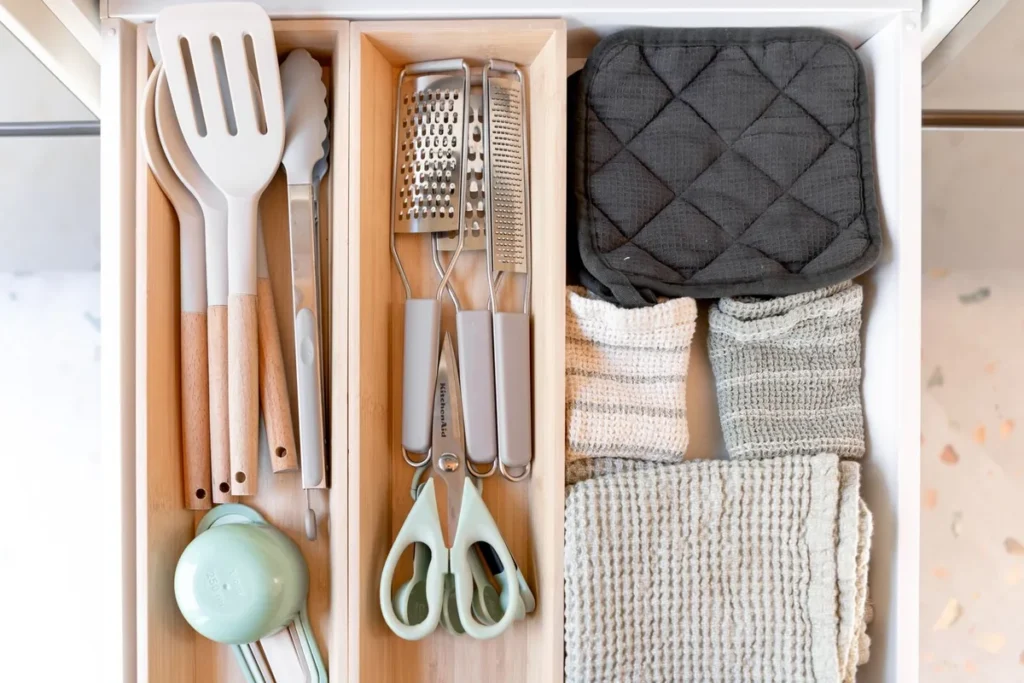
The short answer: Yes, a bamboo drawer organizer is a good buy for a dry kitchen drawer. It is stiff, stays put, wipes clean, and looks warmer than plastic. It is a poor buy for a damp drawer, because bamboo warps and molds when water sits on it, and it must never be soaked or put in the dishwasher.
Open a kitchen drawer in most homes and you will find the same scene: forks tangled with whisks, a potato peeler under a stack of measuring spoons, and tongs that jam it every time it closes. A bamboo drawer organizer is the wooden tray or set of dividers that gives every item its own compartment, and it is the default recommendation for calm drawers. The question is whether the bamboo version is actually good, or a pretty object that warps and slides around.
We did not test bamboo drawer organizers ourselves, and this guide claims no testing of its own. The evidence comes from the testing that exists, The Kitchn testing three adjustable divider sets in November 2026, buyer reviews on Target and Amazon, professional organizers in home publications, and the most honest seller and editorial guides we found. Where sources disagree, this guide says so. Prices and ratings are quoted as shown on 13 November 2026, so treat them as a snapshot. Prices are in US dollars from US retailers.
Are Bamboo Drawer Organizers Good?
Yes, for a dry kitchen drawer. A bamboo drawer organizer is stiff, heavy, and easy to wipe clean, and it makes a drawer look warmer than a plastic tray. It earns its place when the drawer stays dry and cutlery goes in dry. It is the wrong buy for a damp drawer, where bamboo swells and can grow mold.
A bamboo organizer does three things well. First, it is stiff. Bamboo is dense, and its stiffness makes it practical for drawer dividers, as Sinkelle puts it, while thin polypropylene bins can crack at the corners within a year. Second, it is heavy enough to stay put, which matters because a light plastic tray slides when the drawer opens. Third, it wipes clean with a damp cloth. The warm wood look is why most buyers choose it over plastic: a drawer you open ten times a day should look decent.
What it does badly is just as clear. It does not tolerate water, it can crack at thin sections and glued joints, and it can slide if it fits loosely. The Kitchn’s test shows the spread: the Container Store bamboo dividers scored 5 out of 5 for installation and appearance, while the SpaceAid set scored 3 out of 5 because the inserts wasted space. Same material, very different products, which is why this guide judges the format and the build.
The verdict turns on your drawer. Buy one when your drawer stays dry, when you dry cutlery before putting it away, and when you wipe up spills at once. Do not buy one for a drawer under the sink, next to the shower, or where wet items land. For those drawers, plastic is the better tool, and the bamboo vs plastic section below gives the full rule.
Will a Bamboo Drawer Organizer Warp or Mold?
Yes, a bamboo drawer organizer can warp and mold, and dampness is the most common real complaint about it. Bamboo is water resistant, not waterproof, so standing water and damp cutlery make it swell, warp, and grow mold. A dry drawer is safe. A damp drawer, or one under a sink, is not.
Every source we read says the same thing in different words. Sinkelle states it plainly: bamboo is water-resistant but not waterproof, it swells, warps, and can grow surface mold if water sits on it for days, and in a dry drawer it is fine. Handy Laundry warns that lingering moisture can lead to warping or mold. Bamboo is hygroscopic, so it absorbs moisture from the air, swells when wet, and can crack when it dries out again.
The rule follows from that. Dry cutlery before it goes in the tray, wipe up spills the moment they happen, and never use a bamboo organizer under the sink or within reach of shower steam. Cut edges are the weak point: one Singapore guide notes that untreated bamboo wicks humidity at the cut edges, and recommends a bead of food-safe oil. The same water behaviour shows up elsewhere: our bamboo flooring guide covers how bamboo handles standing water, and the lesson is the same, bamboo tolerates splashes and hates standing water.
One seller claim deserves a fair hearing: that a bamboo vanity tray will not warp from bathroom steam. Steam is not standing water, so a tray in a dry vanity drawer is fine, but a tray where water pools will still swell and mold. The honest version is narrow: bamboo resists brief dampness, and it loses to sustained wetness.
How Do You Clean a Bamboo Drawer Organizer?
Wipe it with a damp cloth and mild soap, then dry it at once. Remove everything, wipe every surface, rinse the cloth and wipe again to lift soap residue, then towel dry both sides and let it air dry fully. Never soak it, never put it in the dishwasher, and never leave it wet.
The full routine takes about two minutes. Take everything out and shake out crumbs. Wipe the tray with a cloth dampened in warm water and a drop of mild dish soap, getting into the corners and joints where crumbs collect. Rinse the cloth, wipe again to lift the soap, then towel dry both sides straight away. Stand the tray somewhere ventilated to air dry fully, out of direct sunlight, because strong heat can warp it. For crumbs stuck in the joints, a soft brush works better than a wet cloth. Handy Laundry gives the same routine, and adds that harsh chemicals harm bamboo.
One habit keeps a bamboo organizer looking good: oil it occasionally. A thin wipe of food-safe mineral oil, coconut oil, or vegetable oil nourishes the bamboo and prevents cracking, the same treatment bamboo cutting boards need, covered in our guide to oiling and seasoning bamboo.
One disagreement among the cleaning guides is worth stating. Some guides, including Handy Laundry and EcoSoul Home, recommend diluted vinegar, one part white vinegar to four parts water, as a natural disinfectant. Another guide warns never to use vinegar, bleach, alcohol, or citrus cleaners, even diluted, because the acid degrades lignin, the polymer that binds bamboo fibers. Neither side is a laboratory test, so this guide does not pick a winner. Mild soap and thorough drying is the safe middle ground.
What Size Bamboo Drawer Organizer Do I Need?
Measure the inside of the drawer, not the outside of the cabinet, and buy to those numbers. Width decides whether the tray fits, depth decides whether it reaches the back, and height decides whether the drawer still closes with the contents inside. Leave about 5 millimetres of gap on every side so the tray slides in and out.
Measure first is the most repeated advice in every listing, review, and buying guide we read, and it is repeated because people keep skipping it. Measure the inside width, the inside depth from front to back, and the inside height from the drawer floor to the top edge, then compare all three numbers with the organizer’s measurements, not just the width. A typical kitchen cutlery drawer is roughly 40 to 55 centimetres wide, 38 to 45 deep, and 6 to 10 tall, and a bathroom vanity drawer is roughly 30 to 50 wide, 25 to 35 deep, and 10 to 15 tall, but your drawer is the only one that matters, so measure it.
Depth and height are the failure points, not width, because an expandable tray fixes width and nothing else. A tray that is too deep leaves a dead gap at the back. A tray that is too tall stops the drawer closing once the cutlery is in it, a common failure for spice jars: one spice guide notes that spice organizers need at least three inches of depth to hold standard jars, so measure the inside height first. A tray that is too shallow wastes the drawer’s height and holds too little, a complaint buyers left about the Target Brightroom bamboo organizer.
Is an Expandable Bamboo Drawer Organizer Worth It, and Will It Fit?
Yes, for most buyers, because an expandable tray solves the one problem fixed trays cannot: drawers are never a standard size. It stretches to fit snugly, which also stops it sliding when the drawer opens. The trade-offs are real, though: it loses depth in the middle, and it can lose tension over time.
Will it fit my drawer?
Measure the inside of your drawer first, then match the organizer’s closed and expanded width to it. An expandable tray fits when its closed width is narrower than the drawer and its expanded width reaches the drawer walls. Depth and height still matter, because expansion only changes width, never depth or height.
Every expandable tray publishes a width range, and the range is the buying decision. The Pipishell runs 13 to 19.6 inches, the Purawood 13.25 to 19.75, the Container Store dividers 18 to 22.25, the SpaceAid dividers 17 to 22, the Totally Bamboo tray 13 to 22, and the Umilife Extra Large 17 to 28. Compare your drawer’s inside width with both ends: the closed width must be narrower than the drawer, or the tray will not go in, and the expanded width must reach the walls, or the tray will slide. If your drawer is wider than the expanded width, you need a wider model.
One fit warning comes up again and again: the expansion mechanism takes space. Buyers report losing about half an inch to an inch of usable depth at the back where the two halves meet, and one Target reviewer found the bump in the middle of the SpaceAid spice rack made the back row unusable. A tray that fits on paper can still waste space, so check the compartment depth, not just the width.
The case for expandable is simple. No two kitchen drawers are exactly alike, so a fixed-size tray is a gamble: too small and it slides, too big and it does not go in. An expandable tray stretches to the drawer walls, which looks tidier and stops it sliding around, the most common complaint about fixed trays. The Kitchn’s tester put it plainly: she is perfectly capable of measuring her drawers, but she would rather not, and adjustable dividers take the fuss out of the job.
The case against it is three real trade-offs. First, the middle loses depth when the tray is expanded, so chunky tools that fit in the side compartments do not fit in the middle. Second, a drawer width between the tray’s positions leaves an awkward gap. Third, the tension can fade: one owner watched three expandable trays in a row slowly lose tension, and a Target reviewer found the SpaceAid organizer shortening up on itself just from opening and closing the drawer. A fixed tray has none of these problems, but it only works when measured exactly. For most buyers, expandable is worth it; for a drawer measured to the millimetre, a fixed tray is cheaper and simpler.
What Are the Five Types of Bamboo Drawer Organizer?
Five formats cover almost every bamboo drawer organizer on sale, and they solve different problems. The expandable tray is the default, the fixed tray is the simple one, the dividers are the flexible one, the modular boxes are the room-by-room one, and the knife block is the specialist. Choose the format first, then the size.
| Format | How it works | Best for | Watch out for |
|---|---|---|---|
| Expandable tray | One tray that slides wider | Cutlery drawers of unknown size | Loses depth in the middle; can lose tension |
| Fixed tray | One piece, one size | Drawers measured exactly | Slides if too small |
| Spring-loaded dividers | Dividers that press against the drawer walls | Junk drawers, desks, odd shapes | Inserts can waste space |
| Modular boxes | Separate boxes in several sizes, arranged by hand | Bathroom, makeup, office, junk drawers | Boxes shift in oversized drawers |
| In-drawer knife block | Slotted block, blades down | Knife drawers, replacing a countertop block | Needs a deep drawer |
The expandable tray is the default pick, and the Pipishell is the most reviewed example, at 4.7 out of 5 stars from 42,924 ratings as quoted by KitchnKnife. The spring-loaded dividers are the flexible pick: the Container Store set was the clear winner in The Kitchn’s test, while the SpaceAid set frustrated the same tester because the inserts were too small or too large. The modular boxes are the multi-room pick: the Fabsome 9-box set, 18 by 18 by 2 inches, is used by a professional organizer in nearly every room, for cutlery, brushes, pens, and batteries. The knife block is a specialist: the VaeFae block holds 6 slots for 16 inch knives and 6 for 9.7 inch steak knives, plus a sharpener slot.
Which Bamboo Drawer Organizer Should You Buy?
We do not recommend products to buy, and this site has no affiliate relationships, so this section compares what the ranking guides and buyers actually report, not a pick. The figures come from ranking pages and listing snippets on 13 November 2026, not from our testing, and prices change, so check the live listing before buying.
| Product | Width range | Compartments | Price seen | What the sources say |
|---|---|---|---|---|
| Pipishell expandable tray | 13 to 19.6 inches | 6 to 8 | About 22 USD | KitchnKnife best overall; 4.7 stars, 42,924 ratings |
| Container Store bamboo dividers | 18 to 22.25 inches | Dividers with inserts | Under 17 USD | The Kitchn best overall, 5 out of 5 for installation |
| SpaceAid bamboo dividers | 17 to 22 inches | Dividers with inserts | 22 USD, normally 28 USD | The Kitchn 3 out of 5; Apartment Therapy likes it for nightstands |
| Royal Craft Wood expandable tray | About 13 to 19.6 inches | 7 to 9 slots | About 50 USD at Target | Conflicting: 4.6 from 36,361 per SmartCarting, 3.8 from 19 on Target |
| Purawood expandable tray | 13.25 to 19.75 inches | 7 to 9 slots | Not shown in snippets | Moso bamboo; buyers call it solid and heavy |
| Umilife Extra Large | 17 to 28 inches | Not shown in snippets | Not shown in snippets | Widest range found; for wide drawers |
| Fabsome 9-box set | 18 by 18 inches as a square | 9 boxes | Not shown in snippets | Pro organizer Elsa Elbert uses it everywhere |
| OXO Good Grips (plastic comparator) | Fixed size | With removable cup | 24.95 USD | 4.7 stars, 739 ratings; lower maintenance |
Three patterns in that table matter more than any single product. First, the cheapest good option is not bamboo’s enemy: the Container Store dividers were the best tested and the most affordable in The Kitchn’s test, under 17 USD. Second, the highest rating count does not settle quality: the Royal Craft Wood tray is quoted at 4.6 stars from 36,361 reviews by one site and 3.8 stars from 19 ratings on Target, where several buyers report the bottom separating within months. Never merge the two figures. Third, the price range is wide, from about 12 USD for an IKEA UPPDATERA tray to about 72 USD for a magnetic BESILORD organizer, and the extra money buys build quality and joints, not bamboo itself. A 12 USD mass-produced organizer can crack within three months, while a 22 USD hand-finished one can last five years, per one seller analysis.
Is Bamboo Better Than Plastic for Drawer Organizers?
Bamboo wins for a dry, visible drawer, and plastic wins for a wet one. Bamboo is stiffer, heavier, and warmer looking, and it stays put better than a light plastic tray. Plastic is cheaper, fully waterproof, and can go in the dishwasher. Choose bamboo for dry drawers and plastic for under-sink drawers.
The honest comparison is a table, because the two materials win in different drawers.
| Factor | Bamboo | Plastic |
|---|---|---|
| Water | Water resistant, not waterproof | Fully waterproof; tolerates standing water |
| Cleaning | Wipe with a damp cloth; never soak | Rinse or dishwasher safe; easiest to clean |
| Stiffness | Dense and stiff; holds its shape | Thin polypropylene can crack at the corners within a year |
| Looks | Warm wood tones; suits a visible drawer | Plain; can look cheap after a while |
| Sliding | Heavy, with natural grip | Light trays slide; needs rubber feet or a liner |
| Price | Usually 17 to 50 USD | Usually cheaper; good trays from about 12 USD |
| Long-term cost | Lasts years if kept dry | May need replacing every two years if it cracks |
| Sustainability | Fast growing, renewable | Made from fossil fuels; lasts longer in wet zones |
Professional organizers split the same way. Sara Bereika, quoted by Livingetc, recommends bamboo over plastic for kitchen drawers, calling it a no-brainer because bamboo provides the same benefits. Elsa Elbert of Composed Living uses Fabsome bamboo dividers in nearly every room and reports five years without budging, while noting that plastic costs less. The same organizers choose heavy-duty plastic for areas prone to moisture, pests, or extreme temperatures, and EcoSoul Home warns that extended moisture may cause warping or mold.
Why Does a New Bamboo Drawer Organizer Smell?
A mild grassy smell is normal for new bamboo, but a strong chemical smell means the glue is off-gassing. Laminated bamboo is glued from strips, and the adhesive can release a formaldehyde smell when new. Air the organizer out in a ventilated room for 24 to 72 hours before first use.
The smell has two different causes, and telling them apart decides what to do. Bamboo itself smells mild and grassy, and that fades on its own within a day or two. The sharp, acrid smell some buyers notice when unboxing is usually chemical: it comes from the off-gassing of adhesives used to laminate the bamboo strips, and formaldehyde, a common compound in laminating resins, slowly releases into the air, giving the glue smell that can irritate eyes and throats. The US Environmental Protection Agency sets formaldehyde emission limits for composite wood products under TSCA Title VI, and regulated products sold in the US must be labeled TSCA Title VI compliant. Pipishell’s own listing tells buyers to air the organizer for 24 to 48 hours, and one review cites the manufacturer recommending roughly 72 hours.
Use your nose as a buying check. If a new tray has a strong chemical or varnish-like smell, air it out for two to three days in a ventilated room or outdoors, and do not store cutlery in it until the smell is gone. If the smell is still strong after three days, return it: a tray that keeps off-gassing is a sign of a cheap adhesive, and the finish may not be food-safe either.
How Do You Stop a Drawer Organizer From Sliding Around?
Stop it sliding with a snug fit, rubber feet, or a grip mat underneath. An expandable tray that stretches to the drawer walls cannot slide, and a fixed tray needs rubber feet or a non-slip liner to stay put. The cheapest fix is a strip of grip liner under the tray.
Sliding is the most common complaint in buyer reviews, and the fix depends on the format. An expandable tray solves it by tension: stretched to the drawer walls, it grips and cannot move, which is why Apartment Therapy reports the SpaceAid dividers have not budged an inch in a nightstand drawer after several weeks. A fixed tray needs rubber feet, and the good ones have several thick pads, not two thin strips. Modular boxes need a grip mat or a strip of non-slip shelf liner underneath, because the boxes are not connected and can shift if the drawer is pulled open hard.
Check the sliding in the first week. Open and close the drawer firmly a few times with the tray loaded, and watch whether it creeps forward. If it moves, add a grip liner first: the cheapest fix, and it works at once. If it still moves, check whether the tray is too small: a tray that leaves a gap at the sides will always slide, and no liner can fix a wrong size. The SpaceAid spice rack, which has no padding on the bottom, shows what happens without grip: buyers report the sections sliding apart.
How Long Does a Bamboo Drawer Organizer Last?
There is no single verified lifespan, because the published figures disagree and none comes from a measured study. A well-made, kiln-dried bamboo organizer that is kept dry and oiled can last several years, while a thin, unfinished one can crack within months. Build quality and dry storage decide it, not the bamboo alone.
The published figures span a wide range. One seller analysis puts a mass-produced 12 USD organizer at cracking within three months, and a 22 USD hand-finished one at five years, with the surface smoothing and deepening in tone with use. Elsa Elbert reports five years without budging for Fabsome dividers in her own kitchen. None of these is a measured study, so this guide does not present any one of them as the answer.
What decides the lifespan is visible before buying. Solid bamboo, not MDF with a bamboo veneer, is the first check, and the Fabsome listing states it plainly: fine bamboo wood, no press board or MDF, treated with a quality varnish to avoid moisture and odours. Joint quality is the second: glued butt joints fail first, and buyers of the Royal Craft Wood tray report the bottom separating within months, one writing that it broke in 20 days. Thin dividers are the third: buyers report flimsy dividers cracking, units arriving cracked, and expandable sides slipping off if handled roughly. Buy from a seller whose return policy covers arrival cracks.
Are Bamboo Drawer Organizers Safe for Food Contact?
Yes, when it is solid bamboo with a food-safe finish and low-emission glue. Bamboo itself is safe for cutlery and food contact, and the risk sits in the adhesive and the finish, not the wood. Avoid a tray with a strong chemical smell, and choose one that states a food-safe finish.
The safety question is really two questions, and only one of them is about bamboo. Bamboo itself is a grass, not a treated timber, and a solid bamboo tray with a food-safe oil finish is safe for cutlery. The risk is in how the tray is made: laminated bamboo is glued from strips, and cheap trays can use adhesives containing formaldehyde, which is released into the air as a gas, while the surface finish can be a varnish not rated for food contact. That is why the smell check matters: a strong chemical smell is a reason to air a new tray out and, if it persists, to return it.
Three buying checks cover the risk. First, solid bamboo, not MDF or press board with a bamboo surface, because the filler board is where the cheapest glue lives. Second, a stated food-safe finish, or at least a finish the seller names. Third, a low-emission adhesive claim, such as E0, which caps formaldehyde at 0.5 mg/L, or CARB Phase 2, the California standard the US federal TSCA Title VI rule adopted nationwide. A tray that passes all three and smells of nothing but wood is a safe buy. A tray that fails the smell test is not, whatever the listing claims.
What Is the Best Bamboo Drawer Organizer for a Small Drawer?
For a small drawer, choose narrow spring-loaded dividers or a small modular box set, not a full expandable tray. A full tray needs room to expand, and most expandable trays start at 13 inches wide, which is wider than many small drawers. Dividers and boxes fit where a tray cannot.
Small drawers fail on width first. The Pipishell starts at 13 inches, the Purawood at 13.25, and the Umilife Extra Large at 17, so a drawer narrower than 13 inches cannot take a full expandable tray at all. The Oridom starts at 10.04 inches, which fits smaller drawers, but the honest answer for a small drawer is usually not a tray: two or three narrow spring-loaded dividers, or a small set of modular boxes, turn one small drawer into several zones.
For a small drawer, measure the inside width first, then buy dividers that press against the walls, or boxes that leave no gap. A narrow box for pens, a small box for batteries and keys, and a wide box for tape and string is a complete system for a junk drawer, and it costs less than a tray. The one thing to avoid is a tray that is too big: it either does not go in, or it leaves no room for anything else.
Where Else Can You Use a Bamboo Drawer Organizer?
The same bamboo organizers work in every room. The kitchen is the main use, but buyers use the same trays and boxes in bathroom vanities, makeup drawers, junk drawers, nightstands, desks, and offices, and the format that fits one room usually fits the others.
Kitchen first: cutlery trays for forks, knives, and spoons, spice racks for jars, knife blocks for blades, and dividers for baking tools. The SpaceAid dividers were designed for the kitchen and then moved, by one Apartment Therapy writer, to a nightstand drawer for journals, pens, and charging cables, where they have not budged since. The desk takes them for pens, cables, and chargers. The junk drawer is the hardest test, and nine small boxes give it a shape: batteries in one space, screws and picture hooks in another, spare keys in a third, tape and string in a wide box.
Can you use a bamboo drawer organizer in a bathroom drawer?
Yes, in a dry bathroom drawer, and no in a damp one. A bamboo organizer works in a vanity drawer that stays dry, holding brushes, combs, and tubes. It does not belong in a drawer within reach of shower steam or a leaking bottle, because bamboo swells and molds when water sits on it.
In a vanity drawer, the wide boxes hold brushes, combs, and tubes, the narrow boxes hold toothbrushes, razors, and slim bottles, and the small spaces hold hair clips and cotton buds that otherwise roll to the back. A makeup drawer works the same way, with brushes, lipsticks, eyeliners, and small palettes each in their own space.
The line is the steam and the splash zone. A drawer within two metres of a shower, a drawer under a sink where bottles leak, and a drawer that holds wet items is a plastic drawer, not a bamboo drawer. One Singapore guide puts it bluntly: switch to stainless steel or food-grade polypropylene trays for any drawer within two metres of a shower, and if you must use wood, seal all six sides and keep the drawer dry. Our bamboo bath mat guide covers how bamboo behaves when water pools on it.
The rule is the same in every room: the drawer must stay dry. Buy one set of modular boxes and move them from room to room until you find where they earn their place.
What to Avoid When Buying a Bamboo Drawer Organizer
Most bad bamboo organizer purchases come from the same five mistakes, all avoidable before the order is placed. Buying before measuring is the first, and the most common: a tray that does not fit is a return. Buying a fixed tray for an odd-sized drawer is the second: a fixed tray only works when the drawer is a standard size and you have measured it exactly.
Soaking the tray, or putting it in the dishwasher, is the third, and it ruins the tray in one cycle. Leaving wet items on bamboo is the fourth: damp cutlery, a wet sponge, or a dripping bottle will warp and mold a tray that would last years. Buying a tray that is too shallow is the fifth: it holds too little, and the cutlery piles up.
Two more checks belong on the list. First, check the build before you keep it: solid bamboo, not MDF, joints that do not flex, and rubber feet that grip. If the tray arrives cracked, return it at once, because a crack on arrival is a build defect, not wear. Second, do not trust a single rating number. The Royal Craft Wood tray is quoted at 4.6 stars from 36,361 reviews by one site and 3.8 stars from 19 ratings on Target, and the truth is in the reviews. Read the one-star reviews first, as the Worth It or Waste video does, because that is where the broken bottoms, the popped springs, and the sliding trays are reported.
What real users found
We did not test any of these organizers ourselves, so this section reports what real buyers and reviewers found instead. The findings below come from a hands-on editorial test, reviewer trials in real drawers, verified buyer reviews on Target and Amazon, and a video review built from one-star reviews.
The Kitchn tested three bamboo divider sets hands on and ranked the Container Store set best overall, with 5 out of 5 for installation and appearance, while the SpaceAid set scored 3 out of 5 because its inserts were either too small or too large and always left wasted space. The test was updated 11 November 2026.
One Apartment Therapy writer put SpaceAid dividers made for the kitchen into a nightstand drawer and reports they have not budged an inch in several weeks of daily opening and closing, crediting the spring tension and the small grooves that hold the inserts in place. The piece was published in June 2026.
KitchnKnife names the Pipishell tray its best overall pick and quotes 4.7 out of 5 stars from 42,924 Amazon ratings, with over 8,000 bought in the past month. Its author used the tray for a week and reports nothing shifted, and the listing advises airing it out for 72 hours before first use.
Target verified buyers report the Royal Craft Wood tray breaking early, with one writing that the bottom separated after a few months and calling it not worth 50 dollars, and another that it literally broke in 20 days. The listing sits at 3.8 out of 5 from 19 ratings, against 4.6 stars from 36,361 reviews quoted by SmartCarting.
Amazon buyers quoted by The Kitchn give the SpaceAid dividers 4.5 out of 5, with one buyer saying she texted a photo to her mother right away and her mother bought four, and another praising the felt ends that protect the drawer.
The Worth It or Waste channel on YouTube judged six viral organizers by reading their one-star reviews and gave bamboo spring-loaded dividers a WASTE verdict, reporting that the springs pop loose and the 17 inch minimum misses most drawers. The video notes its voiceover is AI generated.
Frequently Asked Questions
Which tray is best for large cooking tools?
The Hilislog is the pick for large cooking tools, with three wide compartments built for spatulas, ladles, and whisks. Most bamboo trays are cut for forks and spoons, so a big tool either sticks out or does not fit. If your drawer holds serving spoons and tongs, buy a tray with a wide slot.
Can I use a bamboo drawer organizer for things other than utensils?
Yes. The same trays and boxes work in a bathroom vanity for brushes and tubes, in a desk drawer for pens and cables, in a dresser for socks and accessories, and in a junk drawer for batteries and keys. The only rule is dryness.
What should I look for when choosing a bamboo drawer organizer?
First, the inside measurements of your drawer, then solid bamboo rather than thin sections or MDF, joint quality, rubber feet or a grip surface, and a return policy covering arrival cracks. A tray that is too shallow for your drawer, or too wide to expand, is the most common buying mistake, fixed by measuring first.
Are there environmentally friendly bamboo drawer organizers?
Yes, when the bamboo is moso, the glue is low-emission, and the finish is food-safe. Bamboo grows fast and needs little water, which is the real case. The claim to treat with care is the carbon footprint figure some sellers quote, which comes from a vendor’s own comparison and is unverified.
How can I expand my bamboo drawer organizer to fit more items?
Pull the sliding sides out until the tray touches both drawer walls, then arrange the compartments around what you store. An expandable tray gains width, not depth, so bulky tools still need a wide compartment, and the middle loses depth when expanded. If gaps remain, add small boxes in the empty space.
Are bamboo drawer dividers difficult to clean?
No. A bamboo divider wipes clean with a damp cloth and mild soap in about a minute. The work is in the drying, not the washing: the divider must be dried at once and left to air dry fully.
Can you put a bamboo drawer organizer in the dishwasher?
No. A bamboo drawer organizer must never go in the dishwasher, and no cleaning guide or maker recommends it. The heat and the long soaking swell the bamboo, loosen glued joints, and fade the finish. Hand washing with a damp cloth is the whole routine, and it takes about two minutes. If a tray has already been through a cycle, dry it fully and check it still sits flat.
Are bamboo drawer dividers worth the investment for small spaces?
Yes, when the dividers are narrow and spring-loaded, because they turn one small drawer into several zones without a fitted insert. A full tray wastes space in a small drawer, but two or three dividers fit any drawer. The gain is real only if they grip the drawer walls and stay put.