
In 1990, LL Cool J opened a song with eight words that changed everything.
He wanted a girl with bamboo earrings and a nameplate. That was it. That was the whole description.
But those eight words meant something enormous to an entire generation of women. They felt seen. Celebrated. Claimed.
Because those women already knew what bamboo earrings meant. They had been wearing them for years. On the subway. At the corner store. On the stoop.
Now the whole country was hearing about it.
But here is what most people still do not know. The story of bamboo earrings does not start in the 1990s. It does not even start in America.
Where did bamboo earrings come from? The real answer goes back thousands of years. And it runs through ancient Africa, through the civil rights era, through the Bronx, and all the way into your TikTok feed in 2026.
This is the full story. Nobody else has told it all in one place. Until now.
What Are Bamboo Earrings, Exactly?
They Are Not Made of Bamboo
Let us start with the most common question. Are bamboo earrings actually made of bamboo?
No. Not at all.
The name comes from the shape. The earrings have a hollow, segmented design. Those segments look just like the joints of a real bamboo stalk. That is the only connection.
Most bamboo earrings are made from gold-plated metal, brass, or acrylic. The classic ones from the 80s and 90s were usually gold-plated brass. Cheap to make. Cheap to buy. Big on style.
Today you also find them in faux leather, resin, wood veneer, and cardstock. But the shape always stays the same. Those segmented joints are what make a bamboo earring a bamboo earring.
Bamboo Earrings vs Door Knockers: What Is the Difference?
Here is something that confuses a lot of people. What is the difference between bamboo earrings and door knockers?
The answer is simple. Bamboo earrings are one type of door knocker earring. All bamboo earrings are door knockers. But not all door knockers are bamboo.
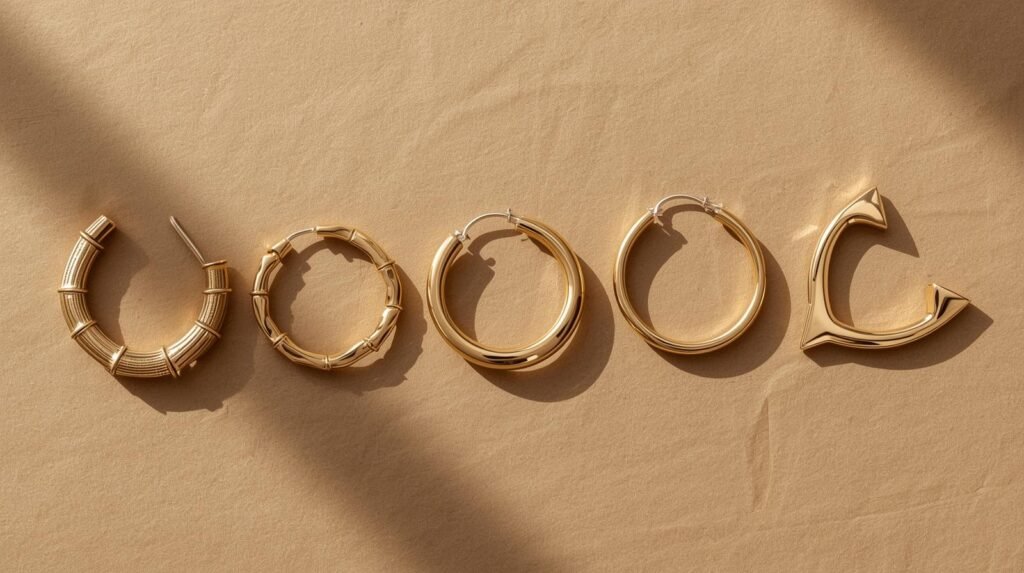
A door knocker earring is any large, hollow, statement hoop that hangs low and moves when you walk. The name comes from the sound they make. When they tap against your neck or jaw, they knock like a door.
Within that door knocker family, there are several different styles. Here is how they break down:
| Style Name | Shape | Peak Era | Known For |
| Bamboo | Hollow segmented hoop with joint lines | 1980s to present | Hip-hop roots, segmented detail |
| Shrimps | Curved, elongated teardrop shape | 1980s to 1990s | Smooth curves, sleek silhouette |
| Dolphins | Two arched shapes that meet at the bottom | 1990s | Rounded, playful look |
| Triangles / Trapezoids | Geometric angular shapes | 1990s to 2000s | Bold edges, structural look |
| Hearts | Heart-shaped hollow hoop | 1990s to present | Romantic, popular in gifts |
| Nameplate | Any door knocker shape with a name on it | 1980s to present | Personalized, identity-forward |
So when someone says door knockers, they mean the whole family. When someone says bamboo, they mean that specific segmented style. Now you know the difference.
The Ancient Roots: Where Hoop Earrings Really Started
2500 BC: The Oldest Hoops in the World
To understand bamboo earrings, you need to understand where hoop earrings come from. And that story is ancient.
The oldest hoop earrings ever found date back to around 2600 to 2500 BC. Archaeologists found them in ancient Sumeria, in the region we now call Iraq. Some of those very earrings are in the Metropolitan Museum of Art in New York today.
Around the same time, the Nubian civilization in what is now northern Sudan was wearing hoop earrings widely. This is important. Nubia is one of the oldest civilizations in the world. And their people wore hoops as part of everyday life and spiritual practice.
Ancient Egypt adopted hoop earrings directly from Nubia. And they wore them at every level of society.
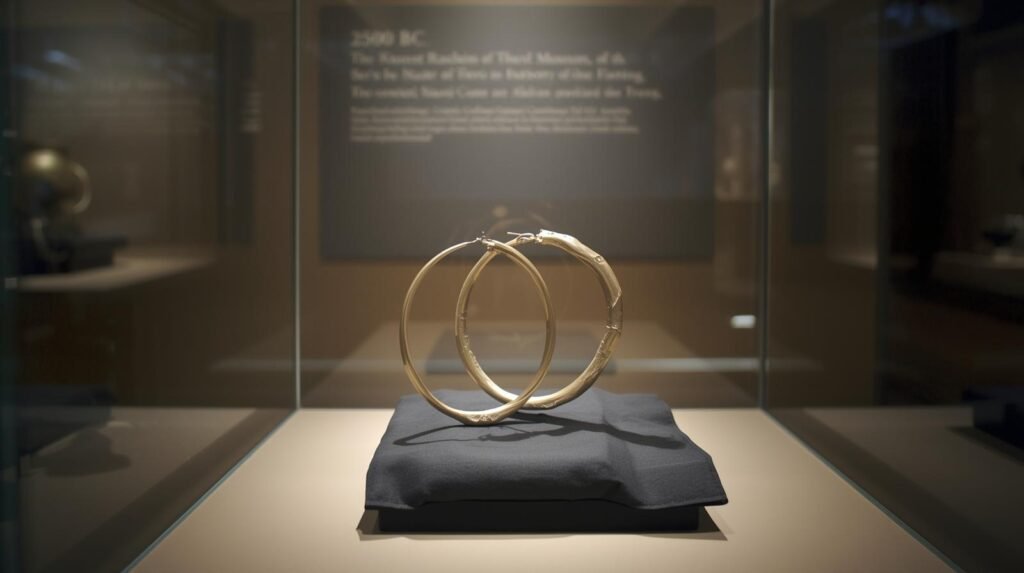
Pharaohs wore them. Queens wore them. Nefertiti, Hatshepsut, and Cleopatra all wore bold hoop earrings. Even mummies have been found buried with their hoops on. The ancient Egyptians believed you carried your jewelry into the afterlife.
So from the very beginning, hoop earrings were connected to power, beauty, and identity in African civilization.
From Royalty to the Streets: Hoops Through the Centuries
After ancient Egypt and Nubia, hoops spread across the ancient world. Greek and Roman women wore them as symbols of wealth. Gold hoops meant status.
Over the centuries, hoop earrings moved in and out of mainstream Western fashion. But in communities of color, they never went away.
In Caribbean, West Indian, African, and Latin cultures, giving a newborn baby girl her first pair of gold hoops is a tradition. It is a rite of passage. A welcome into the community.
Grandmothers pass down hoop earrings to granddaughters. Mothers pierce their daughters’ ears and put in tiny gold rings on the day they are born. This is not fashion. This is inheritance.
The same tradition exists across South Asian and Middle Eastern cultures. Gold hoops mark major life moments. Births. Coming-of-age. Marriage. They carry family memory in metal.
This generational thread is the deep root that bamboo earrings eventually grew from.
The 1960s and 1970s: Hoops as Political Statements
The Black Power Movement and the Hoop
Fast forward to 1960s America. Something major is happening.
The Civil Rights Movement and the Black Power Movement are reshaping American culture. And alongside the protests and the marches, a visual identity is forming.
Large, bold hoop earrings become part of that visual identity. Women like Angela Davis and Nina Simone wear big hoops with natural Afros. Together, those two elements send a message.
The message is: I am proud of who I am. I am not going to shrink myself for your comfort.
In that era, wearing large hoops in predominantly white spaces was an act of bravery. It was not just fashion. It was a statement that you belonged wherever you stood.
As a result, hoop earrings in Black communities started carrying new weight. They were not just beautiful. They were powerful.
Chola Culture and Latina Identity
Around the same time, something similar is happening on the other side of the country.
In Southern California in the 1960s and 1970s, Latina women in the chola subculture are wearing large gold hoops as a core part of their identity. Thick gold hoops. Dark lips. Winged liner.
This look was not random. It was deliberate. It said: this is who we are. This is our neighborhood. This is our culture.
For these women, large gold hoops were a symbol of community and strength. Just like in Black communities, they wore them in spaces that challenged and disrespected their identity.
Consequently, this became another powerful thread in the story. Not hip-hop. Not New York. But the streets of East LA, decades before bamboo earrings became famous.
Both threads, Black and Latina, eventually wove together into the culture that made bamboo earrings iconic.
The 1980s: The Bamboo Era Is Born
Where the First Bamboo Earrings Came From
Now we get to the question everyone asks. Where did bamboo earrings specifically come from?
Here is an honest answer: nobody knows for certain who invented them.
There is no single designer. No patent. No documented origin story. What we do know comes from cultural historians, community memory, and the pattern of how the earrings spread.
The most credible theory is this. Bamboo earrings were first mass-produced in Asia in the late 1970s. Cheap gold-plated metal. Simple to make. Easy to ship.
They then entered the United States through Asian-American flea markets, street kiosks, and open-air markets in urban neighborhoods. Cities like New York, Los Angeles, Chicago, and Philadelphia.
Beauty supply stores in Black and Brown communities picked them up quickly. They sold for under five dollars. Sometimes two dollars. That price point mattered enormously.
Working-class women who could not afford fine jewelry could wear something bold and beautiful. The bamboo earring gave them that. For a few dollars, you could look like a million.
So while no one person invented bamboo earrings, the communities that embraced them first gave them their meaning.
The Hip-Hop Scene Claims the Style
To understand what happened next, you need to understand what hip-hop was in the late 1980s.
Hip-hop was born in the South Bronx in the early 1970s. DJ Kool Herc, Afrika Bambaataa, and Grandmaster Flash created something new. A whole culture built out of poverty, creativity, and defiance.
By the mid to late 1980s, that culture was exploding. The music was getting louder. The fashion was getting bolder. And the message was always the same: we are here, and we are proud of it.
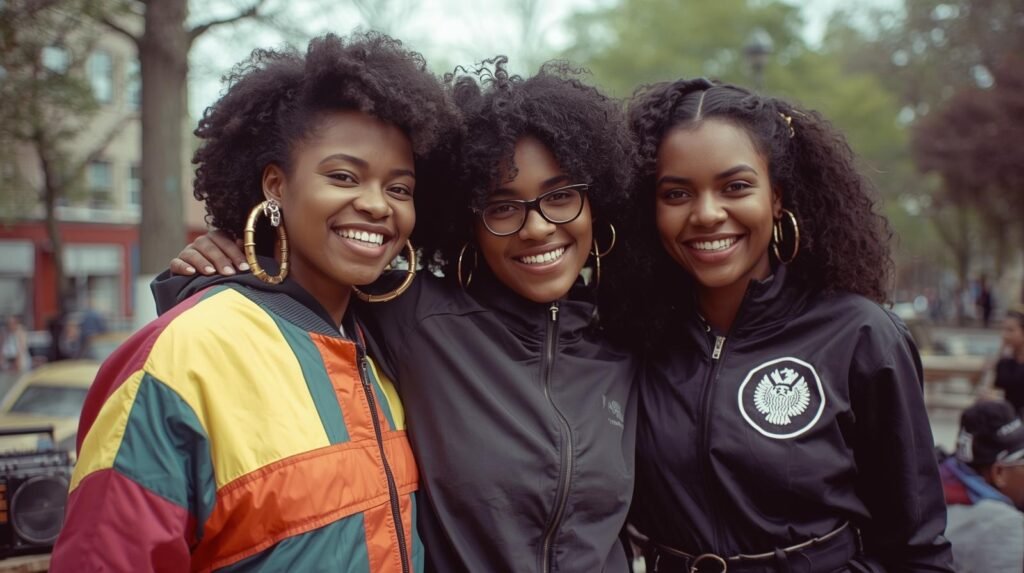
Bamboo earrings fit that message perfectly. They were loud. They were flashy. They were affordable. They were a community.
In Brooklyn and the Bronx, especially, bamboo earrings became a uniform for the women of hip-hop culture. You wore them to the park jams. You wore them to the block parties. You wore them everywhere.
They were not yet famous. But they were already essential.
The Female Artists Who Made Them Famous
Then the cameras started rolling. And everything changed.
Salt-N-Pepa were wearing bamboo earrings in music videos and photoshoots from the mid-1980s onward. They were impossible to miss. Cheryl James and Sandra Denton wore them with the confidence that said: This is who we are.
MC Lyte was another early champion. One of the most respected lyricists in hip-hop history. She wore bamboo earrings as naturally as she wore her skill on the mic.
Roxanne Shante wore them too. Queen Latifah. TLC. These were not just accessories. They were part of a uniform that said: I am a Black woman in hip-hop. And I take up space.
Furthermore, from New York’s underground ballroom scene, drag queens and trans women added their own larger-than-life interpretation of the style. Their versions were bigger, bolder, and more theatrical. That influence quietly shaped the aesthetic too.
So by the end of the 1980s, bamboo earrings were already iconic in the communities that created hip-hop. The mainstream world just had not noticed yet.
The 1990s: Peak Bamboo and How LL Cool J Changed Everything
LL Cool J and Around the Way Girl (1990)
In 1990, LL Cool J released the album Mama Said Knock You Out. On that album was a track called Around the Way Girl.
The opening description of his ideal woman included bamboo earrings at the top of the list. That specific detail sent a signal to millions of listeners.
This was not just a love song. It was a celebration. LL was not singing about a supermodel or a celebrity. He was singing about the regular girl from the neighborhood. The girl at the corner store. The girl on the stoop.
And that girl wore bamboo earrings.
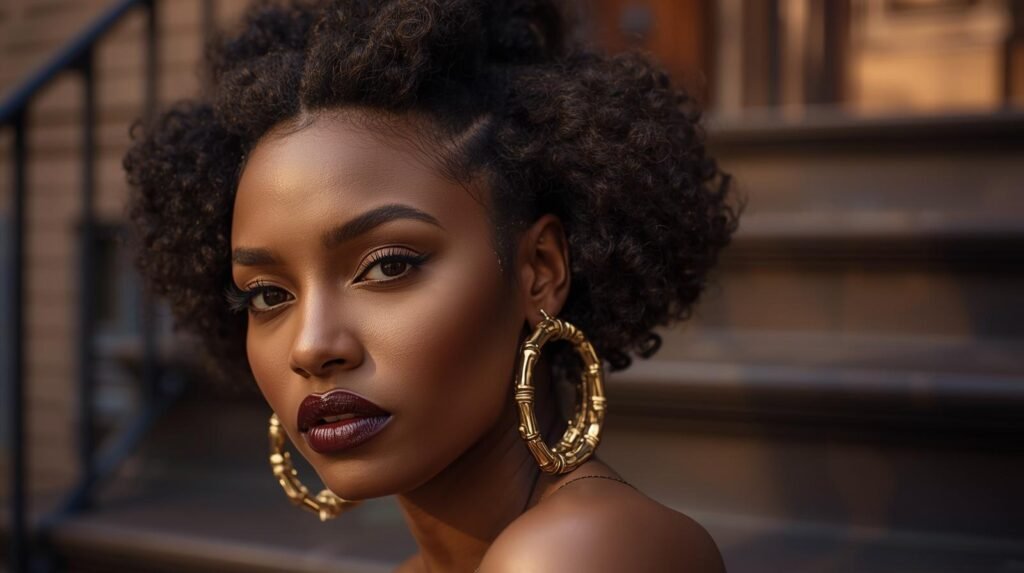
The song went to number one. And suddenly, bamboo earrings had a pop culture moment that the whole country heard.
Women who wore bamboo earrings every day suddenly heard their style described as desirable and beautiful on mainstream radio. That moment mattered. It was validation from within the culture.
It also meant that anyone who had not heard of bamboo earrings before 1990 now had. The earring had its anthem.
The 90s Fashion Peak
From 1990 onward, bamboo earrings hit their highest point in popular culture.
They appeared in almost every female hip-hop and R&B music video of the decade. You could not watch BET or MTV without seeing them.
Destiny’s Child wore them in videos during the early years of Beyonce’s career. Lauryn Hill wore them as part of her signature look. TLC made them part of their visual identity.
And yet, even at peak fame, bamboo earrings still cost a few dollars at the beauty supply store. That was the point. Accessibility was part of the culture. The style was democratic.
Anyone in the community could wear them. Rich or poor. That shared access gave the earrings a unity that expensive jewelry could never have.
Gold-plated metal was the dominant material. Real gold was never required. The style was always the message, not the price tag.
Beyond Hip-Hop: Bamboo Earrings Across Communities
By the mid-1990s, bamboo earrings had also spread widely beyond just hip-hop circles.
Caribbean and West Indian women across the United States and the United Kingdom were wearing them as part of their own cultural identity. For many, the earrings connected back to that ancient tradition of gold hoops passed down through generations.
Afro-Latina women wore them as a bridge between their Latina heritage and their Black identity. The earring sat at the intersection of both cultures.
In New York City specifically, you could see bamboo earrings on every subway line. Every borough. Every neighborhood with a strong community of color.
They had become a shared symbol across overlapping cultures. Not owned by one group. Loved by many.
The 2000s: Mainstream Takeover and the Controversy Begins
When Fashion Took Notice
By the early 2000s, bamboo earrings and door-knocker styles were catching the eye of mainstream fashion.
In 2001, Sex and the City costume designer Patricia Field put bold nameplate door-knocker earrings on Carrie Bradshaw. The show had a massive following. Mostly white, mostly affluent.
Suddenly, a style born on the streets of the Bronx was on premium cable television. And the audience receiving it had no connection to its origins.
Fashion boutiques and high-end stores started stocking similar styles. The same earrings that cost four dollars at the beauty supply store now sell for forty dollars at a downtown boutique.
The cultural meaning was largely stripped out in the repackaging. They became a trend, not a tradition.
The Ghetto to Glamour Double Standard
This is where the story gets uncomfortable. And it needs to be told clearly.
For decades, bamboo earrings were called gaudy and ghetto when worn by Black and Latina women. Employers told women to take them off before job interviews. School dress codes targeted them. Fashion magazines ignored them entirely.
Then white celebrities and fashion designers started wearing them. Suddenly, those same earrings became bold, fashion-forward, and edgy.
The style did not change. Only the person who was wearing it changed.
In 2014, Taylor Swift wore gold bamboo hoops in her Shake It Off music video. Backlash came quickly from people who recognized the cultural borrowing without the cultural credit.
In 2015, designer Riccardo Tisci at Givenchy featured door-knocker earring interpretations in his collection. The fashion press praised his boldness. The communities that wore that style for decades received no mention.
Then in 2016, Urban Outfitters sold bamboo earrings for sixteen dollars. That is roughly four times the beauty supply store price. The same store had previously faced multiple accusations of cultural appropriation. The backlash was significant.
This pattern repeated itself constantly through the 2000s and 2010s. The communities that created the style got criticism. The outsiders who copied it got coverage.
That double standard became central to the larger conversation around bamboo earrings and cultural appropriation. And it is why that conversation still matters today.
The 2010s and 2020s: Multiple Comebacks
The Style That Never Really Left
Here is something important to understand. Bamboo earrings never actually went away.
Women of color never stopped wearing them. The mainstream just kept going through cycles of ignoring them and then rediscovering them as if they were new.
Rihanna wore large bamboo-style hoops throughout the 2010s. Cardi B wore them as part of her signature look as she rose to fame. Beyonce returned to them repeatedly across her career.
Each time a high-profile celebrity wore them, there was another wave of mainstream attention. And each wave also brought another wave of conversation about who deserved credit for the style.
However, something was shifting. More young people were learning history. More voices were speaking up. The story of where bamboo earrings came from was finally getting told more widely.
Gen Z and the Nostalgia Wave (2020 to 2026)
Then Gen Z arrived. And they changed the game.
Gen Z grew up with TikTok. And TikTok is a nostalgia machine. Y2K fashion, 80s aesthetics, 90s hip-hop references: all of it went viral repeatedly between 2020 and 2026.
Bamboo earrings were right at the center of that nostalgia wave. TikTok creators wore them. Styled them. Made tutorials showing how to make them at home.
Importantly, many of those creators were young Black and Latina women who knew the history. They were not just wearing the earrings. They were explaining where they came from. They were tagging the artists. They were teaching their followers.
By 2024 and into 2026, bold oversized hoops, including bamboo style,s were firmly on every major earring trends list globally. The style had come full circle.
The difference this time around is real. More people know the origin. More people credit the communities. More people understand that this is not a trend. It is a tradition.
What Do Bamboo Earrings Represent? The Deeper Symbolism
Strength, Resilience, and the Bamboo Plant Metaphor
There is a reason the bamboo plant and bamboo earrings share more than just a name.
Bamboo is one of the strongest plants in the world. It bends in heavy wind. But it does not break. Cut it down, and it grows back stronger than before.
That is exactly how bamboo earrings have moved through history. They were dismissed as ghetto. They were copied without credit. They were declared out of style. And every single time, they came back.
For women who wear them knowing that history, there is real power in that resilience. The earring that would not stay down.
A Symbol of Upward Mobility and Pride
In hip-hop culture, bold gold jewelry has always represented something specific. It represents making it despite the odds.
When you grew up with nothing, wearing gold was a statement. It said: I am building something. I am taking up the space that was always supposed to be mine.
Bamboo earrings fit that statement perfectly. They looked expensive. They felt luxurious. And they cost almost nothing. That gap between how they looked and what they cost was part of the magic.
You did not need to be rich to look radiant. That accessibility made them a symbol of collective pride, not individual wealth.
A Symbol of Generational Connection
For many women of color, bamboo earrings also connect back to something much older. That ancient tradition of gold hoops passed down through families.
Your grandmother had her hoops. Your mother had hers. You have yours. The styles change. The sentiment does not.
When a young woman wears bamboo earrings today, she is often unknowingly participating in a tradition that goes back thousands of years. From ancient Nubia to the Bronx to her bedroom mirror.
That is not just fashion. That is lineage.
Bamboo Earrings Timeline: The Full Story at a Glance
| Era | What Happened |
| 2600 to 2500 BC | Oldest hoop earrings found in ancient Sumeria. Now displayed at the Metropolitan Museum of Art. |
| Around 2500 BC | Nubian civilization in modern-day Sudan adopts and spreads hoop earrings widely. |
| Ancient Egypt | Pharaohs and queens including Nefertiti and Cleopatra wear bold gold hoops. Hoops buried with the dead. |
| Caribbean, Latina, South Asian cultures | Gold hoops become a generational tradition. Newborn girls receive their first pair at birth. |
| 1960s to 1970s USA | Black Power Movement. Angela Davis and Nina Simone wear large hoops as acts of cultural pride and resistance. |
| 1960s to 1970s East LA | Chola culture in Southern California. Latina women wear large gold hoops as identity and community symbols. |
| Late 1970s to early 1980s | Bamboo earrings appear in US urban markets. Likely manufactured in Asia. Sold under $5 in beauty supply stores. |
| Mid to late 1980s | Salt-N-Pepa, MC Lyte, Roxanne Shante, and Queen Latifah make bamboo earrings iconic in hip-hop culture. |
| 1990 | LL Cool J releases Around the Way Girl. Bamboo earrings get their cultural anthem. Song goes to number one. |
| 1990s | Peak bamboo era. Destiny’s Child, Lauryn Hill, TLC, and nearly every female hip-hop artist wears them. |
| 2001 | Patricia Field puts door-knocker nameplate earrings on Carrie Bradshaw in Sex and the City. Mainstream exposure begins. |
| 2014 to 2016 | Taylor Swift, Urban Outfitters, and Givenchy spark appropriation debates. Style gets repackaged without cultural credit. |
| 2020 to 2023 | Gen Z discovers bamboo earrings through Y2K nostalgia. TikTok tutorials go viral. DIY culture explodes. |
| 2024 to 2026 | Bold statement hoops dominate global earring trends. Bamboo earrings are fully back with more cultural awareness than ever. |
Final Thoughts
So where did bamboo earrings come from?
They came from Nubian queens who wore gold hoops as spiritual armor. They came from Black women in the 1960s who wore them as acts of defiance. They came from Latina women in East LA who wore them as declarations of identity.
They came from beauty supply stores in Brooklyn that sold them for four dollars. They came from Salt-N-Pepa’s music videos. They came from LL Cool J’s voice on the radio in 1990.
They survived being called ghetto. They survived being copied without credit. They survived trend cycles that tried to flatten their meaning into nothing.
And here they are in 2026. Still on the ears. Still carrying history.
If you want to make your own pair, check out our complete DIY guide on how to make bamboo earrings at home. And if you want to understand the cultural appropriation question more deeply, read our guide on what bamboo earrings represent and the ongoing conversation around who gets to wear them.
Because these earrings were never just an accessory. They were always a story.
Frequently Asked Questions
What are bamboo earrings?
Bamboo earrings are large, hollow hoop earrings with a segmented design that mimics the jointed look of a bamboo plant stalk. They are not made from real bamboo. Most are made from gold-plated metal, brass, acrylic, or faux leather.
Where did bamboo earrings come from?
Bamboo earrings were most likely first mass-produced in Asia in the late 1970s and distributed through urban American markets. They were then adopted and made iconic by Black and Latina women in hip-hop culture, particularly in New York City in the 1980s.
When did bamboo earrings come out?
Bamboo earrings began appearing in beauty supply stores in urban America in the late 1970s to early 1980s. They became widely known through the hip-hop scene in the mid to late 1980s and reached peak mainstream popularity in 1990 after LL Cool J’s Around the Way Girl.
Who invented bamboo earrings?
No single inventor is known. Bamboo earrings were likely factory-produced in Asia and popularized organically through urban American communities. The women of hip-hop culture, not a designer or company, made them famous.
Are bamboo earrings a 90s thing?
They peaked in the 90s, but their roots go back to the early 1980s. They are also a major trend again in 2024 to 2026 due to Gen Z nostalgia, TikTok virality, and a renewed appreciation for 80s and 90s hip-hop culture.
Why was LL Cool J obsessed with bamboo earrings?
LL Cool J was not obsessed with the earring itself. He was celebrating the everyday Black woman from his neighborhood, the around the way girl, who wore bamboo earrings as part of her identity. The earrings were a symbol of her realness, her community, and her culture.
Are bamboo earrings coming back in 2026?
Yes. Bold statement hoops including bamboo styles are among the top earring trends globally in 2025 and 2026. Gen Z’s love of 90s nostalgia, combined with the rise of DIY earring culture on TikTok, has brought them back stronger than ever.
What is the difference between bamboo earrings and door knockers?
Bamboo earrings are a specific style within the door knocker family. The bamboo style has a hollow hoop with segmented joint lines that mimic a bamboo stalk. Other door knocker styles include shrimps, dolphins, triangles, hearts, and nameplate earrings. All bamboo earrings are door knockers but not all door knockers are bamboo.